Housing Targets

(co-authored with Jens von Bergmann and cross-posted at MountainMath)

Municipalities in BC are required to submit Housing Needs reports, and integrate these into Official Community Plans and Regional Growth Strategies in something resembling housing targets. The BC Housing Supply Act now sharpens this process and adds some teeth, effectively enabling the province to define housing targets, accompanied by new provincial enforcement mechanisms, where the province selects municipalities not meeting housing need. Left unstated are the details of precisely how we should go about calculating housing needs or housing targets.

Continue reading

Metro Vancouver Planning Regimes

(co-authored with Jens von Bergmann and cross-posted at MountainMath)

In a previous post we looked at the history of planning regimes in the City of Vancouver. Similar shifts happened in other municipalities in the region, and they also fit into a broader shift in planning at the regional level. Regional level planning is less concerned with zoning and the regulations that govern housing production, and more with coordinating services and the broader guiding principles applying to municipal policies. Service provision means regional level planning has an interest in keeping track of population. But how far does that interest go?

Continue reading

Investing in Definitions and Framing

Co-authored with Jens von Bergmann and cross-posted at MountainMath

With last week’s CHSP release of data on the investment status of residential properties and the framing of the accompanying article there has been a lot of rather uninformed and misleading news coverage.

The misleading reporting, combined with sometimes plainly wrong statements by people quoted in the news coverage, on one hand highlights the poor understanding of housing in the public discourse. On the other hand it highlights the importance of providing careful framing with data releases. In general it is good practice to accompany a data release with a brief analysis to provide framing and context. Analysts close to the raw data will have a much better understanding of what the data is measuring and can properly frame the data. Unfortunately, StatCan fell short of doing so, and the overview analysis provided by StatCan itself contains a number of problems. Given the public attention this has gotten it’s probably worthwhile to take a look at what the data does and does not say, and to correct some of the misinterpretations that have been circulating.

Continue reading

A Brief History of Vancouver Planning & Development Regimes

(co-authored with Jens von Bergmann and cross-posted at MountainMath)

Say you want to construct some multi-family housing in Vancouver. How long will it take? The answer is simple: it depends. There are many factors upon which it depends. Here we want to highlight one in particular: when you started.

As it turns out, it used to take a lot less time to build multi-family housing. There is reason to believe we could reduce that time again, but getting there involves gathering a better understanding of our current development regime, and placing it in historical perspective. We begin this process below, before diving deeper into two case studies of developments along Alma Street, located very near one another in space, but separated by some fifty years in start time. We’re going to look at the 14 storey rental building currently under construction at the intersection of Alma and Broadway, and the 12 storey rental building built in 1970 two blocks to the north at 3707 W 7th Ave.

Continue reading

Analyzing Ballot Composition in Vancouver

(Co-authored with Jens von Bergmann and cross-posted at MountainMath)

So we recently had an election in the City of Vancouver. Citizens elected a new mayor, ten council members, park board and school board, giving a majority to the centre-right leaning new ABC (A Better City) Party candidates for each (full results posted by the City). There are a variety of narratives out there about how it all went down. Here we’re interested in examining a couple of them in further detail using the recently released individual ballot data (all ballots remain anonymous, of course). Of note, the mayoral vote is straight-forward, each voter got to vote for one mayoral candidate. The council votes are more interesting. There voters could choose up to 10 candidates. For this post we will focus on council votes, but we’ll return to examining how they relate to mayoral votes.

Continue reading

New Premier New Housing Policy

(Joint with Jens von Bergmann and cross-posted at MountainMath)

In this post, we take a moment to appreciate the first housing policy announcements from BC’s new Premier, offered up just days into his term. David Eby comes to the post fresh from his joint roles as Attorney General and Minister Responsible for Housing. In these roles, he was central to fashioning the teeth behind BC’s housing policy. Initially these teeth were directed at the private sector, with a special focus on rooting out the “toxic demand” thought to be leaving too many dwellings empty. The Speculation and Vacancy Tax (SVT) remains the most visible legacy of this approach, as we’ve written about before and we provide a brief update of SVT results based upon the latest release in our appendix below. But other legacies include things like BC’s beneficial ownership registry, insuring better transparency for private corporations.

Continue reading

Still Short: Suppressed Households in 2021

(Joint with Jens von Bergmann and cross-posted at MountainMath)

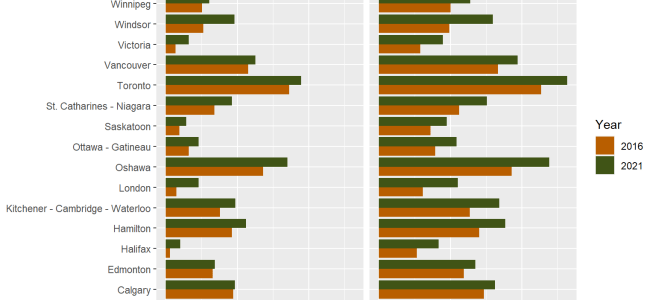
In May we estimated suppressed household formation across Canada using what we called the Montréal Method, finding strong evidence for suppression across many parts of Canada. As a reminder, we designed the Montréal Method to estimate housing shortfalls related to constraints upon current residents who might wish to form independent households but are forced to share by local housing markets. Now that we’ve got 2021 Census data out, it’s time to update our estimates. Given the data available, currently we can only estimate metro area effects of our previous Model 1 (crude household maintainer rates) and Model 2 (age-adjusted household maintainer rates). But that’s a start, and we’re also now enabled to extend the long timelines for Toronto, Montréal and Vancouver from our previous post to include 2021. Overall, current suppression of households alone suggests a shortfall of over 400,000 dwellings in Metro Toronto, and 130,000-200,000 across Metro Vancouver.

Continue reading

Where did all the cheap rents go?

(Joint with Jens von Bergmann and cross-posted at MountainMath)

It can be really useful to count things, but sometimes numbers end up causing confusion and misunderstanding rather than helping. Often this has to do with how the number is presented and attached to claims. Other times it has to do with problematic procedures used to obtain the number. Here we want to explore these problems more in detail concerning a claim that “Canada lost 322,000 affordable homes” between 2011 and 2016. This stat is generally made in reference to “private” rentals, and is contrasted to the number of non-market units built between 2011 and 2016, pegged at 60k units.

Continue reading