The Trouble with Municipal-level Population Projections

Co-authored by Jens von Bergmann and cross-posted at MountainMath

Are people liquids or solids?

Trick question: they’re kind of both. This matters in terms of how we track people and project their location forward in time. There are basic demographic methods that effectively take people as solids. We can see where they are now. We can see how they’ve been moving recently. We can age them forward in time, including adding new little people and imagining older people dying off. And we can project forward how many people we’ll have in the future.

But people are also liquid. They slosh around a bit, but they eventually tend to settle downhill into the places where there are containers for them. Here our best bet in terms of projecting people’s location forward in time is to figure out the lay of the land and where the most likely containers are going to be located.

Sometimes our liquid and solid projections match up ok. But other times they don’t. Let’s make this discussion a little more solid by zooming in to take a look at a potential divergence in projections right here in Metro Vancouver.

When – if ever – will suburban Surrey surpass the population of the City of Vancouver?

Continue reading

Multiplex Reforms: The Details Matter

Co-authored by Jens von Bergmann and cross-posted at MountainMath

Many Canadian municipalities are implementing reforms to allow multiplexes in formerly single family areas. These initiatives are driven by provincial reforms and federal incentives to increase housing supply. We review the findings from our recent paper studying the outcomes of multiplex reforms in Kelowna and Coquitlam that emphasize that implementation details matter, and take a look at early indicators of how multiplexes are faring in Vancouver since the City passed its own multiplex bylaw in late 2023.

Continue reading

Demand based zoning

Co-authored by Jens von Bergmann and cross-posted at MountainMath.

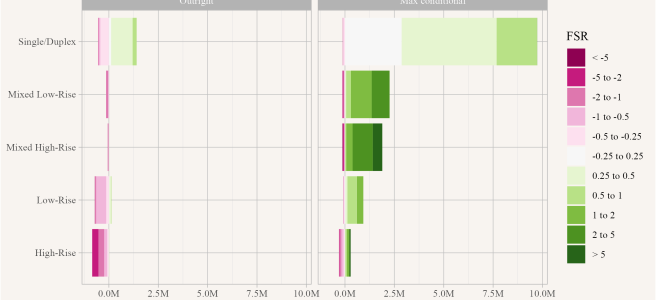
What if zoning was responsive to underlying demand to live in an area? That is, rather than reserving parts of the landscape for the exclusive use of those who can afford an entire underlying lot, what if we instead allow people to build enough residential floor space on the lot to share? This exercise sets up a kind of counterfactual, enabling us to get a look at both: a) what underlying demand for floor space on a lot actually looks like, and b) how our current zoning regime sets itself up to protect the most privileged from having to fully compete with this demand.

Continue reading

Housing is a Housing Problem

Co-authored by Jens von Bergmann and cross-posted at MountainMath.

The main housing problem in Canada is that there is not enough of it. We can see this by looking at prices and rents, but also by looking at people’s living arrangements and rates of doubling up. Doubling up is a direct measure of housing hardship that should get tracked on a regular basis. It also serves as an important compliment to traditional affordability metrics used in Canada that suffer from collider bias that makes it difficult to use them to track progress in solving housing problems. We also develop long timelines to track household formation and doubling up in Canada over the past 80 years to demonstrate the rapid undoubling during the first half of that time period, followed by a reversal to increased doubling up in most of Canada over the latter half.

Continue reading

No spike in “foreign buying”

Co-authored with Jens von Bergmann and cross-posted on MountainMath.

Today the Globe and Mail published an opinion piece about continued flows of “foreign money” in B.C. real estate. Broadly this is a topic that has been discussed in BC for over a decade now and regularly pops up in the news. We’ve written extensively about the slipperiness of the “foreign money” discourse in our paper on Canada’s turn toward Housing Nationalism (Lauster and von Bergmann 2023) (ungated version here). There are a number of conceptualizations of “foreign” in the public discussion, as well as in data sources, policy and law as it applies to real estate holdings and purchases. Our paper describes how the flexible use and application of the “foreign” label plays an integral role in keeping anti-foreign narratives and sentiments alive.

The G&M article continues this pattern, not just mixing and matching concepts but outright misrepresenting the groups targeted by the federal Foreign Buyer Ban and the BC Foreign Buyer Tax. Moreover, it leads with the claim of a “spike” in the value of foreign buying, continuing to push the narrative that our housing problems are driven by foreign origins. We will leave it to our article on Housing Nationalism to criticize this broader framing. For now we will demonstrate that the claim about a spike is wrong, and seems to be based on an error in summing across months in BC data.

Continue reading

Zoned Capacity – promise and pitfalls

(Joint with Jens von Bergmann and cross-posted at MountainMath)

Is there room for new housing? There are lots of ways to try and get at this question, driven by a variety of different value calculations (e.g. if you need housing you might look around and see room for more of it everywhere, but if you’re well-housed and like your neighbourhood just the way it is, then you might think there’s no room at all). But this can also be transformed into a technical question, where we can pin a definition down to potential methods for making more room. Here’s where we start to talk about planning concepts, including zoned capacity. Is there room for new housing in municipal planning practices and regulations?

Continue reading

What if recent apartment buildings in Vancouver were 20% taller?

(co-authored with Jens von Bergmann and cross-posted at MountainMath)

Earlier this year a report from the NSW Productivity Commission in New South Wales, Australia, included a useful estimate to illustrate the harm that’s being done by height restrictions in Sydney. We thought it might be helpful to replicate the analysis for the Vancouver context.

Taking ideas from the report we set up a simple counter-factual question:

What would rents be if every apartment building built in Metro Vancouver over the past five years had been on average 20% taller?

TL;DR

We estimate that planning decisions preventing apartment buildings built in the past 5 years in Metro Vancouver from being on average 20% taller are resulting in an annual redistribution of income from renters to existing landlords on the order of half a billion dollars across the region via higher rents.

Continue reading

Recent Works

A lot of my efforts in this blog go toward figuring out solutions to major housing problems. What works? But I also devote time to figuring out what not to do. What doesn’t work and/or just adds new problems? Last year I spent some time working with teammates to direct these efforts into two major reports. I’m linking these reports below.

Continue reading

Housing Targets

(co-authored with Jens von Bergmann and cross-posted at MountainMath)

Municipalities in BC are required to submit Housing Needs reports, and integrate these into Official Community Plans and Regional Growth Strategies in something resembling housing targets. The BC Housing Supply Act now sharpens this process and adds some teeth, effectively enabling the province to define housing targets, accompanied by new provincial enforcement mechanisms, where the province selects municipalities not meeting housing need. Left unstated are the details of precisely how we should go about calculating housing needs or housing targets.

Continue reading

Metro Vancouver Planning Regimes

(co-authored with Jens von Bergmann and cross-posted at MountainMath)

In a previous post we looked at the history of planning regimes in the City of Vancouver. Similar shifts happened in other municipalities in the region, and they also fit into a broader shift in planning at the regional level. Regional level planning is less concerned with zoning and the regulations that govern housing production, and more with coordinating services and the broader guiding principles applying to municipal policies. Service provision means regional level planning has an interest in keeping track of population. But how far does that interest go?

Continue reading