Fact-checking Vancouver’s Swamp Drainers

[co-authored with Jens von Bergmann and cross-posted with MountainMath]

Swampy facts: the dark, broken, and ugly side of housing talk in Vancouver.

Down south of the border, a politician who shall remain nameless campaigned on “draining the swamp” of Washington D.C., trafficked in countless conspiracies, and lied his way into office. His lies painted a picture of a United States turned dark, corrupt and menacing. He promised to fix it, Making American Great Again, mostly by shutting down globalization and kicking out the immigrants.

In Canada, we like to think we’re immune to this kind of rhetoric. But a strain has made its way into discussions concerning Vancouver, where the intersection of real estate, politics, and globalization are increasingly portrayed as a swamp in need of draining. We don’t believe most of those portraying Vancouver as swamp-like are intentionally lying (and in real life they surely favour the preservation of environmentally sensitive wetlands). Nevertheless many commenters are muddying the discourse with poorly sourced claims as a means of scoring political points and attacking various aspects of globalization.

It’s tricky to track down the spread of all the false claims out there. Fortunately a bunch of them were concentrated in a recent piece on “Dirty Money” in Macleans by Terry Glavin that views Vancouver as “a case study in the dark, broken and ugly side of globalization.” Recognizing that getting facts and interpretations right is often difficult for even the most well-intentioned, let’s work toward correcting a few misperceptions, line by line:

“At least 20,000 Vancouver homes are empty, and nobody’s really sure who owns them.”

Variations of similar statements permeate the media, with various degrees of factual accuracy. The most common misrepresentation is to refer to the 25k homes not “occupied by usual residents” as “empty”, which the above quote avoids by using an appropriately lower number.

The main issue with the above quote is that it’s portraying those “at least 20,000” homes as problematic vacancies, neglecting that that count includes moving vacancies around census day, empty suites (about 4000 of them), and units in buildings that completed around census time and did not have the time to fill in yet.

Accounting for these types of vacancies, we arrive at the ballpark of the Ecotagious Study based on BC Hydro data that found between 10,800 (for year-long vacancies) to around 13,500 (for four-month vacancies) and now the 8,481 empty homes through the Empty Homes Tax declarations, although some of those empty homes found via the EHT are outside of the universe Ecotagious reported on.

When quoting these numbers, the key question is what are the numbers supposed to be used for. If it’s to highlight “problematic” vacancies, then the Ecotagious numbers probably get us the best estimate for that point in time. Since then the number has likely dropped due to Empty Homes Tax pressure, we will have to wait until the repeat of the Ecotagious study to get confirmation on by how much.

And the reason we don’t know who owns them is not for some nefarious reason but simply because the methods we have for estimating empty homes (other than the ones caught by the Empty Homes Tax) do not allow for the identification of units.

“Another 25,000 residences are occupied by homeowners whose declared taxable household incomes are mysteriously lower than the amount they’re shelling out in property taxes, utilities and mortgage payments.”

That’s plain false, we have looked at this before. The 2016 census counted only 8,940 owner households with higher shelter costs than income. An additional 14,510 renter households paid more than their income in rent and utilities, making for a total of 23,450 households in the City of Vancouver that had higher shelter cost than income, most of which were renter households.

The wording of the sentence, followed by the next talking about tax avoidance in British Columbia real estate, seemingly suggests that the majority of these 23,450 households were cheating in some way. Let’s take a closer look at these households with shelter cost higher than income.

One of us (Jens) is partially responsible for bringing this stat into circulation and failing to provide more extensive context from the get-go.

figure-chunk-1

Looking more closely, we see that the bulk of these households are non-census-family households, probably roommates in many cases. Students likely account for a lot of the data. Single parents are also common. While there are some indications of irregularities in the data worth investigating further, broadly suggesting all these households are tax cheats is irresponsible.

“Non-residents own roughly $45 billion worth of Metro Vancouver’s residential properties, and non-residents picked up one in five condominiums sold in Metro Vancouver over the past three years.”

The first part is fairly accurate, CHCP reports that $43 billion worth of residential properties in Metro Vancouver were owned by non-residents. Of course that’s less than 5% of the total value of $884.5 billion.

The second part is a prime example of making statements without understanding the data. We don’t have data on non-resident buyers, presumably referring to buyers with primary resident outside of Canada at the time of the sale.

Considering similar statements in an earlier article by the same author, our best guess is that the author was referring to non-resident owners of condos that were built between 2016 and late 2017. Owners of recently built condos could be taken as a proxy for buyers if one makes some assumptions on resales.

Except the ratio of condo units built between 2016 and late 2017 that were held by non-resident owners is one in 7.1 for Metro Vancouver, and for the City of Vancouver that the previous article was referring to the ratio is one in 6.5. (CANSIM 33-10-0003)

In summary it seems the original statement is the product of playing loose with definitions, Metro vs City mixup and aggressive rounding to pump up the numbers.

“But Transparency International reckons about half of Vancouver’s west-side residences are owned by mystery trusts or shell companies.”

Big if true, a claim so outrageous that it needs data to back it up. It seems that this is based on a transparency international report that the author also referred to in a February column, where the author characterized this as “Transparency International estimates that perhaps half of Vancouver’s high-end residences are now owned by shell companies or trusts”. Now this has morphed into “about half of Vancouver’s west-side residences”. It’s good to remember what the Transparency International study actually did, it looked at the 100 most expensive properties in Metro Vancouver and found that 46 of these were owned by companies or trusts (not all of which have opaque ownership).

Via StatCan’s CHSP (CANSIM 39-10-0003) we now know that 5.61% of Metro Vancouver’s residential properties are owned by companies or trusts (or “non-individuals”), roughly in line with most other Canadian metropolitan areas in BC and ON as the following graph shows. Needless to say, the 100 most expensive properties on Vancouver’s west side are likely quite distinct from the rest.

Even after adding the non-resident owners to the non-individual owners, Vancouver still looks a lot like most other metro areas. In fact, the only metro area that really stands out is London, ON. Otherwise it’s the non-metropolitan portions of BC and ON that have the highest representation of company and trust ownership structures.

figure-chunk-2.company_non_resident

“In Metro Vancouver, homeownership costs amount to 87.8 per cent of a typical household’s income”

It does not. Most people spend far less, as the following graph on share of income spent by owners on shelter costs demonstrates.

figure-chunk-3

The author appears to be conflating running shelter costs of owner households with the RBC affordability metric which compares the cost of financing the typical home for sale in the region to the typical household income. The latter metric may (imperfectly) reflect some of the difficulty now facing those wishing to jump from renting to owning, but has little bearing on how much typical households currently spend in either category.

“Vancouver has also become a major global hub for organized crime networks based in China.”

Here the author immediately pivots to the opioid crisis and the suspicious transactions identified in the recent money laundering report concerning lax oversight of casinos, attempting to link these to broader affordability issues and to globalization. To be clear, both the opioid epidemic and money laundering are serious issues in their own right. The fentanyl crisis has killed way too many British Columbians. As a recent report by Sandy Garossino notes, the criminal organizations associated with money laundering through BC Casinos have also claimed multiple lives. We should be outraged by the crisis and the crime ring, but it’s wrong, as Garossino adds, that this, “mainly bugs us because we figure it’s driving up the cost of housing in Vancouver.” The opioid epidemic demands more sustained attention than it’s likely to receive as a prop for tarring globalization. That’s not at all what it’s about. It requires a comprehensive re-think of our health care systems, pain management strategies, and criminalization of drug use, and the biggest villain in the story so far appears to be a major American pharmaceutical company. As for money laundering, further reporting on its role within the real estate sector has been promised by the Attorney General, but so far it’s not clear that shady practices – while certainly present – have had much to do with driving up real estate prices. As multiple commenters have noted, even if all the $100 million so far reported to have been laundered in our casinos over 10 years was re-invested in real estate, it would represent at most tiny fraction of total real estate transactions. Property transfer tax data shows that Metro Vancouver averaged $5.2bn worth of residential real estate transactions each month in 2017, dropping to $4.4bn during the first 5 months of 2018. There are real reasons to be outraged over the opioid epidemic and money laundering. But the link between these issues and affordability remains tenuous, and insisting upon the link in the absence of further reporting diminishes the importance of the documented damage they’ve already generated without pointing toward any good solutions for affordability, the opioid crisis, or tackling money laundering.

“Freeland could have been describing Vancouver: ‘Median wages have been stagnating, jobs are becoming more precarious, pensions uncertain, housing, child care and education harder to afford.’”

This is plain false. To its credit, back in February the NDP government moved to make childcare much more affordable for British Columbians. Why ignore this progress? Moreover, Vancouver has seen strong jobs and income growth. To gauge wage growth, we look at full-time employment income for couple families, lone parent families and unattached individuals and compare the trajectories to Metro Toronto.

figure-chunk-4

We see that Vancouver CMA has overtaken Toronto for non-family individual income and lone-parent median income, and almost closed the cap on couple family income.

figure-chunk-5

This shows how Vancouver’s labour force participation rate has increased with respect to Toronto while the unemployment rate decreased. Lastly we can look at the regional job vacancy rate for the respective economic regions to see how Vancouver’s job market is much stronger than the labour force is able to fill.

figure-chunk-6

Afterword

In our hyper-polarized environment it is probably not enough to simply point out factual errors without further comment. So we take this opportunity to state that we strongly support stricter oversight and enforcement of money-laundering, as well as implementing measures to increase transparency in property ownership. We are also gravely concerned about Vancouver’s affordability problems. We’ve supported a number of housing policies recently put forward by local governments, including the empty homes tax, the school tax, and the boost to social housing investments, all aimed at fixing regulation and providing more housing to those most in need. It’s important to separate out what governments are doing right from where they might be failing. This is where swamp imagery fails us, blending everything together and dragging it all into the mud.

We think fixing our affordability problems is going to involve making tough choices and policy tradeoffs, and we should approach them with a clear sense of what’s at stake rather than mixed up facts, vague swamp-ish imagery and the sense it can all be blamed on the dark, corrupting forces of globalization. We’ve all seen where that last route can take us.

As usual (for Jens), the underlying R Notebook for this post that includes all the code for the graphs and numbers in this post is available on GitHub. Feel free to download it to reproduce the analysis or adapt it for your own purposes. Hopefully this kind of transparent and reproducible analysis can help establish a shared base of facts. And reduce the amount of guessing needed to make sense of people’s numbers and statements.


Update (July 27, 2018)

Several people have pointed out via Twitter and comments that inflation-adjusted income growth might be a better metric to use. And that’s a good point. In the context of housing we often have nominal housing prices in mind, so nominal income can be a good metric in this context. But inflation-adjusted incomes add another important perspective.

figure-chunk-Add

Here we used Canada-wide inflation estimates, Vancouver’s income growth looks even stronger when normalizing by CMA-specific CPI. (Digging into the reasons for this would probably make another interesting blog post.) The two graphs show the inflation-adjusted incomes, as well as change in adjusted incomes indexed to 2000. We can clearly see the growth in all categories, both in absolute terms, as well as in relative terms compared to Toronto. Despite this, the notion of “stagnant incomes” in Vancouver is quite pervasive in news stories.

How to Become a Resort City

I think many people are concerned that Vancouver is turning into a “resort city” – a playground for the rich – rather than a diverse and thriving city for all. But is this really happening? Yes. And I’m concerned too!

Certainly we see a lot of luxury cars and retail outlets, but we don’t really track wealth very well in Canada. Nevertheless owner-occupiers report their home values in the census and that’s where most wealth ultimately lies for Canadians. We can ask a simple question: where do the millionaires live? By millionaires I’m referring to anyone who reports owning and occupying a home worth a million dollars or more – not a perfect proxy, but not bad. The census uses self-reporting to get at this, and Statcan Table 98-400-X2016232 – in conjunction with total household numbers from Census metro area profiles – enables me to generate the following figure.

MillionaireHHs

Vancouver contains almost as many millionaires as Toronto, despite being less than half the size. Together the two metropolitan areas account for less than a fifth of Canada’s total number of households but over three-quarters of all owned dwellings worth on million dollars or more. To put matters differently, nearly 25% of Metro Vancouver’s households own a dwelling worth a million dollars or more, compared to just over 1% of the Rest of Canada (outside Toronto). We are literally concentrating the One Percent in terms of Canada’s wealthiest households.

Maybe Vancouver’s not quite a resort city yet, but it’s definitely in the neighbourhood!

So how did we get to this point?

In some ways Vancouver was predisposed to growth because it’s got lots of things people want: ocean, mountains, one of the mildest climates in Canada, a thriving port, a railroad line, lots of jobs, diverse ex-patriot communities, parks, strawberry-picking in the Agricultural Land Reserve, etc. This could explain growth overall. But everybody wants these things, not just rich people.

If it’s not just amenities that attract specifically rich people to Vancouver, then how are we becoming a resort city? Some people blame the fact that Vancouver’s amenities have been heavily marketed to rich people around the world in recent years. They have a point: this has certainly happened. But lots of other places try to market themselves to the rich as well. What makes Vancouver special?

We might not be attracting the wealthy so much as we’re systematically excluding everyone else who wants to live here. It’s about changing the composition of in-movers, so that wealthier and wealthier people tend to come (incidentally, this fits with research on neighbourhood change suggesting this is mostly how gentrification occurs).

How are we systematically excluding everyone who’s not rich? Easy! Under conditions of growth, all we have to do is preserve lots of urban land for millionaires and largely prevent anyone else from competing with them. Effectively this is what residential single-family (RS) zoning accomplishes in places like Vancouver, which we can see by comparing what proportion of detached and duplex housing is evaluated at over a million dollars.

ResortCityZoning

Across Metro Vancouver, nearly 60% of detached or duplex housing is evaluated at over one million dollars, yet the vast majority of urban residential land is zoned to support only these forms of housing. This is how you get a resort city, fit only for millionaires (with a little bit of room for their servant-tenants living in basement suites below – which is what duplexes mostly consist of in Canada). This compares to around of quarter of detached houses worth over a million in Toronto, and just over 2% in the Rest of Canada.

We can flip the question around to ask what percent of million-dollar dwellings are single-family detached or duplex dwellings. Strikingly, the answer in Metro Vancouver, Metro Toronto, and the Rest of Canada is pretty much the same: almost 90%.

Luxury zoning is almost entirely detached zoning. Across Metro Vancouver, the converse is also increasingly the case: detached zoning is becoming luxury zoning, affordable only to millionaires.

In places with lots of amenities – including jobs! – where people really want to move, growth is mostly limited by housing. If we only make housing for millionaires, we’ll increasingly have a city of millionaires. If we want to keep Metro Vancouver from becoming a Resort City, we’re going to have to tackle the zoning issue.

For this and more: yadda yadda yadda… book.

Thanks to Frances Bula, Jens von Bergmann, and Chad Skelton for inspiring today’s post and/or snatching away my afternoon! And if you’re interested in what you can do about reforming zoning, look into the platforms of municipal parties, like OneCity, that advocate for inclusivity across our urban landscapes.

Visualizing Succession

After my talk at the Vancouver Historical Society, I’ve been playing around with some of the old fire insurance maps for Vancouver. As it turns out, fire insurance maps are super-awesome resources for historical research. Here I want to explore ways of using them to visualize succession as an urban process.

Succession, meaning the gradual outward expansion of an urban core, was thought by many observers of the early 20th Century to be the key process driving neighbourhood change. For sociologists like Ernest Burgess and Roderick McKenzie, succession was a process of “invasion” from the centre outward through a series of concentrically organized ecological habitats. The central business district (Habitat I) was always attempting to move into the surrounding industrial and commercial areas (Habitat II), which in turn were always invading the areas of dense working class housing beyond (Habitat III), which were always trying to muscle in on the middle class and wealthy residential suburbs on the outskirts of the city (Habitat IV).*

“Succession” was a science-y and neutral sounding concept (having been drawn directly from plant ecology), while “invasion” was quite threatening, especially to the middle class and wealthy suburban neighbourhoods hoping to hold the urban core at bay (very much including its working class & minorities). With the invention, legalization and rapid spread of single-family detached zoning, the middle class managed to mostly surround and contain the urban core, as I describe in my recent talk and book. As a direct implication of halting the process of urban succession, constrained urban cores mostly grow up instead of out, and now we mostly talk about gentrification instead of succession as a key process affecting our cities.

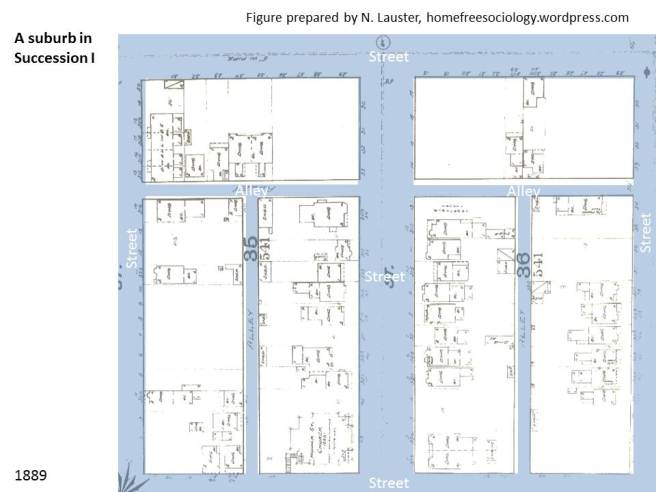
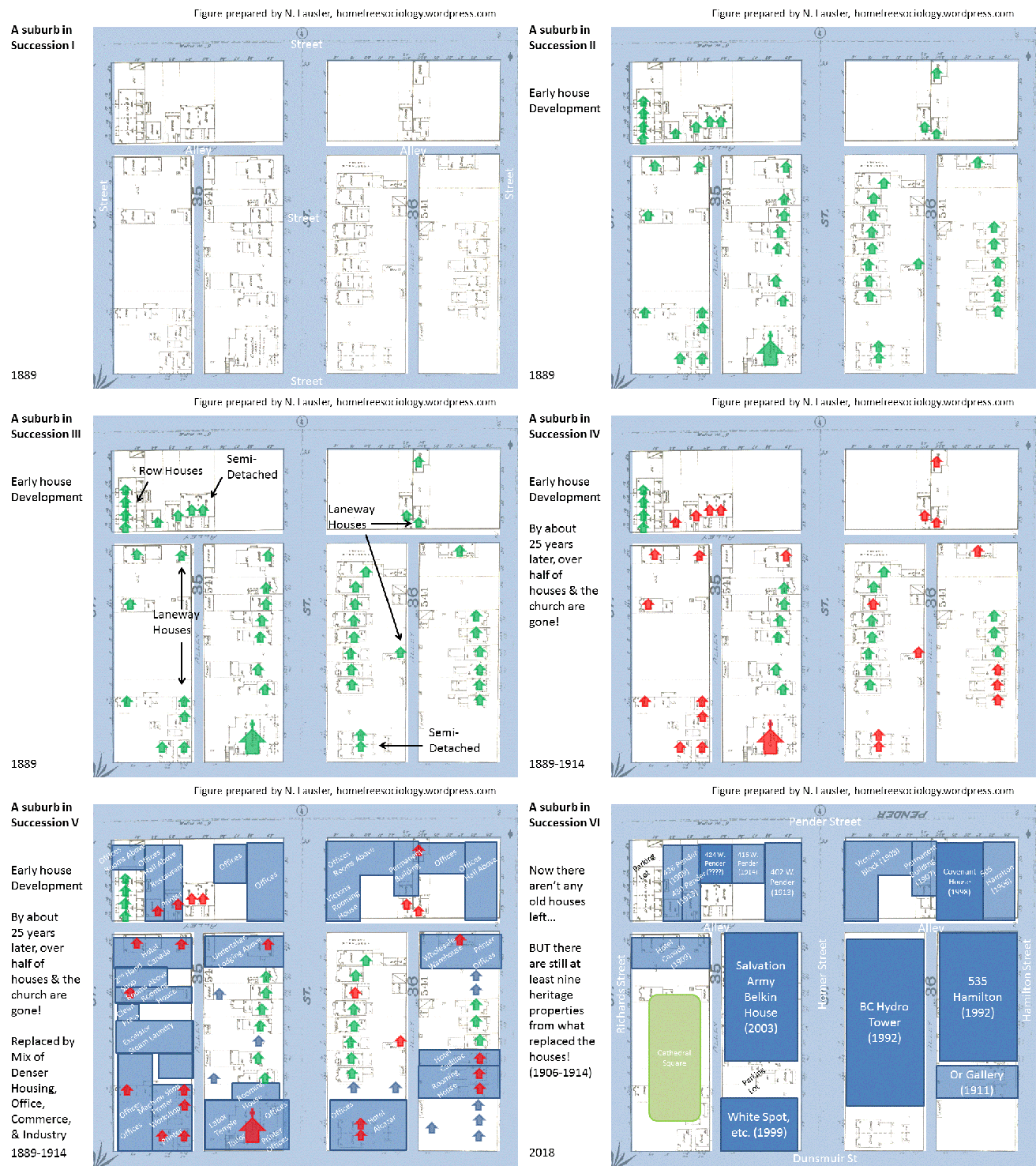
But let’s go back to succession. Can we see it in action? Let’s start with an early residential development consisting of two blocks (subdivided by alleyways into six) on the outskirts of a rapidly growing city in the late 19th century.

ASuburbSuccessionI

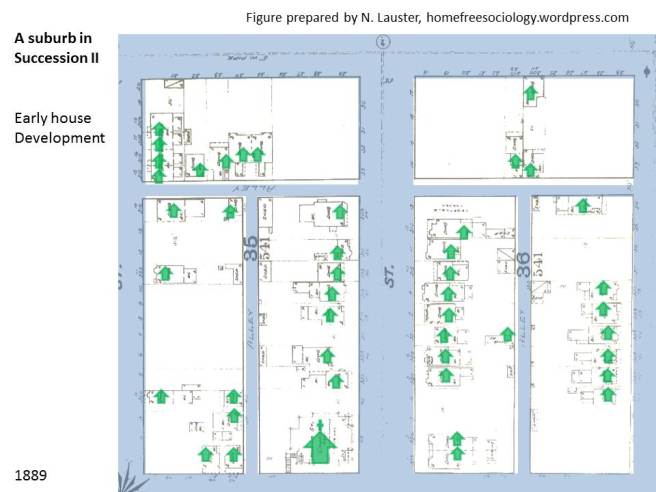
The base layer here is an old fire insurance map from the Vancouver archives, though I’ve faded it out a bit to draw over top of it. Let’s highlight all of the houses.

ASuburbSuccessionII


We can see this is pretty much just a residential neighbourhood at this point, with the only non-residential use a church (lower-left). Most of the other buildings are sheds. But wait a minute, are these all single-family detached houses?

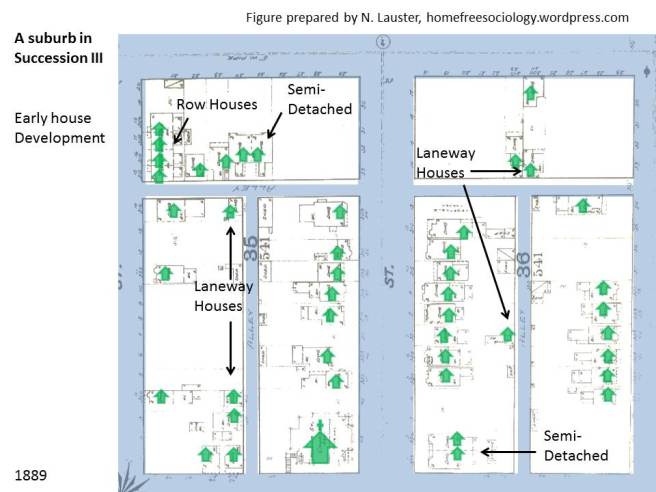
ASuburbSuccessionIII


Trick question! Those weren’t invented yet! So nobody was recording whether or not single families lived in these houses, nor how they might have been subdivided. That said, it’s clear that four houses in the upper-left block were all connected to each other, making them recognizable as rowhouses. Meanwhile, there were at least two houses connected side-by-side on other lots, making them semi-detached houses (by modern Canadian census categories). Also notable: at least four lots had both houses fronting onto major streets and houses fronting onto alleyways – with the latter now identified as “laneway houses” in Vancouver. Lots of “missing middle” housing!

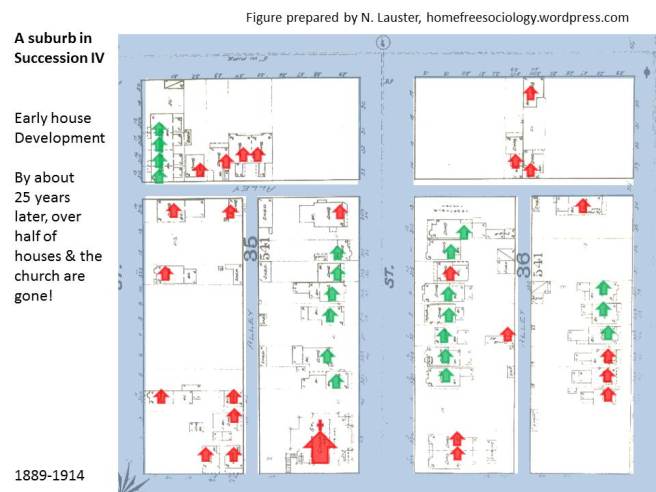
Importantly, these residential blocks were located on the outskirts of a growing urban core in 1889. What will become of them? Let’s jump ahead 25 years and see…

ASuburbSuccessionIV


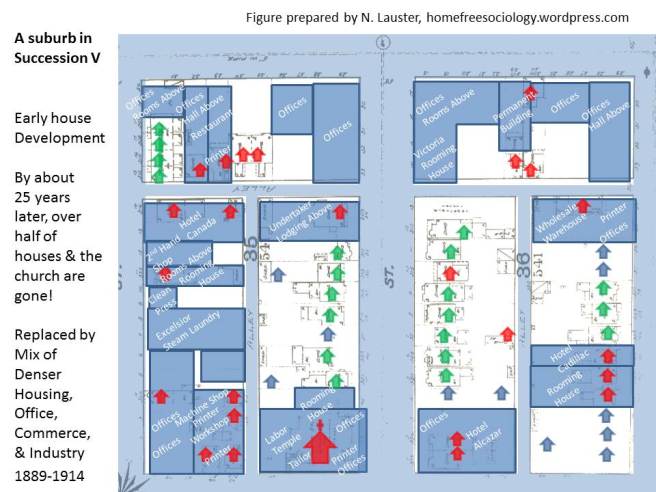
I’ve highlighted in red all of the buildings that disappear over the course of 25 years. Oh no! There goes our church! Over half of the houses are also gone. Devastation in Habitat IV! But at least the townhouses remain. Let’s fill in the neighbourhood…

ASuburbSuccessionV


Some of those old houses remain, and new ones have been added too, meaning that we don’t see a complete replacement of seemingly middle-class residential uses (Habitat IV). That said, for the most part torn-down houses have been replaced by much larger buildings that take up their lots and add abundant industrial, commercial, and office uses to the neighbourhood. At least three hotels (Alcazar, Cadillac, and Canada) join numerous rooming houses, with the latter being an especially important source of housing for the working class and poor (Habitat III). Industrial uses (machine shop, workshop, numerous printers, warehouse) also crowd the block, along with commercial uses and services (second-hand shop, steam laundry, tailor, restaurant). There’s even an undertaker with lodging above! Lots of what Burgess termed a zone in transition (Habitat II). And offices… so many offices. We can make a strong claim for central business district uses (Habitat I). In effect, the entire urban core has moved into a former middle-class residential district over the course of 25 years, give or take, without completely destroying it. On a first pass, pre-zoning urban succession looks more like urban mixing than invasion and replacement. But maybe we just didn’t give it enough time.

What does this marvelous neighbourhood look like now, some 100+ years later?**

ASuburbSuccessionVI


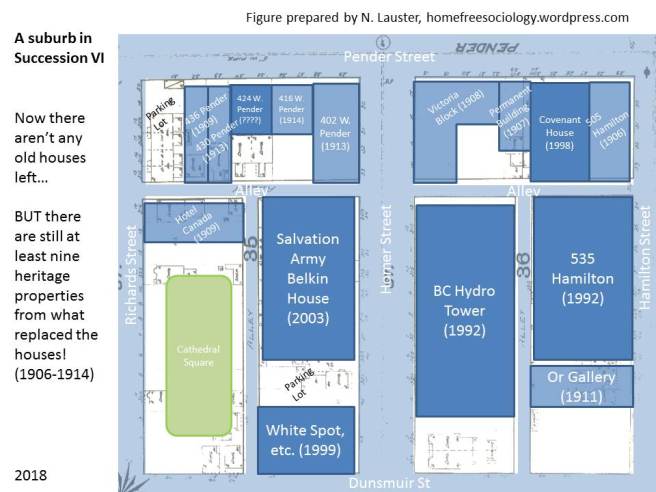
It looks like the two blocks bounded by Pender, Hamilton, Dunsmuir & Richards, right smack in downtown Vancouver. The 19-story BC Hydro Centre Tower dominates these blocks. But remarkably, at least nine of the old buildings that replaced the original houses in the neighbourhood during the 1906-1914 era remain intact! Alas, the townhouses in the upper-left have been replaced by a parking lot. Overall, the neighbourhood still has a mix of low-income housing, commercial and service space, and office space, though probably not a lot in the way of middle class housing (have to seek out some condos nearby for that).

I grabbed the dates on all the buildings I could find from VanMap‘s Assessment data. Old Fire Insurance Maps can be found in the Vancouver Archives.

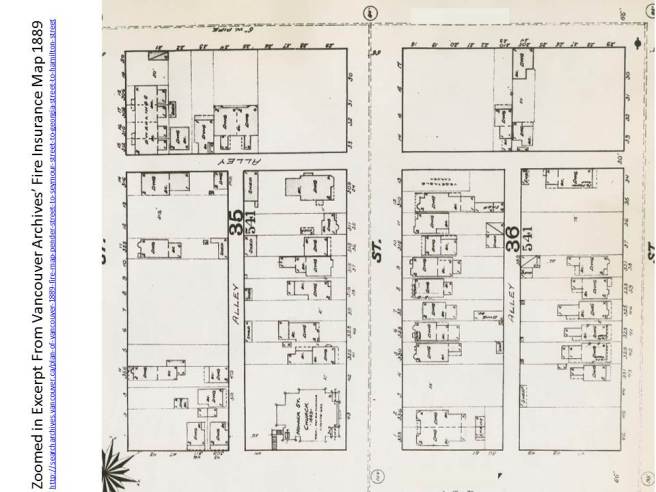
Here’s the Fire Insurance Map from 1889, with zoomed in panel below:

Excerpt-1889

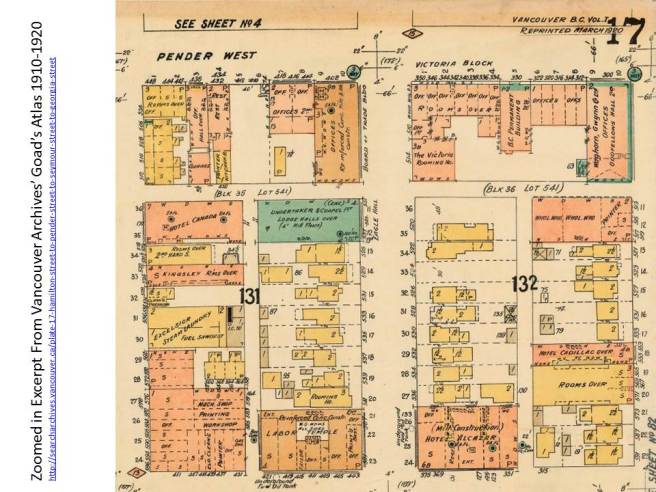
Here’s the Goad’s Atlas Map from 1910-1920, with zoomed in panel below:

Excerpt-1910-1920

This is a first-pass, of sorts, at drawing upon Vancouver’s old fire insurance maps to get at patterns of urban succession in the days before zoning. I’d welcome suggestions, collaborations, and better visualizations! (This was pretty much all done with powerpoint on the fly). In the meantime, here’s my cheap-o little animated gif of the slides above. Enjoy!


ASuburbAnimated


*- The Chicago School of Sociology modeled this process on Chicago itself – though McKenzie, it should be noted, also detoured to Seattle in describing “The Ecological Approach” to the study of The City (1925), in a volume for which Park & Burgess are usually given first billing.

**- The maps date from 1889 and somewhere between 1910 and 1920, which is why I say “give or take” in assessing the length of time that’s passed! Though the Goad’s Atlas dates itself as 1910, it was reproduced (with consolidated updates) in 1920, and includes buildings up to at least 1914, which is why I can narrow it down to around 25 years after 1889.


If the Problem is Speculation, then Why Focus on Foreigners?

Ok, I’ll admit it. I’m an immigrant to Canada. And from the US, which has recently seen a surge in anti-immigrant and anti-foreigner rhetoric and mobilization. We saw the same, of course, in the UK leading up to Brexit, and there are outbreaks in many other places around the world as well. Anti-foreigner rhetoric is having its populist moment. And I don’t like it.

So I’m especially sensitive to anti-foreigner rhetoric. Combine that with my research interests in housing and immigration and my love for my adopted city of Vancouver, and well, you can probably see where this is going: I think we should stop our destructive focus on blaming “foreigners” for our housing problems.

This doesn’t mean we should stop paying attention to the impact of immigration policy and global flows of capital (and there are many good reasons to oppose wealth-based immigration policies like the investor program still operating out of Quebec!)* But it does mean we should stop using “foreigners” as our go-to explanation for sky-high housing prices.

Why? First, it’s dangerous. It should be patently obvious at this point that anti-foreigner rhetoric is the handmaiden to fascism. If I need to explain why that’s bad news, go visit some other blog. Second, it’s sloppy. The concept of “foreignness” is not well-defined in rhetoric, readily lends itself to racism, xenophobia and related “other”-blaming, and remains inconsistent with rhetoric when applied to policy. Let’s take Andrew Weaver’s recent foray into advocacy for a ban on foreign ownership as an example. He defends the ban this way: “We are delighted for people to come and work and live and own property in B.C. but it’s not okay for people to park capital here with no intention of living here.” I’m on-board with carefully tracking flows of capital, but does “foreignness” now apply to folks from Alberta and Ontario? And how do we square “foreignness” with the complexity of immigration? (I worked here on a visa for three years prior to becoming a permanent resident and then citizen, fully intending to live here all the while). Analyst Andy Yan offers a different, but related take for his focus on foreign-buying data: ““It comes down to a question of fairness. As people struggle with keeping their existing home or even having a home in Metro Vancouver, is it fair to treat them in the same way as someone who has a secondary or tertiary home here?” This is an entirely legitimate question, but it has little to do with foreignness, and everything to do with speculation and investment. To put the matter differently, if we’re trying to counter the possible negative effects of speculation and counteract wealth inequality, then I’m in, but if all we’re doing is coming up with policy responses to favor Canadian speculators over foreign speculators, then count me out.

And just what is the balance between “foreign” speculation and Canadian speculation? This is a tricky question to answer, in no small part because we DON’T track global capital very well. Like, at all… I’m all on-board at doing better with this – let a thousand Panama Papers blossom and the CRA take notice! But for now, instead of tracking capital, we track bodies and assign them to residence and rights of citizenship in complicated fashion. We have legislation in BC distinguishing “Foreigners” on the basis of PR and Citizenship status, regardless of their actual place of residence (our “foreign-buyer tax“). And now we have Andrew Weaver extolling the virtues of New Zealand’s proposed “foreign-buyer ban“, which is a little more complicated, but linked to assigned residency (e.g., temporary residents on visas can buy a home, but have to sell it when they leave). The latter issue of residency is what was kinda-sorta measured by Statistics Canada in its recent release of data on non-resident (“foreign”) property ownership (CHSP). This is the data Andy Yan’s been playing around with. But to date most write-ups of this data that I’ve seen, including that from Statistics Canada, have simply focused on the comparison between non-resident (outside Canada) and resident (in Canada) property owners. When we use this as a proxy for talking about speculation, the implicit assumption seems to be that everyone outside of Canada is a speculator/investor/vacation home owner, and everyone living in Canada owns only the property they live in. We lose sight of domestic speculation and investment. How do we fix this?

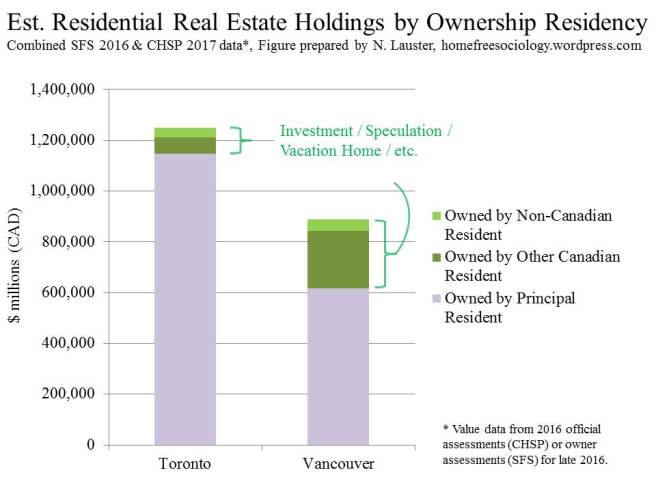
One answer is we combine this information with Statistics Canada’s Survey of Financial Security (SFS). This handy little survey differentiates between principal residence and other real estate for participants, including those in metropolitan Vancouver and Toronto. Here I’m going to combine these datasets together in a very simple and replicable fashion to divide up the value of residential real estate into principal residence, other Canadian residence, and cross-border (Non-Canadian) residence. Effectively I’m just taking the total value of resident real estate holdings from CHSP and subtracting the Principal Residence real estate holdings value estimated from SFS to get the Other Canadian Residence category. This enables us to compare domestic speculators/investors/vacation home owners with foreign speculators/investors/vacation home owners. So what does total property value look like broken down into Principal Residence, Other Canadian Residence (a.k.a. “domestic investors”), and Non-Canadian Residence (a.k.a. “foreign investors”)?

Something like this:

Res-RE-Holdings-Residency

Principal resident owners are separated out in purple, leaving only the properties held by investors / speculators / vacation home owners and the like in green. These are further distinguished between owners residing someplace else in Canada and owners residing someplace else across the border. In Toronto, these two groups are closely matched, though domestic investors look just a little more prominent than international investors and both are dwarfed by principal resident owners. In Vancouver, overall investment in the real estate market by non-owner occupiers is much, much larger, and domestic investors account for the lion’s share of the investment. Many of these investors, no doubt, live in Vancouver (where the SFS data estimate around 1 in 5 families own a second property besides their principal residence). Others live in Toronto, Calgary, and elsewhere across the country.  But with respect to Vancouver’s place in Canada the following seems clear: If speculation is the problem, then its largely home-grown.

There are some decent arguments out there for favoring the buyers in purple over the buyers in green. We’ve got lots of policy options for reducing the value of BC properties as investment vehicles – many having to do with tax policy. There are even better arguments, I think, for focusing on providing lots of affordable rental and non-market housing options for people so that ownership isn’t the only decent game in town. But what arguments do we see for favoring the folks in dark green over the folks in light green? If the important thing is to prop up the middle class in their entry into home ownership, why pit middle-class home ownership against foreigners instead of against the far broader class of investors and speculators as a whole? It’s for BC’s Green Party to answer that one, I guess…


*- I’m proud to have elicited the approval of at least one prominent academic I admire by ending my recent co-authored piece on Chinese-Canadian immigration with the line: “Investigations into the work of home-making suggest how Canada’s immigration policies contribute to rather than ameliorate global inequality, revealing an invitation that reads: give us your energetically leisured, your wealthy, your elites yearning to breathe freely.” Yes. We can do better, including taking in lots more refugees instead of fast-tracking “investor-class” immigrants!

NOTE: Inspired by the transparency of Jens von Bermann’s gitHub kits, but not knowing how to do that, please see my following spreadsheet if you’re interested in the data extracts I worked with and how I produced the above! Feel free to check my work and by all means let me know if I missed something!

ValueRE-SFS-CHSP-2016

A Little Army of Artisanal Landlords

A relatively recent Sightline Institute post by Margaret Morales explores a key difference between development patterns in Seattle and Vancouver. While Seattle tends to construct lots of purpose-built rental apartments, Vancouver tends to construct condominiums. Why? The post walks us through various explanations, many of which have to do with tax codes. Rental construction in Canada is burdened by bad tax policy, including, for instance, the application of GST to rental construction (many housing advocates were hoping the recent Canada National Housing Strategy would roll back these taxes, but no luck!) On the other side of the border, many Seattleites would actually like to see more condos! Morales provides guidance for what’s holding condo development there back – much of it having to do with insurance policy.

On the whole, Morales provides a nice little dive into cross-border policy differences*. Moreover, Sightline is a handy little organization to have around. I’ve been a fan ever since I first came across their old papers (here and here) comparing Vancouver and Seattle in terms of sprawl. I still teach with these sometimes!

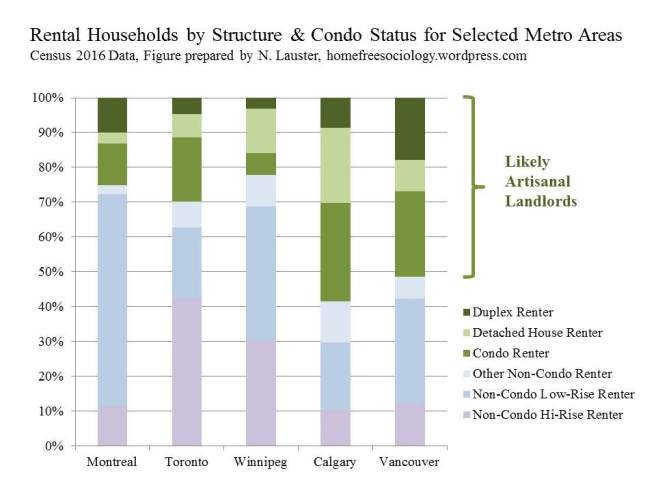
But I wanted to provide a little more insight into Vancouver’s rental situation. Morales is absolutely right about Vancouver’s dearth of purpose-built rental construction (though more is in the pipeline!) Nevertheless, Metro Vancouver appears to have almost EXACTLY the same proportion of households renting as Metro Seattle: just a little over 36%. How does that happen? Enter Vancouver’s little army of “artisanal landlords.”**

RentalStock

What do I mean by “artisanal landlords”? Effectively I’m talking about people who own and rent out one or more properties beyond their principle residence, but probably don’t consider themselves professional landlords (I’m sure there’s a reasonable cut-off concerning how many units you might own before crossing over… maybe five?). These artisanal landlords are important for multiple reasons. First, to get back to that Sightline piece, while Vancouver’s mostly been building condos, about one in three condos ends up occupied by renters.*** Effectively, this means about a third of our condo stock is actually treated like rental stock, only controlled by artisanal landlords. Legally, these rentals are subject to both the residential tenancy act and local strata (condominium) by-laws (which in some cases do not allow rentals at all). This sometimes makes for confusing jurisdiction, especially since tenants are often forced to communicate with strata councils through their landlords, and vice-versa. As for the artisanal landlords themselves, they may have limited knowledge of their actual obligations, and if they contract management of their properties out, that adds another level of bureaucracy to an already tenuous relationship.

In addition to condo rentals, another huge chunk of Vancouver’s rental stock is made up of secondary suites. Many (though not all) of these secondary suites are carved up from buildings that were once, ostensibly, single-family detached houses. So we get the familiar basement apartments Vancouverites know and *ahem* love, often tucked away beneath their landlords above. Sometimes the above suites are rented out too, and even further subdivided. Pretty much all duplexes are owned by artisanal landlords, many of them on-site. Triplexes and other internally subdivided houses that might be owned by artisanal landlords are trickier to find (grouped in with the non-condo other and low-rise categories above).

Then, of course, there are the rented detached houses, which in most cases are likely also owned by artisanal landlords. Combining the three likely artisanal (or smallholding) landlord types, we see they make up the majority of rental situations in Vancouver (as well as in Calgary). Other rentals, especially low-rises (which may contain as few as three units) and townhouses, may also be run by smallholding landlords, but are more likely to have professional landlords.

The difference between artisanal and professional landlords matters for how well different rental units are run, how often discrimination occurs (see my past scholarly work on this here), how many protections renters receive, how stable tenancies are likely to be, and how well rental units can be tracked (the CMHC has only recently tried to get a handle on what they call the “secondary” rental market, and Metro Vancouver can only estimate a range for just how many secondary suites exist in the area, echoing my difficulty in pinning them down beyond “likely”).

So if we have some idea about how many rental units are likely controlled by artisanal landlords, can we estimate how many artisanal landlords there are? This is actually surprisingly tricky! It’s not a question asked in the Census. But there IS a question asked about ownership of real estate aside from one’s principle residence in Stats Canada’s Survey of Financial Security (tables here). There are caveats to using this measure as a proxy for how many artisanal landlords we’ve got in Metro Vancouver (lots of people own vacation properties elsewhere and non-residential real estate is also presumably included), but it gives us something to work with.

The data suggests that over 20% of Vancouver’s families own real estate aside from their principle residence.**** That’s approximately 216,000 families in all, potentially making for quite a few artisanal landlords (the number has more than doubled between 1999 and 2016). We also know the median value of these holdings, which is CAD$400,000 – about the price of many Vancouver condo units (this value doubles for Vancouverites in the wealthiest quintile). Of course, this probably doesn’t even include those artisanal landlords with basement suites below them, since it’s likely they’re considering their secondary suites as contained within their principle residences.

So even though Vancouver hasn’t built nearly as many purpose-built rental buildings as Seattle, we’ve still built lots of units that get rented out. Moreover, artisanal landlords are worth keeping an eye on, both because of what they imply for renters and rental markets, and because they’re likely a potent force in local politics. Considered as a class, they have plenty of plausible reasons to both oppose new purpose-built rentals (competition for tenants) and to cast blame on foreigners (competition for properties). It’s a group worth watching more closely.


*- minor note: I managed to rip only a teeny bit of my hair out over the mixing of terms for tenure arrangements (rental, condominium ownership, etc.) with terms for structure arrangements (apartment, rowhouse, etc.). But I suppose when I write a book describing how often people fail to make these distinctions – often justifiably – I really can’t complain.

**- I stole the “artisanal landlord” descriptor from Jens Von Bergmann, who may very well have stolen it from somewhere else.

***- notably, this does not include condos not occupied by usual residents, where we do not have data from the census.

****-Of note, the only other major metro area exceeding 20% of families reporting owning RE besides their principle residence is Calgary!

Notes on the “Myth” of housing supply

Much has been made of a recent study purporting to demonstrate that adding to supply has done little to nothing to bring greater affordability to Canada’s most unaffordable cities. Though I’m loathe to keep it in the limelight, I feel some responsibility to respond to the study, both because I was quoted in its initial media roll-out (despite not having had a chance to see the study), and because once the study was finally written and released it cited me – kind of – through an old press release for my book (To the author: thanks for citing me, though I might also recommend actually reading my book!).

Unfortunately, I need to start by noting that the study itself is not high quality, either theoretically or methodologically. The terms supply and demand are not conceptualized in the way the economists who more or less invented them use them (i.e., as terms in the balancing equation that constitutes the market pricing mechanism), but rather in somewhat idiosyncratic fashion. In part as a result, I initially found it a little confusing to respond to the study. I certainly agree that widening inequality makes our general reliance upon market-distribution of housing problematic for insuring equitable outcomes. In other words, the whims of rich people for a second or third home carry way more weight in the market than the shelter needs of poor people. That is a real problem that would be entirely consistent as an interpretation of the study’s findings. But that’s not the same as arguing that supply doesn’t matter, and indeed would even suggest that adding lots of non-market housing (new supply!) would be a direct way of insuring the housing needs of poor people outside of the market.

It would seem to me that the only reason to suggest supply DOESN’T matter is to effectively take off the table many policy options that might help address our current housing affordability issues. It’s kind of like we’re all in a sinking boat. Most of us are saying, “we’ve got to bail out this water and plug that leak in order to stay afloat!” But someone in the boat is picking a fight, arguing, “No! Look, we’ve tried bailing out water. Look at all the water we’ve bailed out! But now we’ve still got water in the boat. We should stop bailing out and just focus on plugging the leak.” That’s an interesting strategy, but I’d rather stick with bailing out and plugging up at the same time. (I’ll leave the economists out there to keep providing other metaphors).

So yes, I’ll continue to argue for more supply – especially by enabling more housing options on all that single-family residential (RS-zoned) land in and around Vancouver currently reserved only for millionaires. But I’ll ALSO continue to suggest we should be doing things to make the housing market work better, including (but not limited to):

  • Taxing Vacant Homes (and vacant lots!) like Vancouver’s new Empty Homes Tax
  • Raising Property Taxes, esp. in progressive fashion
  • Rebalancing tax burdens from income to property, as with the clever BC Housing Affordability Fund proposal
  • Cap the currently unlimited tax exemption of capital gains from sale of primary residence

All of these things would make investment in housing as a commodity less profitable and help remove some incentives currently in place to sit on empty properties, without renting them out, in order to accrue the capital gains by doing nothing as the property appreciates (e.g. speculation). But if we’re truly concerned about housing affordability, let’s not tie one hand behind our backs. Let’s keep bailing out water and plugging the leaks in our housing market at the same time.

What about the methods of the study themselves? They need some work. For instance, the author uses different measures and different data sources to compare affordability across time, with the most recent data (taken from Demographia – not gonna link to them) also the least transparent. The author also only focuses on market purchase price (as opposed to rent and/or cooperative share price), effectively setting aside those for whom affordability is a more life and death matter. I’m not going to do a deep dive here, in part because with respect to purchasing affordability, even had the comparison been carried out more carefully, the same results would obtain. There’s no doubt Vancouver has gotten more expensive in recent years!

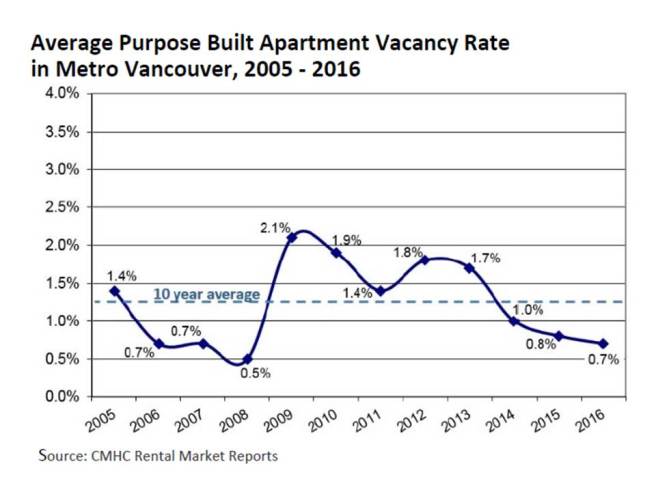
But what about that supply issue? Have we been overbuilding as much as the author suggests, adding an eye-popping 1.19 dwellings for every new household created since 2001? I replicated this result based on census data I gathered right after the first media report came out, and it deserves its own blog-post (up next! spoiler: I’m pretty sure we’re not overbuilding). Before I get there let me leave you with recent vacancy rates for rentals in Metro Vancouver. If we’ve got too much supply, it sure hasn’t hit the purpose-built rental market. Latest update just came out. Good news! We’re almost back up to 1%.

Vacancy-MetVanHouseBook


Losing my religion

From the start, sociologists have been fascinated with how city-living influenced morality, religion, and mental life. Even medieval proto-sociologists, like Ibn Khaldun, wrote about the “natural groups” of Bedouins and sedentary town folk, chastising the latter for the corrupt state of their souls:

Sedentary people are much concerned with all kinds of pleasures. They are accustomed to luxury and success in worldly occupations and to indulgence in worldly desires. Therefore, their souls are colored with all kinds of blameworthy and evil qualities. The more of them they possess, the more remote do the ways and means of goodness become to them. Eventually they lose all sense of restraint. [link]

Where Khaldun saw moral decay in the settled urban life, Simmel (1903) saw the rise of individualism and a blasé attitude.

If one asks for the historical position of the two forms of individualism which are nourished by the quantitative relation of the metropolis, namely, individual independence and the elaboration of individuality itself, then the metropolis assumes an entirely new rank order in the world history of the spirit. The eighteenth century found the individual in oppressive bonds which had become meaningless-bonds of a political, agrarian, guild, and religious character. They were restraints which, so to speak, forced upon man an unnatural form and outmoded, unjust inequalities.

Put differently, Khaldun and Simmel roughly agree on the underlying urban dynamics, if not on their desirability. Left to its own devices, city-living reduces the hold of organized religion upon the soul. And yet, the very organization of religion demands a certain gathering together of like-minded people. In effect, organized religion requires the kind of density only really found in cities. Bit of a conundrum.

At any rate, this is really just setting up my curiosity over how religion is distributed by metropolitan area in Canada. Unlike in the US, we’ve got Census data (or in the case of 2011, National Housing Survey Data) on religious affiliation. It’s definitely not the same as religiosity or fervor or spiritual life. But it does tell us something about the reach of organized religion. As it turns out, all across Canada, most Canadians still have some religious affiliation.


Religion-Metro

Quebec remains decidedly Catholic, even if in many cases this marks more of a cultural affiliation than any belief or strict adherence to dogma. The vast majority of Quebecois still identify as Catholic, even in Montreal (64%), the Canadian capital of all things blasé. Nevertheless, Montreal, like other big (one million plus) metros, is far more diverse in the kinds of religion people practice than the rest of Quebec, with vibrant Jewish and Muslim communities. Metro Toronto adds large Hindu, Sikh, and Buddhist constituencies to the mix, and is also (no surprise) decidedly less Catholic than Montreal.

In general, moving westward from Toronto, metropolitan residents are more and more likely to have no religious affiliation whatsoever. At the far western edge of Canada, little Victoria is the least religious of all, with fewer than half of its residents declaring any affiliation! Of note, Vancouver remains the least religious of the big metro areas, beating out Calgary, Edmonton, Toronto, Ottawa, and Montreal in roughly that order and following a West to East trajectory. Kind of interesting!

Yet Vancouver is also the most Sikh and most Buddhist part of Canada. Here the gateway status of Vancouver mixes in interesting fashion with its history of immigration. This leaves open an interesting question. As different immigrant groups arrive in Vancouver, are they making it more religious? Does Vancouver’s overwhelming secularism affect minority communities the same way it does everyone else? Or are new religious communities expanding in Vancouver as different groups gain density and the ability to organize more effectively?

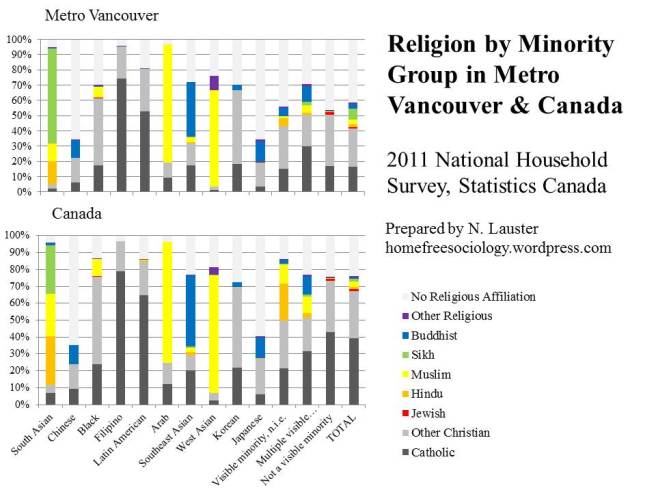
Here I’ll just use visible minority status as an (imperfect) shortcut for different groups in Vancouver, breaking down religious affiliation accordingly, and comparing to the distribution we see across Canada.

Religion-Metro-VisMin

The figure above really demonstrates the assortment of religious tradition by different minority groups (as well as non-minorities). South Asians in Metro Vancouver are much more Sikh than in the rest of Canada. Arabs and West Asians are mostly – but not entirely – Muslim just about everywhere you go. South Asians, Filipinos, and Arabs are the most religious minority groups, despite their differing religious profiles. By contrast, Chinese and Japanese minority groups are the least religious (in marked contrast to Koreans – see the research of Judy Han on this, or just watch Kim’s Convenience).

Vancouver as a big metro area really is less religious, across nearly every visible minority group, than we see for Canada as a whole. The proportion of people identifying as having “No Religious Affiliation” averages almost 50% higher across visible minority categories in Vancouver, as compared to Canada.

Why? Good question. Has Vancouver led us to become too “accustomed to luxury and success in worldly occupations and to indulgence in worldly desires,” As Khaldun might have it? Or maybe Vancouver is just the Canadian epicentre of, “individual independence and the elaboration of individuality itself,” as suggested by Simmel. That western gradient might suggest a potent mixture of frontier-mythologizing, migrant self-selection, and Simmel-style urbanism at work. But I have to admit, I’ve got no problem going with Khaldun if it means I can pit local churches, mosques, and temples against the sheer ubiquity of Vancouver’s fancy sports cars.

Ok, here’s REM:


The Million-Dollar Mansions and Migrants of Metro Vancouver, 2011 edition

Just who lives in all of these million-dollar and above properties concentrated in Metro Vancouver? I don’t yet have the micro-data for 2016 that would allow a deep investigation. But 2011? That I can do!

Here I’m playing around (once again) with the Canadian Census Analyser maintained by CHASS at U Toronto (access through UBC Library). All my analyses were run on-line: they’re basically just custom cross-tabs from the NHS (our replacement for the long-form census in 2011), sorting by characteristics of household heads and weighted according to sample weights. Metro Vancouver is about as low as I can get as a geographic level for microdata without getting special permissions (and tiny sample sizes).

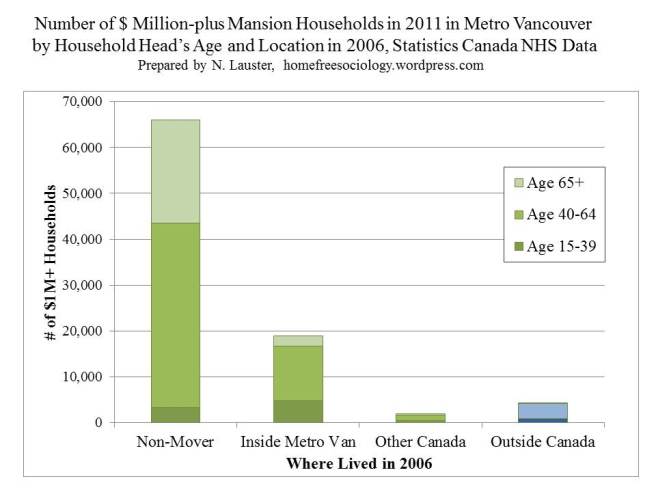
First I wanted to get a breakdown of who was living in million-dollar homes in 2011 by age and where they lived five years before (2006). This gives us a sense of both who’s lived in these places for awhile, and who bought recently. Note: Even though I refer to these as “mansions” below, I don’t actually know what they look like or even how big they are – I just know they were valued by their owners as over a million dollars. Still a fair amount of money in 2011! (Also worth noting: in 2011 we were still coming off of the Great Recession, which only gently brushed Vancouver…)

Mansions-Migrants-1-AgeLocation

Hey, what do you know? The vast majority of households living in million-dollar homes in 2011 had been living in their places since at least 2006. A good proportion of these householders were older – likely retired – but not actually the majority. Most were still clearly working age. The next biggest group of households are those who moved into their current place from elsewhere in the metropolitan area of Vancouver. Very, very few moved into a million-dollar mansion from someplace in Canada outside of Metro Vancouver. Seriously: who could afford to do so? Most other cities in Canada are far cheaper than Vancouver. So a lot of what we see in terms of people moving into million-dollar mansions around Metro Vancouver are locals trading homes with one another.

What about migrants? People who moved to Metro Vancouver from outside Canada are definitely there, but overall in 2011 they represented a relatively small proportion of million-dollar mansion owners. Even in terms of new buyers, they represent less than a quarter of million-dollar mansion owners who moved in between 2006 and 2011. That’s big enough to have a substantial effect on the market! But by no means did most purchasers of million-dollar properties in Metro Vancouver come from away. Most buying in the years prior to 2011 were already locals.

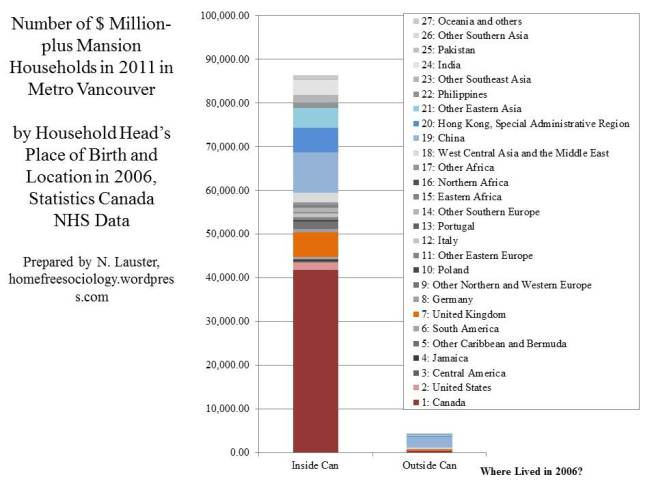
Of course, people have been flocking to Vancouver from all over the world for quite some time, so even if they’d been in Vancouver for awhile by 2006, they still might’ve been born elsewhere. We can break down million dollar mansion owners by where they were born as well as by where they were five years ago. Here’s what that looks like:

Mansions-Migrants-2-Pob-Location

No surprise: the modal million dollar home owner was born in Canada in 2011 (shaded red above), with another big chunk born in the UK (orange). I put Americans (like me!) in pink, just for fun. The other large group of million-dollar home owners I highlighted come from Eastern Asia (in shades of blue above). Why are so many million-dollar homes in Vancouver owned by immigrants? Some of this, no doubt, has to do with the “skill” and wealth-based selection processes of the Canadian immigration system. But another important part of the story – especially for those in blue – probably involves the enormous real estate fortunes being made all around the big cities of the Pacific Rim (where most East Asian migrants are coming from). A lot of East Asian immigrants to Vancouver are probably housing lottery winners in their countries of origin, and Vancouver property looks relatively cheap from many places across the water! Wealthy East Asian buyers account for over half of those moving into million dollar homes directly from outside of Canada between 2006 and 2011.

But are the majority of migrants moving to Vancouver from Eastern Asia (or elsewhere) moving into million dollar homes? Not so much. Here I break down the proportion of householders living in million dollar homes by place of birth and where they lived five years prior to the 2011 census.

Mansions-Migrants-6-Percent-Pob-Location

Most residents of Metro Vancouver (born immigrants and native-born) live in more modest dwellings, rather than million-dollar mansions. Of note: for those born in Canada and living in Canada five years prior to the 2011 Census, just under 10% lived in million-dollar mansions. Many immigrant groups, but by no means all, exceeded this figure. Those born in the USA, the UK, South and Western Africa, China, Hong Kong, and other parts of East Asia all fell in the 15%-20% range for the proportion of household heads living in million-dollar plus homes. Of course that means the vast majority of migrants, over 80% in most cases, were NOT living in million dollar mansions in 2011.

What about people who moved to Canada from another country in the last five years? Interestingly, this includes a fair number of Canadians. Something to keep in mind when we talk about “foreign wealth!” At any rate, those who’ve recently lived overseas tend, overall, to be even less likely to live in a million dollar mansion than those who’ve lived in Vancouver for more than five years…with two notable exceptions: China and Pakistan.

I don’t actually know what to make of Pakistan – except that it might just be a small sample-size issue. The same sample-size issue probably helps explain why Jamaicans look so wealthy – though it’s possible I’m just missing all the wealthy Jamaican neighbourhoods in Vancouver. For China, it does appear that recent migrants are more likely to live in million-dollar mansions than earlier (pre-2006) migrants. This accords with broader perceptions that Chinese migrants to Vancouver are increasingly selected for wealth. That said, the vast majority of new immigrants from China (over 80%) still weren’t living in million-dollar mansions in 2011.

Now that we’ve got some general idea of the distribution of housing wealth in Metro Vancouver (from five years ago anyway), I’ll try and return to an enduring mystery in my next post: what’s up with low-income households owning million-dollar mansions?


Lottery winners of the Pacific Rim

Sociologist Harvey Molotch famously suggested that cities should be understood, first and foremost, as Growth Machines. The big takeaway is that the urban political class and overlapping landholding class tend to agree with the basic idea that growth is good and should be encouraged. For the landholding class, in particular, growth is good for their bottom-line. Land value goes up as more and more people are encouraged to concentrate in the same place (particularly if they’re wealthy people). So big landholders, who also often drive local politics, actively and aggressively push for growth. They’re aided and abetted by numerous other parties, including local media. Along for the ride in more or less passive fashion are local home owners, many of whom might be understood as “lottery winners” as they watch their property values soar. Sound familiar, Vancouver?*

Of course, “lottery winnings” from housing wealth are only really available for people to tap into if they a) sell their housing and move somewhere cheaper, or b) avail themselves of complicated financial instruments akin to mortgages. But this sets up a really interesting dynamic, especially with respect to immigration. People can move from a “lottery winning” locale to a much less dynamic real estate market and pocket a lot of change along the way, arriving as a wealthy immigrant. In places with less developed mortgage systems, this pattern can be further complicated, as sellers will have accumulated few loans against their housing before selling (setting aside, for the moment, those who don’t own property).

What does this imply for immigration around the Pacific Rim? Much of immigration takes place to and from the big “gateway cities” of the Pacific Rim. These gateway cities tend be very expensive markets locally because the flow of international migrants drives much of real estate dynamics. Partially as a result, local prices can drift upward from what might be expected by local incomes. But gateway cities are also quite diverse in terms of the success of their local growth machines. As a result, some “lottery winners” are far wealthier than others. By selling their home in an expensive growth machine and moving to a cheap one, migrants can cash in their lottery winnings.

Where should we expect this to be a feature of immigration streams in the Pacific Rim?

I recently stumbled across Numbeo, providing crowdsourced estimates for property prices by square meter of size (as well as rents, etc.) for cities around the world. I still have a lot of questions about this data (and I’m more than happy to entertain critiques!), but they seem quite transparent in their methods, and I can see their stuff is already being used in (forthcoming) academic articles, so it seems like worthy play material. Using their estimates for property prices (in Canadian dollars), I put together the following comparison:

Pacific-Rim-Comparison-Price

I’ve highlighted Vancouver in blue as a big gateway into Canada. Of note: when it comes to the Pacific Rim, anyone selling their home to the left of Vancouver before migrating to same could arrive with a great deal of wealth, especially if they’re moving from a city centre! Vancouver looks cheap to arrivals from Hong Kong, Singapore, Beijing, Shanghai, Tokyo, Shenzhen, San Francisco, Seoul, Sydney, and even (to some extent) Taipei. “Sell your place, move to Vancouver, and get rich!” could also work at least moderately well for arrivals from London and New York City.

On the whole, this provides some important evidence to contextualize patterns of immigration into Vancouver. Positioned as a gateway into Canada from the Pacific Rim, we should expect a lot of East Asian immigrants to arrive quite wealthy just from selling off their homes in their city of origin! That’s setting aside a host of related issues (e.g., Canada’s selective immigration policies – including its relatively terrible investment class program, China’s selective emigration policies, intergenerational concentration of wealth in single children) that favor wealthy immigrants, as well as others (e.g., China’s capital controls and less developed mortgage system) that complicate the story.

Recent (and generally good, I think!) reporting in Vancouver has emphasized the crooks among Vancouver’s wealthy immigrants – and by all means, go get them! But this has a tendency to obscure how you don’t have to be crooked to arrive in Vancouver with money to spend. You just have to be lucky. And there are lots of real estate “lottery winners” scattered around the Pacific Rim, including many homegrown right here in the Lower Mainland.

Lots more to think about, but I’d love to hear more about a) the Numbeo data! and b) how this maps onto people’s thoughts about Vancouver’s role as gateway to the bustling growth machines of the Pacific Rim.


*- This dynamic is viewed as providing home owners a material interest in siding with growth machines. Of note, Molotch’s analysis is pretty solid with respect to North American cities at their founding and through most of the Twentieth Century, and it still mostly holds for central cities. But anti-growth coalitions began to arise and drive metropolitan politics pretty quickly, most dramatically in the suburbs, where NIMBYism and exclusionary policies are pretty much the norm. Lots to say about that, including both that “material interest” can be interpreted quite flexibly and it’s not the the only thing driving NIMBYs, but I’ll set it aside for the moment. How do Growth Machine stories explain other places? Growth Machine analyses are often received critically in Europe, where they don’t seem to work as well, but have been largely embraced – at least in modified form – across much of Eastern Asia. In China in particular, the political economics of urban growth have received a great deal of attention, in particular the collusion between local politicians and local developers (paywalled examples here and here, or see books like Li Zhang’s excellent In Search of Paradise: Middle-Class Living in a Chinese Metropolis for a view from the ground). But less attention has been paid to the more or less passive “lottery winners” of Eastern Asia’s rapid urban growth. In the context of China, of course, urban growth was joined to the privatization of housing, producing many double-winners (as well as many new losers, especially rural migrants to cities). See Forrest & Izuhara (sadly pay-walled) for a really nice view of how intergenerational housing wealth accrues – or fails to do so – in Shanghai. It’s one of my regular teaching tools!

Why Keep Adding Empty Bedrooms?

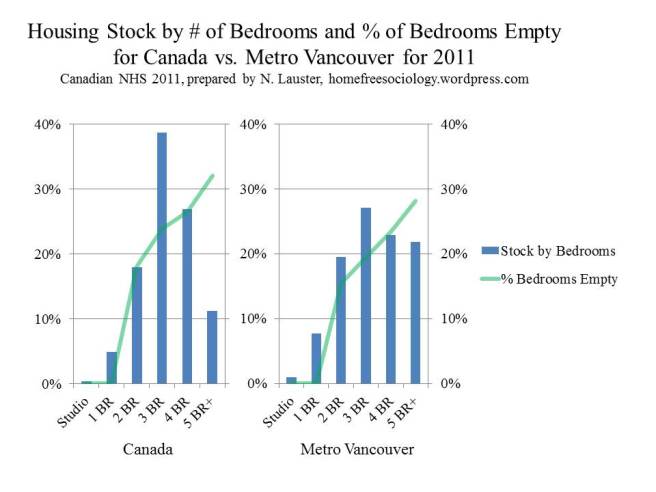
I’ve been playing around with different ways to visualize bedroom data, and here I thought I’d just add one more, combining the data on housing stock by number of bedrooms by what (minimum) percent of bedrooms must be going empty for Canada and Metro Vancouver. I think this best demonstrates how Metro Vancouver has traded off its 3BR “Family Size” units for 5 BR “Super Size” units and bedrooms that largely go empty.

Bedrooms-Stock-by-Empty-2011

I won’t re-hash my previous two posts, but this is largely because of zoning forbidding the construction of townhouses and related forms of “family size” stock that could more efficiently use all the land currently being taken up by “super size” mansions. It shouldn’t come as a surprise that bedrooms are more often put to use in Vancouver than across the rest of Canada, and often times people are being creative in making the best use of mansions they can. But why not let other kinds of housing into Vancouver’s “Great House Reserve” to fill in the growing gap we’re seeing in “family size” units?

[UPDATE: My bedroom antics have now made their way into the Vancouver Sun and The Province along with my mug! And also onto Roundhouse Radio]