The story of an empty unit

Before we moved to the townhouse in Vancouver where we live now, we had a two bedroom apartment on the top (fourth) floor of a low-rise building in Kitsilano.  We had fabulous neighbours in the building, and have remained close to at least a couple (knowing we were bike commuters, they all pitched in and bought us a chariot bike trailer after we had our first kid!  Such a sweet gift!)  My partner and I lived there together for about seven years.  For about five of those years, we shared the place with at least one kid.  For somewhere between three to four of those years, the apartment downstairs from us remained gloriously empty.

An unoccupied housing unit!  Right below us!  We weren’t going to question our good fortune too closely, but for the most part, we remained at a loss to explain why it remained unoccupied so long.

That said, we had at least some idea why it became unoccupied in the first place.  We lived in a strata (condo) building.  The strata association, after struggling to figure out how to deal with a couple of bad tenants living in the building, decided to pass a no-rental by-law.*  The apartment downstairs from us had been rented out by its owner(s), and when the tenants left after their contract ended, they couldn’t be replaced.  We figured it was only a matter of time until the landlord sold the place.  But we had no idea just how MUCH time would pass.

Lots of things happened.  To our knowledge, it seems the owner may have received the apartment as an inheritance.  They tried to sell at some point after their tenants left, but the deal fell through.  The owner may, it seems, have had some major medical issues that kept them from paying attention to the apartment.  Then the building had a major repair scheduled, and everyone had a hard time selling until it was done.  In fact, the place downstairs from us was never sold.  Instead, the owner eventually managed to get a hardship exemption and rent to a new tenant.**

So there you have the messy story behind at least ONE of the empty apartments showing up in the City of Vancouver’s new report on unoccupied housing.  An anecdote, to be sure, but possibly a helpful one.  There are all kinds of reasons why housing units can remain empty.  To be sure, these reasons no doubt include speculation, shoddy real estate practices, and also the second (or third, or fourth, etc.), but seldom visited home ownership practices of the ridiculously wealthy.  But they also no doubt include things like inheritances (that may or may not be contested), landlords coping with (and/or contesting) no rental provisions newly imposed by their strata corporations, owners coping with illness (which can be quite long-term), plain inattentiveness, and a host of other reasons that might puzzle the neighbours without seeming especially nefarious.

To return to Vancouver’s new report on unoccupied housing, which I’ve been trying to puzzle out (just like everyone else, it seems!), the big finding is the stability we seem to be seeing in terms of a relatively large (but not outstanding) proportion of the City’s apartments left empty – especially, it seems, in my old neighbourhood of Kitsilano.  Here’s where my anecdote (apparently drawn from the dataset under analysis!) may come in handy.  The sheer diversity of reasons the apartment below us remained empty for three to four years may reflect a broader diversity of reasons properties across the city often remain empty.  That diversity, in turn, may help explain the striking overall stability we seem to be seeing in occupancy.


*- I learned the other day, via a visiting scholar, that no rental provisions are apparently illegal for condominium associations in Australia.  This was especially striking to me because we get our Strata legislation from Australia (they call their condos “strata” too!)  Incidentally, we lost some good neighbours over that no rental provision…

**- The new tenant who moved in was awesome!  The poor guy had moved hoping to get some peace and quiet after experiencing a noisy upstairs neighbour in his old apartment.  But he was EXTREMELY good-natured about our kid(s).  He attributed this to the fact that he could (almost) always count on everything quieting down around 8pm, when we put all the noisy folk to sleep.

Vancouver’s Detachable Housing Markets

I looked into the new interface for CMHC’s Housing Market Information Portal today (new to me, anyway!)  My review so far: it’s pretty handy.

Here’s a chart I put together illustrating what I think is an important (but sometimes overlooked) aspect of urban housing markets: they are often highly detachable.

Van-DetachedSales-Rents

Urban real estate is heavily regulated.  Zoning is hugely important across North America, setting up distinct land markets.  Single-Family Residential takes up the most urban land.  But there are further regulatory protections of interest, including residential rental contracts and rent control.  Together with less formal market segmentations and protections, regulation creates an environment where there is little certainty how what’s going on in one little sub-market will translate into another little sub-market.  In other words, there’s no such thing as one big market (take it from Polanyi, if not from me).  Instead there are many little markets with often arcane connections between one another.

For much the same reason, there’s no such thing as one Vancouver real estate market.  Market rents for rental units already need to be subdivided into primary markets (rental only buildings) and secondary markets (here condo rentals, but theoretically also including secondary suites).  Even with the shaky secondary market data we have available from CMHC surveys (see the blue line from 2007 onward) we can already detect how the more closely observed and regulated primary market differs from the condo market.  BC’s rent control (restored by the NDP in 1992) probably has something to do with the slow and gradual rise in market rental rates (I’m setting aside, for the moment, broader arguments that it might also have diminished investment in new rental stock).  With the data we have on it, the condo rental market looks much more volatile.

But an even larger gap can be observed between what’s going on between apartment rental markets and single-family detached sales markets.  Where rents have risen gradually across the entire time period observed, the sale prices of single family detached houses went boom and bust in the 1990s, and (as everyone knows) have since boomed without stop. Fortunately (I think), there isn’t much of a relationship between the crazy things single-family sales prices are doing and what renters are feeling.  At least not yet.

That’s not to say there aren’t real problems with what’s going on in the single-family detached market.  And it’s not to say there aren’t other real problems with the rental market (we still have nearly a third of renters living in Core Housing Need).  But the complex regulatory environment, that both constrains and enables urban real estate markets, keeps these problems somewhat distinct.  It may also explain why those outrageous single-family house prices aren’t (yet) leading to a loss of “Vancouver’s life blood.”

Still, we could, and should, work on making our regulatory environment better.  But we should focus on making things better for those most in need.  As it pertains to the relationship between different markets, in my ideal world we’d be looking to bring the apartment rental and detached sales markets closer together by further relaxing the regulations fencing off single-family detached houses from internal subdivision, gentle densification, and redevelopment.  It wouldn’t do much to bring the price of single-family houses down, but it could bring in a lot of new rental supply.

Of course, my ideal world would also contain a lot more non-market housing options, especially cooperatives!  But that’s perhaps a different story.


Bringing Anecdotes to Data Fights

Don’t Bring an Anecdote to a Data Fight.

So goes the meme, and it’s funny.  In a nerdy sort of academic way.  But is it good advice?

All good data fights are about competing stories.  For instance, there’s a prominent local story suggesting people are leaving Vancouver in droves over high housing costs.  Transforming this into a data fight, it quickly becomes apparent that more people are arriving than leaving – a severe blow to the story.*

But maybe it’s not all people we’re worried about – it’s the lifeblood of Vancouver that’s leaving.  People in their thirties and forties, whose careers are just taking off, but who can’t maintain a family in the tiny hell-holes this city provides.  The data actually tell us that, at least across the Metro Area (where we might expect “lifeblood” to have a useful meaning), more people in their thirties and forties are coming than leaving, it’s just that they often end up in the suburbs rather than the central city.

The data fight can keep going on its own (and I expect it will).  The stories continue to evolve accordingly.  But there’s another response to this sort of data, which goes something like:

Ok, but some of my friends have left.

This was, in effect, one of the comments I received over my recent posting about migration trends.  The standard response, of course, would be “Don’t Bring an Anecdote to a Data Fight.”  But I actually appreciate the comment, and now I’m kind of wishing I’d followed up on it by asking for more details.  Why?  I actually think it can be very valuable to bring anecdotes to a data fight.

A couple of years back, I remember first coming across news stories about people fleeing Vancouver because of housing prices.  (Ok, maybe even more than a couple of years.  I’m getting old, too old to go back and track them down).  What was striking to me about so many of these stories was the lack of verification.  When pressed, our dearly departed often described their moves more in terms of great new job opportunities, or desire to be closer to family, than in terms of housing costs.  This isn’t to say housing costs weren’t and aren’t a factor in many moves.  Indeed, they show up as a (relatively) common reason for moves provided when people are surveyed about why they move (see here for a report from the USA).  So I’d be surprised to find no one leaving Vancouver over housing prices.  But for the same reason, I’m often struck by how difficult it is to establish these kinds of motivations, even using anecdotes.  Clearly we could do a better job tracking movers in Canada!

But back to anecdotes: of what use is an anecdote in a data fight?  Let me count just a few of the uses:

  1. The absence of anecdotes can be telling.  If you’ve put in a good faith effort and you can’t find an anecdote that resonates to a story of interest – one you’re trying to tell, or one you’re reading – then maybe the story just doesn’t work.  Even if the data seem compelling, if I can’t find place a particular and unique instance where the relationship they purport to show actually works, I’m going to be very skeptical.  And I should be.
  2. Anecdotes can provide examples of the complexity that necessarily pertains to how well data stories might work in the real world.  For instance, they might show a story works in some circumstances, but not in others (which can help drive further data fights).  I’m very interested in anecdotes that help differentiate the people leaving Vancouver from those arriving.
  3. Put slightly differently, but in an important way, anecdotes sometimes remind us about underlying heterogeneity.  Data fights are usually about trends, averages, average effects, and correspondingly dominant story lines.  But that shift is important – averages mask differences.  We should be very careful about allowing one story to dominate others if we can establish cases where alternative stories fit best.  Anecdotes that remind us of this serve an important purpose.
  4. Anecdotes can call into question the validity or reliability of data.  This works best not by drawing upon a few counter-examples that call the story being told by the data into question (there are usually already baked into the data), but rather by drawing upon a few examples that call into question how the data were collected and/or interpreted.  In other words, tell me that you have friends who have left Vancouver and it won’t change my basic understanding that more people are coming than leaving.  But tell me that you have friends who left Vancouver but were still counted by the Census as being here, and I’m going to want to know more.
  5. Anecdotes remind us, often in emotionally resonant terms, how important (or unimportant) some data fights might be.  Indeed, this is one of the frustrations of many quantitative social scientists: sometimes a good story is far more compelling than all of their carefully assembled data.  Bringing anecdotes to a data fight can help sell the importance of the data exemplified by the anecdote.  Politicians know this.  Social scientists should too.
  6. When drawn from a data set, anecdotes also offer a way to check the data, making sure it works how we think it works.  Often this is the glory of mixed methods – qualitative & quantitative – kinds of analysis.  I don’t want to wade into any data fights without checking a few of the anecdotes contained within my data to make sure they make sense.

Anyway, the long and short of it is: please bring your anecdotes to your data fights.  Especially if it’s a fight with me.  I want to see them!  And I want details!


Can we blame Scalia for Vancouver’s unaffordable real estate?

On the face of it, probably not.  Indeed, maybe the blame runs in the other direction – perhaps, the former US Supreme Court Justice’s death was hastened by glancing at the price of a detached house on the West side of the City.  But bear with me…

Scalia’s death opens up a spot on the Supreme Court, and the ensuing nomination contest should prove… interesting.  Republicans are, predictably, arguing that President Obama shouldn’t make any nominations, leaving the Supreme Court pick to his successor.  One argument is that there simply isn’t enough time.  The New York Times put this argument to rest today with a handy graphic revealing that Obama has 342 days left in office, and its never taken the Senate more than 125 to confirm (or reject) a nominee. Plenty of time!

But which former nominee took the longest to get confirmed?  A quick scan reveals it was none other than Louis Brandeis.  Probably because he was an incorruptible progressive, and also Jewish.  I’ve long been fascinated with Brandeis.  Initially this was just because of his association with the eponymous University (yes, it is named after him), and my difficulty in deciding how to pronounce his name (rhymes with bran-face?).  But then I discovered he was part of the Supreme Court during a decision of particular interest to my research.  He was part of the Euclid v. Amber Realty court majority deciding in favor of the legality of use-based zoning by municipalities in the USA in 1926.  This was actually quite a close decision, despite only three judges formally dissenting, and had Brandeis not been there, it could easily have gone the other way.*  But he’s also notable for co-authoring a relevant defense of the right to privacy that predated his time on the court.

I’d suggest that the basic logic of Brandeis’ right to privacy argument (from 1890) also motivated the legalization of zoning, especially as it pertained to the establishment of single-family detached residential areas.  To quote the former:

Recent inventions and business methods call attention to the next step which must be taken for the protection of the person, and for securing to the individual what Judge Cooley calls the right “to be let alone” [10] Instantaneous photographs and newspaper enterprise have invaded the sacred precincts of private and domestic life; and numerous mechanical devices threaten to make good the prediction that “what is whispered in the closet shall be proclaimed from the house-tops.”

Ha!  1890!  Good thing we nipped the threat to privacy from those newfangled mechanical devices in the bud.  Anyway, the City itself was often seen as a threat to privacy, as well as to peace and serenity.  Turning to the Euclid decision, zoning for the segregation of uses was understood to:

increase the safety and security of home life; greatly tend to prevent street accidents, especially to children, by reducing the traffic and resulting confusion in residential sections; decrease noise and other conditions which produce or intensify nervous disorders; preserve a more favorable environment in which to rear children, etc. With particular reference to apartment houses, it is pointed out that the development of detached house sections is greatly retarded by the coming of apartment houses, which has sometimes resulted in destroying the entire section for private house purposes; that, in such sections, very often the apartment house is a mere parasite, constructed in order to take advantage of the open spaces and attractive surroundings created by the residential character of the district.

The big thing legitimized by the Euclid decision was the segregation of single-family detached houses from apartment buildings.  The legal legitimacy granted to single-family residential zoning in the US spread to Canada via consultants like Harland Bartholomew, primary author of Vancouver’s planning from the late 1920s.  Our zoning legislation has increased in complexity since then, but there’s been strikingly little erosion in the single-family residential zoning (RS) setting aside the City’s land to support only single family houses in the 1920s.**

As I like to think of it, we put in place a Great House Reserve around the urban core(s) of Vancouver, and it’s pretty much still in place today.  Once the City’s middle class felt they could afford the price.  Now, for a great many reasons (here are only a few), that’s no longer the case.  But due to the maintenance of existing zoning restrictions, we’re still reserving the vast majority of the City’s residential land for single-family houses.  Effectively, we’re now only allowing multi-millionaires to play there.  No wonder they’re dominating the news.

Still, protecting the exclusive rights of millionaires is the sort of thing Scalia might’ve liked.  Maybe we can blame him for the high cost of our real estate after all?


*see, for instance, Baar, 1992; Power, 1989; and Valverde, 2011 (I can provide full cites on request!)

**of course now you can usually add a secondary suite and a laneway house to single-family residential lots in Vancouver if you really want to, so that’s something!

Is the Lifeblood of Vancouver Leaving?

The rising unaffordability of housing is a real concern in Vancouver.  But we should be clear about how and why.  Summarizing the concerns of many, The Globe & Mail’s Gary Mason writes of “A crisis in Vancouver: The lifeblood of the city is leaving.” As I noted previously, scares about the depopulation of Vancouver are easily dismissed by examining migration and mobility figures.  Both the City and the Metropolitan Area of Vancouver are growing, not declining.

So just who are we talking about as the lifeblood of Vancouver?  For that matter, what are we talking about as Vancouver?

Let’s start with the latter question.  The City of Vancouver, of course, lies at the heart of the Metropolitan Region of Vancouver.  Should we be concerned about anyone leaving the City of Vancouver?  Maybe.  But if they’re just crossing Boundary Road to go live in Burnaby or even catching the SkyTrain down to Surrey, it doesn’t seem like that big of a deal.  Indeed, to stick with the metaphor, if Vancouver is the heart of Metro Vancouver, so long as our lifeblood keeps flowing in and out and all around the larger region, we shouldn’t have a problem.  That’s kind of what we want it to do. The bigger problem, it seems, is if our lifeblood is leaving the region altogether.  This suggests we should be most concerned with patterns of migration and mobility pertaining to Metro Vancouver as a whole.  Or maybe it’s worth keeping an eye on both Vancouvers: City and Metro Area, but keeping in mind that different issues are involved with each.

So who are we talking about as lifeblood?  After all, both the City and Metro Area just keep getting bloodier and bloodier as they grow in size.  Gary Mason tells us to pay special attention to those in their 20s and 30s.

 For many young adults, however, the city increasingly represents a place of which they no longer can afford to be a part. Consequently, Vancouver faces an almost existential threat; what happens when the lifeblood of any community, those in their 20s and 30s, decide to leave? … Frustrated over the inability to find even a condo at prices their salaries can accommodate, many young people are saying goodbye.

Really?  Are more of these young folks leaving than coming?  Using Canadian Census data, I ran the numbers for the most recent time period I could get a handle on: 2006-2011.  There’s a simple technique in demography of gathering age-specific net migration figures by breaking down the population by age-group in each year, aging them forward (giving them babies at appropriate fertility rates and killing them off at appropriate mortality rates – here I used age-specific death rates for Canadians in 2008), and then seeing how many of them you’d expect to be around.  If you subtract this figure from the actual figure you see in the next census, you get an age-specific net migration rate (expressed below in percentage form).  Here’s what I get for both City and Metro Region:

Van-Net-Mig-2006-11

For the greater metrolitan region, Vancouver’s lifeblood doesn’t seem to be going anywhere.  Many more people in their 20s and 30s are pouring into Vancouver than are leaving.  This is an important point to keep in mind, if only to set the record straight about the implications of the region’s unaffordability.

What about the City of Vancouver?  For those in their late teens and early twenties, the phrase “pouring in” is simply inadequate.  We have a tsunami on our hands.  Why?  Probably in part because Vancouver is a university town – in fact it’s MY university town.  But also because central cities tend to attract young people, provide them with jobs, and provide the diverse kinds of housing stock able to support them.  It’s true that the balance shifts between the City of Vancouver and the rest of the metropolitan region as people age.  The City of Vancouver is a net loser for people in their thirties and beyond.  No doubt many of them are looking for more spacious and affordable housing, and they would stay in the City if they could find it there.  But crossing the border into Burnaby, or down to Surrey, or out to Coquitlam, seems like pretty normal circulation.  The type experienced by central cities everywhere (yes, I checked, and Toronto experiences it too).

2016 is upon us, and soon we’ll have a new census.  We’ll all be eagerly awaiting the results (well, anyone who has bothered to read this far, anyway).  Who knows?  It’s possible patterns will have shifted by then.  But it’s also worth holding on to a healthy dose of skepticism.  Vancouver has at least 99 problems associated with housing affordability, but losing our lifeblood ain’t one.


The Pyramids of Vancouver (updated)

Frances Bula has a nice piece following up on transnational investments in Vancouver’s real estate market, in particular including the big commercial and industrial properties, like the Molson Brewery.  Are purchases being crowdfunded?  If so, what does that mean? Are all of the investor/buyers being told about the planning restrictions in place?

There are lots of interesting points to draw from all of this.  One point, a point that sometimes gets lost in simplified political economic analyses of urban affairs, is that developers don’t always get their way.  There is little reason to suspect that either the City or Metro Vancouver are bluffing in their commitment to keeping the Molson Brewery zoned for light industrial land use.   Municipal regulations and their regulators still have power, even in the face of the “sharing economy.”  The Province has even more power, which is why we don’t yet have Uber in Vancouver.  It’s also why the BC Securities Commission is apparently looking into some of these crowdfunding advertisements.

Another and perhaps more disturbing point concerns the potential for crowdfunding (and other forms of investment) to operate as scams.  We know they’re out there (we’re definitely not getting straight stories from all the parties involved in the “Sun Commercial real estate brewery project”).  This is, of course, a problem for investors – mostly, it would appear, operating out of China – some of whom are undoubtedly more deserving of sympathy than others.  But scams are also a problem for Vancouver.  In a local sense, they potentially tie up properties (big & small) in litigation, leaving them unattended for years.  In a larger sense, the more of them there are out there and the more of them buying and selling to one another, either by design or by accident, then the more the market as a whole looks and feels like a giant pyramid scheme.  It’s a long, long way down to the bottom, and getting longer by the day.

*** Ummm… And here is more on pyramid-building practices via Kathy Tomlinson at the Globe & Mail.  Read the whole piece!  It’s worth it!

New Social Housing for Vancouver?

Vancouver’s mayor announced yesterday a plan to set aside 20 city-owned properties (worth an estimated $250 million) for social housing if the federal government would cough up $500 million to fund construction (joined by some commitment from the province).  Up to 3,500 new units might be added.

This seems like a smart move, insofar as the Liberal government is looking for shovel-ready projects to invest in, and has already raised social housing projects as a possibility.

To put the 3,500 possible new units in context, their addition could add nearly 14% to the current non-market housing stock for the City of Vancouver.  That’s not trivial.  Looked at a different way, 3,500 new social housing units could help house the 1,746 people counted in the City of Vancouver’s 2015 homeless count.

Still lots to be figured out here, including who will run these units if they get built.  But this seems like a positive step for the City.

Gateway Vancouver

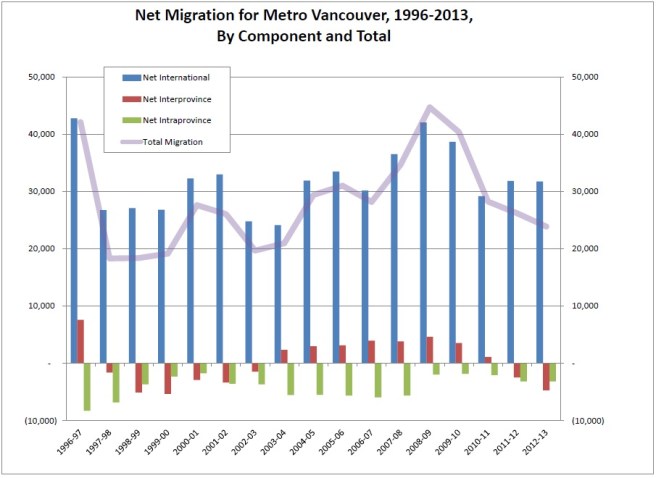
Metro Vancouver is a great source of data.  I’ve put together this little figure drawing upon their net migration dataset from 1996-2013* to get a sense of how different components of net migration influence the region.  Obviously, the overwhelming driver of growth for Metro Vancouver comes from international migration, and it has for some time.  Vancouver is a gateway metropolis into Canada.  By contrast, net provincial migration rises above and falls below zero like the tides (perhaps in response to the fortunes of oil next door).  Net intraprovincial migration is consistently negative.  More people leave for other parts of BC than arrive from the rest of the province.

NetMigMetroVan

On the face of it, this seems consistent with the gateway story.  Immigrants flood into Metro Vancouver, from whence people gradually trickle outward to the rest of the province.  But this kind of data has also been used (especially when it works in conjunction with the outward tide of interprovincial migration) to suggest that unaffordability in Vancouver, particularly of single family houses, is driving everyone away.  More often, the stories are anecdotal: a doctor leaves in a huff ; a public relations professional moves to Squamish; a Calgary management consultant refuses an offer to move to Vancouver.  But sometimes arguments are made, and vague statistics leveraged, suggesting that housing prices are pushing everyone out of Vancouver.

Taking all forms of migration together, that story simply doesn’t work.  Quite obviously, too many people are still coming in to Vancouver to claim that everyone is being pushed out.  But there is another kind of story that can be told: housing prices (or other forces), linked perhaps to particular lifestyles or standards of living, are pushing some types of people away.  Professional people.  Entrepreneurial people.  Young people.  People with kids.  People from the area.  People who aren’t immigrants.

Housing prices and rents really are very, very high.  And some of these stories may even be true (though I suspect most aren’t).  One way or another, I hope to look into many of them in the future (consider this part I).  But for now it’s worth noting that any story focusing on the loss of some types of movers and migrants runs the risk of implicitly or explicitly devaluing the many others who keep arriving.


*- yearly data compiled from BC Stats and Statistics Canada data, including immigration records and use of tax records to estimate intra and interprovincial migration, which is kind of neat!

Renewing the Compact City

There will be a talk by Dr. Hazel Easthope on “Renewing the Compact City: Lessons for the renewal of multi-unit housing” at the Allard Law School (room 122), Feb 9th, 12.30-13.30.

Much of it will be about what to do with strata (condo) properties at the end of their “natural” lives.

In this seminar, Dr Hazel Easthope will present findings from a two-year research study of strata scheme termination and renewal in Greater Metropolitan Sydney (in the state of New South Wales, Australia). This study outlined the tensions arising from the conflicting interests of the multiple stakeholders involved including tenants, owners, developers, bankers and property managers. The research used innovative methods to examine how best to deliver outcomes that are both economically viable and socially sustainable in the context of private-sector driven housing development.

Of special note, given my earlier posting, here too we see research being transformed into new legislation.

The outcomes of this research informed details of the legislation that was passed in New South Wales at the end of 2015 and that will come into effect in July 2016. This legislation, which includes provision to terminate a strata scheme with the approval of 75% of all owners, has some striking similarities with that proposed for British Columbia.

Great stuff.  Click here, or above, for more information.

Having and Needing

I’m slow to the game on this.  Probably because I don’t yet quite get the twitter.  But I noticed, via a big billboard near Commercial and Broadway, that the #DontHave1Million phenomenon (?) campaign (?) movement (?) hashtag thing in Vancouver has now been joined by the #DontNeed1Million hashtag thing, which is more clearly an advertising campaign.

Evelyn Xia, who began the #DontHave1Million hashtag thing, credits another story, about doctors leaving over the unaffordability of Vancouver housing, for her politicization.

I hope to return to the topic of housing affordability and its effects on mobility and migration in the near future.  But for now, I’m reminded of nothing so much as the tune we sing for the two kids around our household on a regular basis:

(edited after I learned how to embed!)