The Trouble with Municipal-level Population Projections

Co-authored by Jens von Bergmann and cross-posted at MountainMath

Are people liquids or solids?

Trick question: they’re kind of both. This matters in terms of how we track people and project their location forward in time. There are basic demographic methods that effectively take people as solids. We can see where they are now. We can see how they’ve been moving recently. We can age them forward in time, including adding new little people and imagining older people dying off. And we can project forward how many people we’ll have in the future.

But people are also liquid. They slosh around a bit, but they eventually tend to settle downhill into the places where there are containers for them. Here our best bet in terms of projecting people’s location forward in time is to figure out the lay of the land and where the most likely containers are going to be located.

Sometimes our liquid and solid projections match up ok. But other times they don’t. Let’s make this discussion a little more solid by zooming in to take a look at a potential divergence in projections right here in Metro Vancouver.

When – if ever – will suburban Surrey surpass the population of the City of Vancouver?

Continue reading

Multiplex Reforms: The Details Matter

Co-authored by Jens von Bergmann and cross-posted at MountainMath

Many Canadian municipalities are implementing reforms to allow multiplexes in formerly single family areas. These initiatives are driven by provincial reforms and federal incentives to increase housing supply. We review the findings from our recent paper studying the outcomes of multiplex reforms in Kelowna and Coquitlam that emphasize that implementation details matter, and take a look at early indicators of how multiplexes are faring in Vancouver since the City passed its own multiplex bylaw in late 2023.

Continue reading

Demand based zoning

Co-authored by Jens von Bergmann and cross-posted at MountainMath.

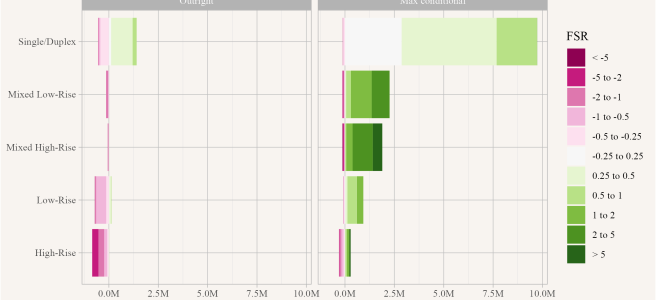
What if zoning was responsive to underlying demand to live in an area? That is, rather than reserving parts of the landscape for the exclusive use of those who can afford an entire underlying lot, what if we instead allow people to build enough residential floor space on the lot to share? This exercise sets up a kind of counterfactual, enabling us to get a look at both: a) what underlying demand for floor space on a lot actually looks like, and b) how our current zoning regime sets itself up to protect the most privileged from having to fully compete with this demand.

Continue reading

Migration and Housing Costs

Co-authored with Jens von Bergmann and cross-posted at MountainMath

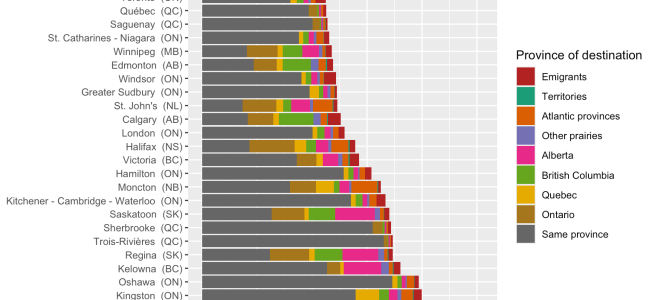
New data supports a common theme: Housing costs seem to be increasingly important as a determinant of long-distance migration, adding to their traditional importance within short-distance moves. But there are still some interesting caveats. We have a look at the data, compare it to what we know of flows, and think through some of its perhaps unexpected implications.

Continue reading

Zoned Capacity – promise and pitfalls

(Joint with Jens von Bergmann and cross-posted at MountainMath)

Is there room for new housing? There are lots of ways to try and get at this question, driven by a variety of different value calculations (e.g. if you need housing you might look around and see room for more of it everywhere, but if you’re well-housed and like your neighbourhood just the way it is, then you might think there’s no room at all). But this can also be transformed into a technical question, where we can pin a definition down to potential methods for making more room. Here’s where we start to talk about planning concepts, including zoned capacity. Is there room for new housing in municipal planning practices and regulations?

Continue reading

What if recent apartment buildings in Vancouver were 20% taller?

(co-authored with Jens von Bergmann and cross-posted at MountainMath)

Earlier this year a report from the NSW Productivity Commission in New South Wales, Australia, included a useful estimate to illustrate the harm that’s being done by height restrictions in Sydney. We thought it might be helpful to replicate the analysis for the Vancouver context.

Taking ideas from the report we set up a simple counter-factual question:

What would rents be if every apartment building built in Metro Vancouver over the past five years had been on average 20% taller?

TL;DR

We estimate that planning decisions preventing apartment buildings built in the past 5 years in Metro Vancouver from being on average 20% taller are resulting in an annual redistribution of income from renters to existing landlords on the order of half a billion dollars across the region via higher rents.

Continue reading

Housing Targets

(co-authored with Jens von Bergmann and cross-posted at MountainMath)

Municipalities in BC are required to submit Housing Needs reports, and integrate these into Official Community Plans and Regional Growth Strategies in something resembling housing targets. The BC Housing Supply Act now sharpens this process and adds some teeth, effectively enabling the province to define housing targets, accompanied by new provincial enforcement mechanisms, where the province selects municipalities not meeting housing need. Left unstated are the details of precisely how we should go about calculating housing needs or housing targets.

Continue reading

Metro Vancouver Planning Regimes

(co-authored with Jens von Bergmann and cross-posted at MountainMath)

In a previous post we looked at the history of planning regimes in the City of Vancouver. Similar shifts happened in other municipalities in the region, and they also fit into a broader shift in planning at the regional level. Regional level planning is less concerned with zoning and the regulations that govern housing production, and more with coordinating services and the broader guiding principles applying to municipal policies. Service provision means regional level planning has an interest in keeping track of population. But how far does that interest go?

Continue reading

A Brief History of Vancouver Planning & Development Regimes

(co-authored with Jens von Bergmann and cross-posted at MountainMath)

Say you want to construct some multi-family housing in Vancouver. How long will it take? The answer is simple: it depends. There are many factors upon which it depends. Here we want to highlight one in particular: when you started.

As it turns out, it used to take a lot less time to build multi-family housing. There is reason to believe we could reduce that time again, but getting there involves gathering a better understanding of our current development regime, and placing it in historical perspective. We begin this process below, before diving deeper into two case studies of developments along Alma Street, located very near one another in space, but separated by some fifty years in start time. We’re going to look at the 14 storey rental building currently under construction at the intersection of Alma and Broadway, and the 12 storey rental building built in 1970 two blocks to the north at 3707 W 7th Ave.

Continue reading

Analyzing Ballot Composition in Vancouver

(Co-authored with Jens von Bergmann and cross-posted at MountainMath)

So we recently had an election in the City of Vancouver. Citizens elected a new mayor, ten council members, park board and school board, giving a majority to the centre-right leaning new ABC (A Better City) Party candidates for each (full results posted by the City). There are a variety of narratives out there about how it all went down. Here we’re interested in examining a couple of them in further detail using the recently released individual ballot data (all ballots remain anonymous, of course). Of note, the mayoral vote is straight-forward, each voter got to vote for one mayoral candidate. The council votes are more interesting. There voters could choose up to 10 candidates. For this post we will focus on council votes, but we’ll return to examining how they relate to mayoral votes.

Continue reading