Housing is a Housing Problem

Co-authored by Jens von Bergmann and cross-posted at MountainMath.

The main housing problem in Canada is that there is not enough of it. We can see this by looking at prices and rents, but also by looking at people’s living arrangements and rates of doubling up. Doubling up is a direct measure of housing hardship that should get tracked on a regular basis. It also serves as an important compliment to traditional affordability metrics used in Canada that suffer from collider bias that makes it difficult to use them to track progress in solving housing problems. We also develop long timelines to track household formation and doubling up in Canada over the past 80 years to demonstrate the rapid undoubling during the first half of that time period, followed by a reversal to increased doubling up in most of Canada over the latter half.

Continue reading

No spike in “foreign buying”

Co-authored with Jens von Bergmann and cross-posted on MountainMath.

Today the Globe and Mail published an opinion piece about continued flows of “foreign money” in B.C. real estate. Broadly this is a topic that has been discussed in BC for over a decade now and regularly pops up in the news. We’ve written extensively about the slipperiness of the “foreign money” discourse in our paper on Canada’s turn toward Housing Nationalism (Lauster and von Bergmann 2023) (ungated version here). There are a number of conceptualizations of “foreign” in the public discussion, as well as in data sources, policy and law as it applies to real estate holdings and purchases. Our paper describes how the flexible use and application of the “foreign” label plays an integral role in keeping anti-foreign narratives and sentiments alive.

The G&M article continues this pattern, not just mixing and matching concepts but outright misrepresenting the groups targeted by the federal Foreign Buyer Ban and the BC Foreign Buyer Tax. Moreover, it leads with the claim of a “spike” in the value of foreign buying, continuing to push the narrative that our housing problems are driven by foreign origins. We will leave it to our article on Housing Nationalism to criticize this broader framing. For now we will demonstrate that the claim about a spike is wrong, and seems to be based on an error in summing across months in BC data.

Continue reading

No Shortage in Housing BS

(Joint with Jens von Bergmann and cross-posted at MountainMath)

Say you built a bunch of housing in a cornfield in the middle of rural Iowa. Would people come to live in it? Maybe. But probably not. Let’s imagine the same scenario scooted over to Vancouver. The conditions for our little field of dreams have changed. Here we’re pretty comfortable predicting: if you build it, they will come. Housing limits population growth here in a way it does not in rural Iowa.

Continue reading

Recent Sightings

A round-up of recent sightings on-line (cause where else am I gonna show up?)

June through July saw me presenting at the Canadian Sociological Association (CSA) meetings, joining a panel presentation with the Vancouver City Planning Commission (VCPC), and giving an invited talk with the QMI / Urbanarium Urban Lunch Series ahead of the forthcoming visit by Alain Bertaud. Details, Abstracts, Slides, and Video Links (where available) below!

Continue reading

Vancouver’s Crime Pandemic! That wasn’t.

We now have over six months of pandemic conditions in Vancouver and crime data to (roughly) match. We also have all kinds of claims about crime flying around, sometimes pushed by the police (VPD) themselves, only heightened by click-seeking reporters and the vote-seeking politicians. So we should probably check into the data. Long story short: there’s scant evidence of a crime wave showing up in the VPD crime data.

Continue reading

Wealth vs. Income

co-authored with Jens von Bergmann & cross-posted over at MountainMath

Wealth and income are different things. Wealth is measured in terms of assets minus debts at any given point in time. It can accumulate or deplete over a lifetime and across generations. By contrast, income represents some variation of how much money one makes over a given time period (usually a year). Most people get this on some level. But since both income and wealth deal with people and their money, the terms are also often used interchangeably. So it was that the CBC yesterday reported that “B.C. budget 2020 promises new tax on wealthy to help ensure future surpluses” despite the actual new tax being a tax on high-income individuals. Continue reading

Running on Empties

(co-authored with Jens von Bergmann and cross-posted at MountainMath)


A spectre haunts housing policy. The spectre of empty homes. So how many empty homes are out there?

Unfortunately, inept analyses of census data often leaves us with incomplete, or even worse, completely wrong answers to this question. When we get data on empty homes for a given city, they’re seldom put into comparative perspective. What’s worse, sometimes when they’re put into comparative perspective, they’re compared with the wrong data and picked up by credulous media, spreading misinformation. So let’s try to do it right!

Here we want to compare some big metro areas and cities in Canada with similar metro areas and cities in the US. As a bonus, this comparison sheds some light on our incomplete data in Canada, and why empty homes have managed to become so central to Canadian housing discussions.

Empty homes

In Canada we only have one national measure of empty homes, the Census. It estimates the number of dwelling units that are not occupied on census day. It does not offer any insight to why those homes are not occupied. Nor is it part of the standard release data, for most censuses it is only available as a custom tabulation. However, the related number of homes not occupied by usual residents is part of the general census release data and available down to the census block level. It is given by the number of dwellings minus the number of households (aka “occupied dwelling units”), so it includes dwellings that are occupied by people who usually reside in a different “household.” To understand what that means we need to remind ourselves that the census counts people, and tries to count them only once. And each person belongs to exactly one household. This gets tricky for people that call several places their “home”, for example a student that rents an apartment near university but also lives with their parents during summer, or someone working in Fort McMurray for months at a time but lives with their family elsewhere during work breaks. These people may think of their family’s home as “home”, and the other place as “temporary”. In the census, the “temporary” home will be counted as “occupied by temporary residents” and not count as a “household,” as their main household is elsewhere.

Canadian numbers

Canadian data is pretty simple. To start off we look at Canada’s major census metropolitan areas by their share of unoccupied dwellings. For context we also show the temporarily occupied units. We get a range of unoccupied households somewhere between roughly 2% and 10%, with most bigger metros hanging toward the middle, between 4% and 8% (or what the Lincoln Land Institute considers the desirable range of “reasonable vacancy”).
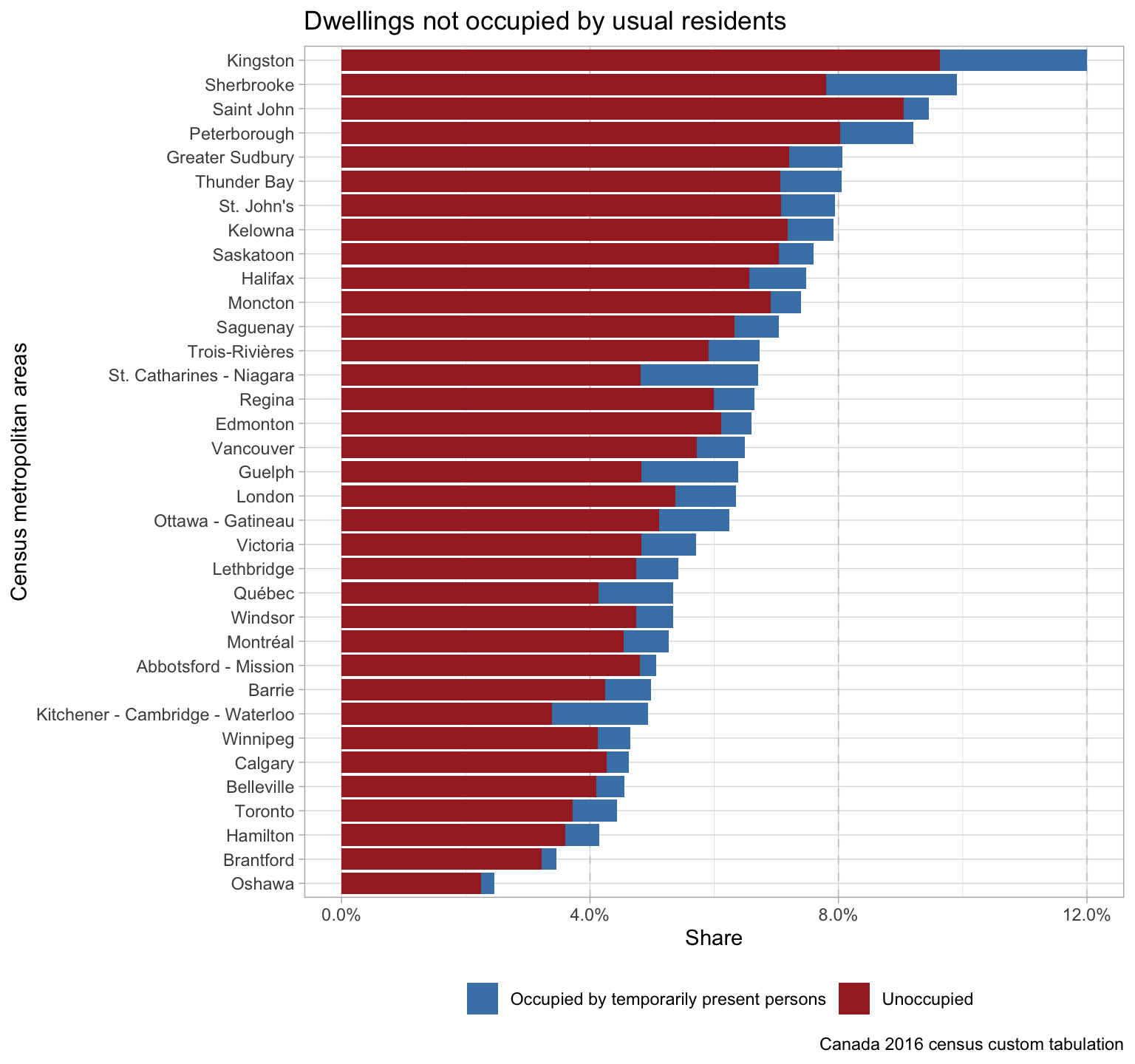
 

Fig1

We can also look at municipalities, keeping in mind that the comparison across municipalities is inherently difficult as different municipalities play different roles within (or outside of) metropolitan areas. Here’s a selection of municipalities, including the boundaries for the old (pre-amalgamation) City of Toronto, just for kicks. Note that municipalities still tend to hang between the 4% to 8% reasonable vacancy range, but the high share of temporarily occupied homes in Waterloo stands out, likely a function of students making up a large share of the town’s population.

Fig2

US Data

US data on unoccupied homes is available from multiple places. Here we use the American Community Survey as similar to the Canadian Census. (But see also the American Housing Survey for fun cross-referencing).

Fig3

US data is great in that it adds important context to unoccupied units, specifying the reason the unit is unoccupied. This context is often completely absent from Canadian housing discussions. It clearly splits out the transactional vacancies, (units for rent or for sale), from moving vacancies (units sold or rented, but not yet occupied), from recreational vacancies (units for recreational, seasonal or occasional use), from other vacancies (not otherwise accounted for).

The range for US Metropoles is also much higher than for Canada, running 12% and higher in the seasonal vacation-oriented metros of Florida, Arizona, and Southern California. Just below these metros sit some of the rust belt metros (Pittsburgh, Detroit, St. Louis) that have lost population, resulting in higher “other vacancies” from homes left behind. Houston seems driven by a high proportion of dwellings available for rent. Overall the data show that many empty homes may be accounted for by these kind of transactional vacancies and moving vacancies, together comprising vacancies we might also think of as good vacancies insofar as they enable people to move between homes to find the best fit. Down toward at the bottom we see just under 5% in the Twin Cities of Minnesota.

Overall, vacancies tend to be higher in the US than in Canada. As unoccupied dwellings rise much above 5%, they seem to be increasingly explained by recreational vacancies and other vacancies. A baseline of other vacancies remains largely unavoidable (e.g. homes under major renovations, tied up in court cases, etc.), and also appears to include people showing up as temporary residents in Canada. We can use ACS data on Usual Residence Elsewhere to provide figures similar to what we get in Canada, comparing all North American metros on roughly the same basis. Here we’ll just show the 14 biggest US metros along with the 6 biggest in Canada.

Fig4

Overall Canadian metros tend to have lower vacancy rates (combining unoccupied with temporarily occupied) than US metros. Seasonal destinations (Miami and Phoenix) – that also provide second homes for many Canadians – top the vacancy rates for large metro areas, followed by a diverse mix of large metros. Edmonton and Vancouver, though high for Canada, fit very comfortably in the low end for the US (running from Seattle to Boston), while Toronto, Calgary and Montreal occupy the bottom.

What of the bad kind of vacancies, often associated with second or higher order homes for the wealthy or holding properties off the market for speculative purposes? Empty Homes Taxes and Vacancy Taxes in Vancouver and BC attempt to target just these kinds of dwellings, and so far they indicate that just over 1 in 9 unoccupied units end up getting taxed as second homes or otherwise vacant without defensible cause. Vacancy data from the US suggests that were such taxes imposed in places like Miami, that figure would likely be a lot higher. But Miami markets itself as a seasonal or vacation destination.

Vancouver’s Empty Homes Tax covers the City. BC’s speculation tax covers a region larger than cities or even any given metropolitan area. Just for kicks, let’s peek in on counties, a unit of governance in the US with no firm equivalent in Canada. Weirdly, counties can contain portions of cities, like New York County, which contains only the island of Manhattan within NYC. Sometimes counties are the same as cities, as seems to be the case for San Francisco county. Other times counties are a little larger, as with King County (containing Seattle). Sometimes they’re much larger, as with LA County. How heavily would vacancy taxes likely fall in these various counties? In the counties acting like metropolitan areas, including King County and LA County, overall unoccupancy rates are similar to Metro Vancouver. Vacation homes would likely be hit unless deemed ineligible for year round use. Some, but not all, other vacancies would likely be taxed. The vast majority of empty units probably wouldn’t remain empty long enough to trigger taxation. Counties containing Manhattan and San Francisco, with much higher seasonal use, would probably be hit much harder.
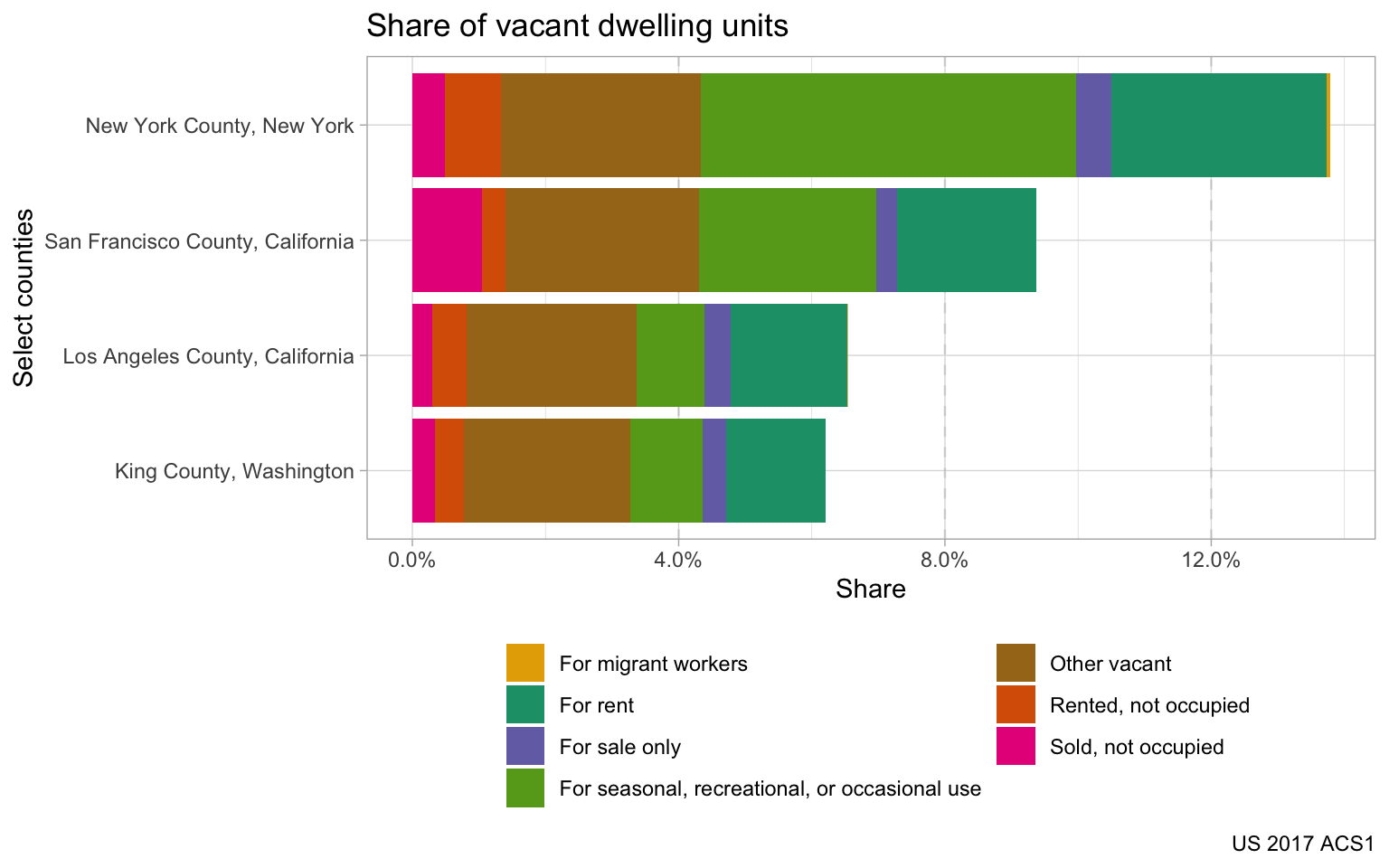
Fig5

Altogether, unoccupied dwellings are broadly similar between the US and Canada, with slightly more dwellings showing up as unoccupied in most metro areas to the south. Lots of municipalities, regions, and counties might profitably consider Empty Homes or Vacancy Taxes. But most unoccupied dwellings in most metros wouldn’t be much affected by them.

Code linked at GitHub!

Gateway Communities of Vancouver

Gated Communities are kind of awful, but the communities that form at GateWAYS are actually pretty cool. In a world of immigration, that’s where we tend to get a lot of our diversity.

As Canada’s Gateway to the Pacific Rim, Vancouver is fortunate to be full of Gateway Communities, both as a central City and as a broader Metropolitan Area. Nearly half of Vancouver’s residents were born outside of Canada. Where do they come from? All over, but we get especially large representation from across Asia. Media stories tend to focus on Chinese immigrants to the area, where Mainland immigrants have recently overtaken historical streams from Hong Kong and Taiwan. But the streams from China constitute only a minority of Asian immigrants overall. Large streams from the Philippines, India, Iran, South Korea, and Vietnam also pour into both the City and Metro region of Vancouver. Other streams from the UK and Europe, the USA and the Americas, and Oceania (especially Australia) build upon the proximity and colonial legacy of Canada. Relative to the descendants of settlers past, First Nations and other Aboriginal identified Canadians make up only a small proportion of the area’s residents, though their cultural impact is profound and local First Nation bands are emerging as a development powerhouse in the area.

Let’s draw upon Statistics Canada’s community profile data from the last Census (2016) to put this all up for comparison:

Metro-City-Immig-2016

The City of Vancouver and the Metro Region have similar aboriginal identified populations. There are slightly more settler descendants in the surrounding municipalities than in the City of Vancouver proper. Non-permanent residents, including those on student and work visas, round out the population, and are slightly over represented in the City of Vancouver relative to the Metro area as a whole. In terms of immigrant Gateway Communities, the City of Vancouver and the Metro Region as a whole are relatively well-matched. The big exception is that the City of Vancouver has historically added more immigrants from China than the region as a whole, which has added more immigrants from India. For recent migrants, this trade-off has shifted. Now the City of Vancouver and the Metro Region add about the same proportion of immigrants from China, but where the City of Vancouver loses immigrants from India, it adds immigrants from Europe and the Americas (especially the UK and the USA).

Metro-Suburbs-RecentImmig-2016

We can break out a selection of suburbs by their recent immigrants to see where people are going. Immigrants from India tend to favour Surrey as a destination. Richmond received outsized attention from Chinese immigrants. North Vancouver selects for Iranian immigrants. Also, North Vancouver, like the City of Vancouver, seems to select for immigrants from Europe and the Americas. As pointed out recently by Kishone Roy and in the past by others, American immigration to Vancouver probably hasn’t received as much attention as it should! Especially since the USA’s Federal Voting Assistance Program believes Vancouver houses more American citizens abroad than any other world city! (Given that the Census only shows 26,445 immigrants to Vancouver born in the USA, many of these Americans abroad are undoubtedly dual citizens who were granted citizenship from past residency in the USA or from their parents).

OverseasAmericans-2016

As demonstrated by the difference between citizenship and place of birth in the case of ties to the USA, just looking at place of birth doesn’t fully represent the nature of Gateway Communities. The same issues certainly arise in comparing those born in Hong Kong to the much larger community claiming ties to Hong Kong. Aside from place of birth and citizenship, there are other ways to think about and chart the diversity gathered in Vancouver by virtue of its Gateway status. Immigration often produces linguistic communities, that are sometimes (but not always) passed between generations of immigrants. How many languages have 5,000 or more speakers in Metro Vancouver?

Metro-LinguisticCommunities-2016

The wonderful thing about looking at languages is that it helps break down nations into their component parts. Cantonese, once the dominant Chinese linguistic community in Vancouver, must now share with Mandarin. But Wu and Min Nan linguistic communities also remain vibrant and point toward the diversity within China as well as the Chinese diaspora. Similarly, we get a lot of immigrants from India, but we get an especially large number from the Punjab. When they arrive, they pass on Punjabi between generations. Far fewer speak Hindi, despite its dominance in India. We also see multiple linguistic communities from the Philippines, with both Tagalog and Ilocano having over 5,000 speakers. The vast majority of residents speak English, but French is also relatively common and a diverse cast of other European languages find a home in Vancouver.

Let’s look at the diversity of Vancouver in one more way. Instead of thinking about how different communities measure up to one another in Vancouver, let’s see how they measure up to their sending countries. In some ways this is similar to the study of Americans abroad carried out by the USA’s FVAP above, but we’ll put it in context of the population of sending country. How many people immigrate to Metro Vancouver per million people living in their homeland (i.e. country of birth)? This gives us a rough sense of the “risk” of moving to Vancouver and/or its “pull” upon various places around the world. We can look at both total immigrants born elsewhere and just recent immigrants, having arrived in the five years prior to the 2016 Census (2011-2016).

Metro-ImmigrantsPerMillionHome-2016

In terms of “pull,” Hong Kong is the hands-down winner. There’s at least one Hong Kong transplant living in Metro Vancouver now for every one hundred residents of Hong Kong. The pattern is similar, if less pronounced, for Taiwan. But Hong Kong and Taiwan are also (kind of) cheating. They are both still considered part of China in many respects, though their historical patterns of connection to Vancouver are far more intense. For more recent immigrant streams, the connection is less pronounced, but still there. The recent pull from the Philippines contends with Hong Kong, and along with South Korea and Iran, conspires to beat the pull for recent immigrants from Taiwan.

In terms of “pull” for recent migrants, about twenty-six Chinese in a million immigrated to Metro Vancouver between 2011-2016. This means Mainland China lags far behind Hong Kong, Taiwan, the Philippines, South Korea, Iran, the United Kingdom, and all of Oceania in terms of risk of immigrating into the region. But, of course, there are a lot more people living in Mainland China than any of these other places.

There aren’t that many more people in China than in India. India’s patterns of immigration to Vancouver are somewhat deceiving. Most arrivals are from the Punjab region, and the numbers belie the importance of Vancouver to the Punjabi Sikh diaspora. Looking just at residents of Vancouver with knowledge of Punjabi who were born abroad, the estimate for how many Punjabis have moved to Vancouver sits around 3,000 per Million residents of the Indian Pubjab, placing the “pull” of Vancouver for this particular region inbetween the pull for Taiwan and Hong Kong.

Overall, this is a reminder that the Gateway Communities of Vancouver are strikingly diverse. Ideally media stories should strive to avoid erasing this diversity when talking about how immigration affects the City and the region. ALL of these collectives offer the possibility for meaningful communities to form, gathered together here in Vancouver, just inside the Gates to Canada. Considered all together, they help keep the Gates to Canada open.

There is no Brain Drain, but there might be Zombies

co-authored by Jens von Bergmann & cross-posted at MountainMath & (as of Feb 8th) updated with slightly better mortality estimation


Zombie attack! Zombies fleeing Vancouver want to eat your brain… drain… or something.

A couple of weeks ago The Canadian Press reported a story asserting that young professionals were leaving Vancouver because of the high cost of housing. This fits in with a common zombie refrain that we hear from the media. It’s a story that just won’t die, no matter how many times it’s proven wrong: Millennials, or young people, or boomers, or people important for some other reason are leaving Vancouver because of housing. Usually there are supporting anecdotes, and indeed, it’s not too hard to find people leaving Vancouver who will tell you about their frustrations with housing. But here’s the thing: there is almost never supporting data that actually indicates a decline in people worth caring about. Why? Two reasons. First, in growing cities, like Vancouver, when some people leave, even more people come in to replace them. Second, ALL people are worth caring about.

If we set aside that ALL people are worth caring about – just for a moment – we can take up some important questions about differences in in-flows and out-flows of people in Vancouver. Maybe there are aspects of in-flows and out-flows that should trouble us. In The Canadian Press story, we’re led to believe Vancouver is experiencing a brain drain, so that all the smartest and best people are somehow leaving and they’re either being replaced with people who are not so smart OR they’re not being replaced at all. As noted above, Vancouver is growing. So we know whoever leaves is being replaced, and then some, by new people coming in. But are the people arriving in Vancouver somehow less brainy than those leaving? We’re both immigrants to Vancouver, and quite frankly we find that a little offensive. Everyone arriving in Vancouver has a brain, so population growth cannot result in a brain drain. But we set aside, for a moment that idea that ALL people were worth caring about. So let’s try putting differences in in-flows and out-flows in slightly less offensive terms by returning to the “young professional” framework. Are people arriving in Vancouver unable to do the same kind of professional work as those who leave? Are we losing out on educational credentials?

Ideally we could easily access direct information on in-flows and out-flows to Vancouver (and in some places with population registry data, this is easily accomplished). In Canada we work mostly with census data, and the out-flow data, in particular, isn’t generally made public. But as we’ve demonstrated previously, we can compare across censuses to get net migration data broken down by age group. We just age people forward from one census to the next and compare how many we see in the next census to get a sense of how many people – in net terms – must’ve moved in or out over the years in between.

Now if we’re interested in education then it complicates age-based net migration models. After all, people can and do acquire new educational credentials as they age forward in time. That said, we can probably assume that most people who acquire university degrees and more advanced credentials do so by age 25. We’ll leave out some late achievers, for sure, but if we assume we have a pretty stable division into those with a completed Bachelor’s degree or more, and those without by age 25, then we can get a sense of how those populations change as they age forward in time. So, with apologies to late achievers, that’s what we’re going to do.

We’ve got ten year age groupings by education to work with in 2016 data. So let’s go back to 2006 data for comparison. Is it plausible that we lost a bunch of “young professionals,” defined as people with university degrees, who weren’t replaced as they aged forward and left Metro Vancouver between 2006 and 2016? Data says… nope.

Prof-Updated-Mortality2

As a matter of fact, Vancouver added a lot more young university graduates than left. Young people with university degrees continued to arrive in greater numbers than they left well through their thirties and on into their forties (we like to think of forties as young). The age labels here refer to people’s “in between” age, that is the ages they mostly passed through between 2006 and 2016 (i.e., the age range each group was in 2011). It’s only once those with university degrees hit their fifties that we start to see a roughly even net flow out of in Vancouver. What’s more, this pattern looks very similar in other major Canadian metro areas. The only exception is Montreal, where people with university degrees really do stop arriving in their forties. But it’s probably not a housing crisis driving them out.

Strikingly, across the board, young people with university degrees are far more likely, on net, to move into our major metro areas than people without university degrees. In many respects, we should expect this. Professionals, in particular, are often drawn by their economic opportunities. Once they arrive anywhere, they’re often paid well enough that they have an easier time navigating local housing markets than non-professionals. Yes, professionals may also have higher expectations about what kinds of housing they deem acceptable than others, but people adapt. One of us has written a book with that theme. In the same way that professionals may drive gentrification, professionals are actually at LESS risk of displacement out of expensive places, like Vancouver, than are non-professionals.

Let’s double-check the results for Vancouver by looking at in-flow data. The Census provides information about where people lived five years before arriving at their current destination. Do we really see a lot of professionals moving into Vancouver through their thirties and forties? Yes. In fact, for “Skill Level A Professionals” this is exactly what we see. We don’t know how many are leaving from this data, but we know a lot of professionals are arriving – more so than in other occupational skill-level categories.

occupation-inmove-2

For mobility data the age group labels refer to people’s age in 2016. For an alternative view we can group non-movers and non-migrants (people that did move but not to a different city) together and show the makeup of each skill level by mobility and age group. Again we see that professionals tend to have higher shares of migrants than other skill levels, especially in our lower two age brackets. Those in occupations requiring only a high school degree or on-the-job-training are actually the least likely to come from afar.

occupation-inmove-3

Takeaway: we do not have to worry about a “brain drain” in growing cities like Vancouver. Moreover, we don’t have to worry about professionals leaving. Due to better pay, professionals are better equipped to deal with a tight housing market than most others. Building more housing would certainly give professionals more options to choose from, and we might want to relax our millionaire zoning to direct professionals toward competing with the independently wealthy rather than the poor and working class. But it’s the poor and working class we should really be worried about losing. More housing can lead to a more equitable city with room for people who aren’t well-paid professionals or independently wealthy. And if we want to prevent displacement, we should focus more on those actually at risk. That suggests both building more and promoting a LOT more non-market and rental housing.

Methods

There are some details to be explained when computing net migration data for professionals. We already noted that professionals might get degrees at some later stage in life, but that tends to bias our estimates toward lower professional in-migration. Furthermore, when computing net migration one needs to kill off an appropriate number of professionals to account for mortality as Nathan has explained in details before. We use BC mortality rates for the appropriate years and age groups for this, but that probably over-estimates mortality as educated people tend to have lower mortality rates. This would bias our estimates toward higher professional in-migration. We could adjust for that by reading into the literature to figure out the appropriate fudge factor, but the effect is so small that we just ignored this. We made some adjustement to how we compute mortality rates and now assume a 20% reduced mortality rate for people with bachelor or above, and according higher mortality rates for people below a bachelor. This is a very rough approximation of the impact of educational attainment on mortality.

Those interested in even more details we direct to the code for the analysis, where Jens is teaching Nathan how to code with R.