Zoned for the Holidays

(here’s a little piece I originally wrote for the UBC Sociology Newsletter as a seasonally themed op-ed style essay)

What if we treated every day like a holiday? Imagine prioritizing time with family, over and over again; repeatedly enjoying travel at its most crowded; eating so much rich food that we practically burst; and buying so many expensive gifts that we drive ourselves into debt, every single day!

I suspect it would be awful, and I actually like my family! It would also be bad for democracy, bad for our health, and bad for the planet, not to mention absolutely unaffordable. Yet all across North America, this is pretty much the ideal behind how we’ve fashioned our cities, at least since the first half of the twentieth century. Insofar as it matters, we’re zoned for the holidays.

Zoning is the primary legal force behind the sprawl of single-family detached houses we see choking off the older, denser workaday urban cores of every major metropolis on the continent. Most people live in single-family residential zoned neighborhoods, which we might also think of as Great House Reserves. Nothing but houses, houses, and more houses is allowed across the majority of our metropolitan landscapes.

All those detached single-family houses prioritize privacy and focusing time on our families, or at least one particular version of our families, to the exclusion of sharing more public spaces with those around us. The more we live in houses, the less we tend to encounter people different from ourselves, diminishing our sense of obligation to others. What’s more, to get anywhere interesting, or even just to get to work, people who live in houses tend to first have to get past many other houses that look much like their own. So they drive on roads clogged with other drivers. And travel to work isn’t optional, because living in a house is really, really expensive. In many cases, zoning for houses has been used to keep out the poor on purpose. Yet we all pay for houses, even people who don’t live in them.  That’s because houses take up a lot of land and eat up a lot of energy, leading to all sorts of broadly shared environmental costs. And living in a house isn’t even very good for us! People tend to be healthier when they integrate walking or cycling into their daily lives, and to do that, it helps to have places to go.

Could we build our cities differently? Are we ready to stop treating every day like a holiday? One answer might be found in Vancouver, Canada’s third largest metropolis. Over the last fifty years, Vancouver has moved farther and faster away from reliance upon the single-family house than any other metro area in North America. Indeed, as residents will quickly confirm, no one except millionaires can afford a house in Vancouver any longer. How has this dramatic transformation affected the people who live here? Well, let’s start with how the city is regularly ranked the most livable on the continent.

If you’re skeptical of the rankings, try talking to some of the residents. As one middle class apartment dweller recently explained to me: “I can walk to the end of my street and there are probably, at a minimum, thirty ethnic restaurants within three minutes of my front door. I overlook the ocean. Access to transportation, to work, it’s so central. It doesn’t matter where I go, I’m in the middle of everything! And yet, I feel like I’m in a tiny little community. I know all the shopkeepers. I know all my neighbors. It’s like being in a small town, but living in the center of a huge city. I really feel like I have the best of all worlds.” Vancouver is proof that alternatives to the house can be made imminently livable for all types of families as well as for those living alone.

Despite the travel, the cost, and the occasional family fractiousness, the holidays can be nice. But treating every day like a holiday is a recipe for disaster. In much the same way, living in a house can also be pleasant.  But it’s only one way to live the good life. Vancouver demonstrates there are many more versions of the good life worth considering. By prioritizing only one kind of dwelling in how we zone, most metropolitan areas are severely constraining our options.  What’s more, they’re driving us toward the least socially just, least sustainable, least healthy, and least affordable lifestyle possible.  Maybe it’s time to reconsider and open up our options. Maybe we should start building our cities for everyday life instead of zoning for the holidays.


Detachment and Democracy

In my book I suggest that houses make poor habitat for democracy. The big argument here, I think, is that houses tend to prioritize control over private space. In so doing they generally encourage detachment from public life. Houses suggest we can cut ourselves and our families off from those around us rather than investing in ways of figuring out how to live together. The “single-family detached” house reifies the notion that the only ties that matter are those of kinship, cutting off our obligations to the broader social world. As I describe in my book, and as further detailed in the work of historians like Frykman & Löfgren (see their excellent book Culture Builders) and John Gillis, this was a strategic move on the part of a rising urban middle-class in the late 19th and early 20th centuries. Housing was meant to serve as both a stage for demonstrating moral worth and a sanctuary from the moral claims of others (the latter rendered obsolete by the extension of market governance).

In a broader sense, most houses are surrounded by other houses. That’s a legacy of zoning, of course. But it tends to insure that even when residents leave their housing, they don’t have many public places to go, and to the extent they bump into anyone, their encounters tend to be with people much like themselves.* As described by a variety of political theorists (from Susan Bickford to Thad Williamson to the wonderful Iris Marion Young), who we regularly run into influences who we think we need to take into account in our politics. In much the same way that getting our news through social media tends to provide us only a very partial picture of the world, surrounding ourselves with similar people does much the same, and tends to lead us toward intolerance of difference.

So too many houses is concerning for collective projects like democracy. On a related note, there is a very strong correlation (r=0.82) at the state-level between the proportion of structures made up of detached houses and the proportion of votes that went to Donald Trump. Here’s the scatterplot:

trumpvote2houses

Housing data come from Census (American Fact Finder) 2010-2014 ACS 5-year estimates. Vote data comes from USelectionatlas.org (thanks Dave Leip), and of course is subject to change – especially as recounts get under way! And yes, the correlation is still quite strong if you remove Washington DC (r=0.74) or drop mobile homes (r=0.76), bivariate analyses I’ve already tried (all are defensible variations on the theme). I haven’t run the analyses yet, but at the county level, you’d likely get similar results, if not stronger. More urbanized counties voted heavily for Clinton, as you can see mapped out here (and let’s not forget that she won the popular vote).

So did the USA build its way to Donald Trump? There’s a correlation and a plausible connection, fitting with an alarming streak of intolerance running through the Trump campaign. But there’s also Vermont and New Mexico (one of my home states!), clear outliers from the pattern. Other stories might be told as well and surely will be in the months to come, but this one’s definitely worth keeping in mind.**


*-that said, suburbs are getting more diverse! See, for example, Christopher Niedt’s book.

**-for instance the historical association between racism and zoning in the USA is also worth noting, with the persistence of racism possibly playing a role in both the way zoning has configured the housing stock and the 2016 vote (see, for instance, Dorceta Taylor’s work on some of these connections)…

Muckraking and Making Better

We have some fabulous muckrakers working in Vancouver journalism. For instance, this story about luxury resort living and tax loopholes on Agricultural Reserve Land is really important stuff. Kathy Tomlinson, Ian Young, and a host of other local journalists in the muckraker tradition are doing really great work exposing some of the corrupting practices we see – especially those concerning local real estate. The role of good muckraking journalism is especially important for holding politicians accountable and insuring we get regulations that work and are properly enforced.

At the same time, there’s a danger that only doing and paying attention to muckraking moves us toward cynicism. That we think everything is getting worse. Even more maddening: that we can’t do much to make it better. That everyone is corrupt. That all processes are poisoned. That the world is going to hell in a handbasket.

Lest we forget: this is basically the narrative that propelled Donald Trump’s campaign and rise to power in the USA.  And here’s the thing: it’s false.

By and large, the world has gotten better for people. It’s still getting better for most people, a little bit every day. That doesn’t make the news, but it’s what we see in the data. Here’s Hans Rosling, a big data guy, making the case. As a bonus, it’s in Swedish (my dissertation was on Sweden – I miss the sound of Swedish being spoken – but don’t worry, there are English subtitles!):

Other Hans Rosling videos, with more of the data visualizations he’s rightly famous for, can be found here, here and here.

To be sure, there are still problems (e.g., Global Warming, Social Inequality, etc.). But we should take heart in how much humanity has accomplished, and move forward in the spirit of doing even better. In many respects, I suppose that makes me a progressive.But it’s more than just a belief. It’s what’s in the data.

Progress is definitely the big story we see in terms of things like life expectancy. For most people, life has been getting longer and better. We shouldn’t lose sight of this. Watch Hans Rosling, or play around with publicly accessible population reference bureau data if you want big picture stuff.

How does this matter in Vancouver? I see the same general pattern whereby for most residents things are getting better. (For example, BC has the longest life expectancy in Canada. Rents aren’t terrible.[**] Though stubborn, Core Housing Need is down from the 1990s. And millennials are not fleeing the city or metro area in droves). To be sure, we still have problems, and muckraking helps expose these problems. But there’s a danger that if we only get muckraking, we start to think Vancouver is a terrible place to live and it will never get better. We see some evidence of this kind of negative storyline inflecting discussions with young people in Vancouver. This is why it’s important that even as we acknowledge the important role of muckraking, we also need to celebrate Vancouver’s many victories and everyday pleasantries and push back against the idea that it’s a hellhole.

Because it’s not. It’s a pretty nice place to live.

And we can keep making it better. For everyone.*

*This was more or less the theme of my talk on “What we see in the media and what we see in the data” at the BC Non-profit Housing Association meetings in Richmond today.

[** – UPDATE – though wouldn’t you know it, the latest CMHC report on rents hit the media four days after I posted, demonstrating a big, 6.4% jump in rents in the past year. Rats! On the bright side, there are lots of new rental starts, so more units should be on the way. Definitely worth a look at the report.]

“Ride This Out” and Housing Summit Slides

In my last post, I combined a Leonard Cohen theme (“You Want it Darker“) with somewhat cathartic musings about the US election, in which the nation seems to have declared 2016 the Year of the Scary Clown. The next day, I found out Leonard Cohen had died.  Technically, he appears to have died before I wrote the post, which is important because I don’t want to risk causing the deaths of any other beloved musicians. On that note, here’s a bit more of a rousing theme about riding out the election results and getting back to work (please don’t die, Imaginary Cities!):

Also, the slides from my talk for the Vancouver Re:Address Summit on Housing and the Future of City Building have now been posted.* The background image is from a photo I took of a lovely mural over on Vancouver’s East Side, where the row of houses just doesn’t quite fit into the urban scene. Funny that.

*For some reason, I think whoever posted the slides thought my first name was “Michael”

You want it darker…

So America’s taken a turn for the dark, and a page out of the songbook of Leonard Cohen.

The vote suggests a turn toward a darker vision of America as it currently exists, painting a bleak picture of a rigged system put in place by a self-interested elite living side-by-side with a misled multicultural mob in the hellish cityscapes along the coasts.

I don’t recognize this vision. And I’m not sure how many others do. The polls failed us, suggesting somewhere between a 71% to 99%+ likelihood of a Clinton win (credit where it’s due, Nate Silver at least got the uncertainty right! I long suspected and hoped that Sam Wang was closer). We seem to have ushered in a new, dark age in polling, long feared, but until recently mostly postponed, at least in US politics.  Here, too, we’ve taken a turn for the dark.

And of course, we have no idea what Trump will do as president.He’s promised to “Make America Great Again,” suggesting a return to a glorious, and largely imaginary past. It’s true, income inequality during and after WWII, under FDR, hit all-time lows, according to Picketty and Saez, only to take off again in the 1980s under Reagan.

picketty-saez-incomeinequality

To be sure, much of the decline in income inequality seemed connected to a broadly prosperous working class and large manufacturing base. But I have a hard time seeing a Republican government successfully bring this back, especially given widespread antagonism to the unions that often made this work. I have a much easier time seeing Republicans attempting to “make American great again” by curtailing the rights of women and minorities. This, of course, is the vision of where the alt-right wants to take us, and it’s squarely in-line with the Trump campaign.  Here, too, America has taken a turn for the dark. Possibly very, very dark.

A Republican government will own the next two years (at least) and possibly longer. The (in my view likely) failure of this government to enact policies that will make anything better for either the vast majority of people who voted for them, or for those who didn’t may move us toward a political re-alignment in the long term, favoring some set of Democrats and responsible Republicans. But the temptation will be there for Republicans to instead pin the blame for their (likely) failures on imaginary internal and external foes. This temptation has basically been Trump’s entire campaign. It’s too easy to imagine it taking hold in a wider form, even if I hadn’t just read through Philip Roth’s excellent The Plot Against America this past year.  You want it darker?  It doesn’t get much darker than the macho victimhood of fascism.

If there’s an even darker lining to all of this darkness, it’s that Trump seems to be a liar, a con-man, and a narcissist. He hasn’t played well with his fellow Republicans. Who knows what he’ll do in power?  Maybe he’ll just use his position to enrich himself and sell more stuff. I fear he will try to make good on his promises, but I take some small, weird measure of comfort from his failure to do so in the past and the fact that I remain so thoroughly in the dark about how things will turn out.

You want it darker? We kill the flame.

Media Coverage of My Book

The Death and Life of the Single-Family House: Lessons from Vancouver on Building a Livable City (winner of the John Porter Tradition of Excellence Book Award from the CSA) has now been covered by:

BOOK REVIEWS (as of Sep 24th, 2018)

  • BOOK REVIEW: Housing Studies TBD – 2018 – Hazel Easthope
  • BOOK REVIEW: Contemporary Sociology 47(1) – 2018 – Brian J. McCabe
  • BOOK REVIEW: Journal of Urban Affairs TBD – 2018 – Wayne Beggs
  • BOOK REVIEW: Canadian Journal of Urban Research 26(1) – Summer 2017 – Joshua Evans
  • BOOK REVIEW: Choice 54(10) – June Issue (2017) – M. Gunter, Jr.
  • BOOK REVIEW: Spacing Vancouver (Feb 14, 2017) – Yuri Artibise
  • BOOK REVIEW: New York Journal of Books (Nov 28, 2016) – Marilyn Gates

TV/RADIO/PODCAST (as of Sept 30th, 2017)

  • Roundhouse Radio (The Real Estate Therapist, Sept 30, 2017) – Interview with Joannah Connolly.
  • Science for the People (podcast, Apr 28, 2017) – Interview with Rachelle Saunders
  • Metropolis (Metro podcast, Nov 28, 2016) – Interview with Luke Simcoe & Matt Elliott
  • Arts on Air (CiTR 101.9, UBC Arts podcast, Nov 28, 2016) – Interview with Rachel Sanders & Brittany Duggan
  • C-FAX Radio (1070 AM, Victoria, Nov 7, 2016) – Interview with Adam Stirling
  • CBC Radio (The 180, Oct 30, 2016) – Interview with Jim Brown
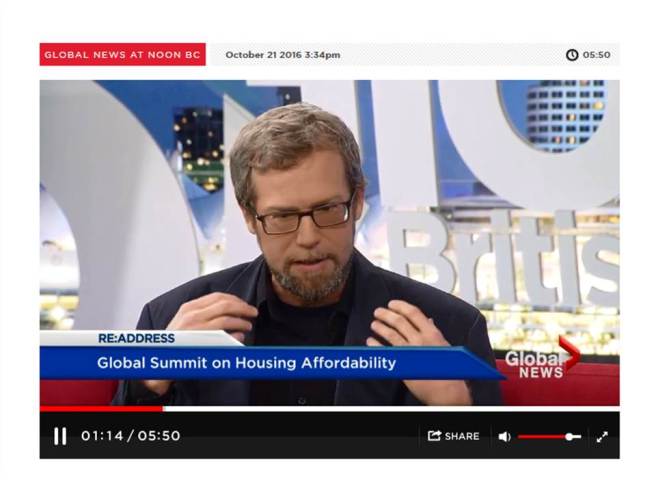
  • Global TV (Global News at Noon BC, Oct 21, 2016) – interview with Sophie Lui (re-posted Jan 19, 2017, in support of piece on home prices)
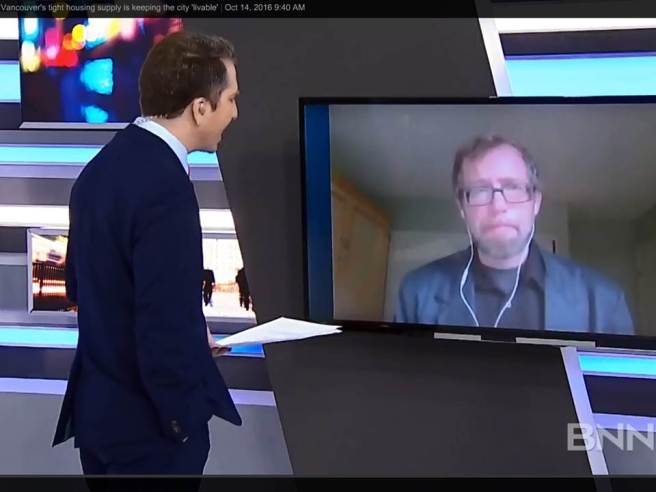
  • Business News Network TV (Oct 14, 2016) – interview
  • CKNW/Omni Radio (The Jon McComb Show, Oct. 12, 2016) – interview with Jon McComb
  • Vancouver Real Estate Podcast (Oct 5, 2016) – interview with Matt and Adam Scalena
  • CBC Radio (On the Coast, Aug 11, 2016) – interview with Stephen Quinn [listen to just my clip here]

PRINT/ON-LINE (as of Jan 6th, 2017)


BIG questions on Global TV

Including: do I really look like that?  Do I really sound like that?

globalnewstalkinghead

Actually, this turned out to be more of a pleasure than I anticipated. Even the make-up part! The make-up artist put me at ease and went out of her way to help me get some tea before my appearance. All in all, a very friendly crowd there at Global.  Click here for the full interview, or just click on the image above.

As noted, I’ll be providing a closing keynote address on Thursday for the upcoming Vancouver Re:Address summit on Housing Affordability.  My research and forthcoming appearance at the summit was also recently covered by Stephanie Ip at the Vancouver Sun (a former student – one of three now working in media who’ve recently interviewed me – how cool is that?).  What’s more, my own copies of my book finally arrived in the mail this week!  Hooray!  The roll-out keeps rolling along.  [UPDATE: and Christopher Cheung, another former student turned talented urban journalist, has a thoughtful write-up of my book here, fresh off the press!]

[UPDATE: I’m going to keep a more systematic list of media coverage below, mostly for my own purposes, and in order to keep the entire blog from focusing solely on my media blitz, but feel free to check out the links!  I’ve moved this to a separate, standalone post as of Nov. 1st]

The Death and Life of the Single-Family House: Lessons from Vancouver on Building a Livable City has now been covered by:

PRINT/ON-LINE

TV/RADIO/PODCAST

  • CBC Radio (The 180, Oct 30, 2016) – Interview with Jim Brown
  • Global TV (Global News at Noon BC, Oct 21, 2016) – interview with Sophie Lui
  • Business News Network TV (Oct 14, 2016) – interview
  • CKNW/Omni Radio (The Jon McComb Show, Oct. 12, 2016) – interview with Jon McComb
  • Vancouver Real Estate Podcast (Oct 5, 2016) – interview with Matt and Adam Scalena
  • CBC Radio (On the Coast, Aug 11, 2016) – interview with Stephen Quinn [listen to just my clip here]

Q&A on The Death and Life of the Single-Family House

Sandwiched between my teaching duties, my attempts to roll out the book, and my unhealthy obsession with the US election, I haven’t had much time to contribute commentary here on the blog about the many recent and ongoing developments concerning housing here in Vancouver, and across Canada more broadly.  Lots of new moves from taxing vacant homes in the City of Vancouver to tightening CMHC mortgage lending rules all across the country.

But back to my book…

DeathLifeHouseCover

…the roll out continues!  And today the book was featured in a UBC Media Release.  This was an edited Q&A, along with edited video of me talking in front of some houses in the University Endowment Lands (UEL).  For those interested, I’m providing the full Q&A below, with questions posed by UBC Media Relations (mostly the very helpful Thandi Fletcher):

In your book, you make the case that single-family houses are bad for the environment, urban vitality and people’s health. Why is this?

Let’s take these one at a time: With respect to the environment, the development of single-family houses directly consumes an enormous amount of land for suburban or ex-urban style sprawl, disrupting and displacing prior ecologies. By virtue of sprawl, houses also encourage people to drive everywhere, boosting greenhouse gas emissions. Moreover, houses generally require more energy to heat and cool than other types of dwelling, further leading to greater greenhouse gas emissions. Just about any way you look at it, single-family houses tend to be bad for the environment.

Strikingly, detached houses also tend to deaden city life. Houses are generally surrounded by more houses, with lots of private space and very little public space. Mostly you don’t run in to anyone you don’t already know. Urban vitality thrives when the private and public are more balanced: when people have places to go and things to do near where they live and they can walk or bike or take transit to get there. All of these ways of getting around put people in contact with one another and make for an engaging environment where people can go simply to watch other people.

Of course walking and biking are good ways to get around not just because they provide for more urban vitality. These kinds of activities are good for us because they keep us healthier. Denser, more vital, and more walkable environments encourage healthier habits. Single-family houses don’t tend to get us out and about as often.

A lot of people are still emotionally invested in the idea of owning a single-family house. They grew up in one and can’t imagine not also raising their families the same way. What do you say to them?

The first thing I say to them is that they are not alone. Culturally, many people have come to think of the house as an important symbol of success. Many others see acquiring a house as an important aspect of taking proper care of their children. No one wants to be viewed as a failure or a bad parent.

But the second thing I say to people who can’t imagine doing without a house is that they might try letting their imaginations run a little more wild. Vancouver actually provides a wonderful environment for re-thinking what’s important, both in terms of broader cultural understandings of success, and in terms of everyday aspects of livability. Most of the people who live here, including parents with children, have made a home without a house.

What’s more there is real strength in diversity. In that sense I won’t suggest a single optimal alternative to the single-family house. We have people who really enjoy high-rise living and others who thrive better in low-rise neighbourhoods. We have people who love the yard access and porch feel of some of our newer townhouses, and others who prefer the character of life in our older, subdivided mansions. There are lots of lovely ways to make a home, which is one reason we shouldn’t reserve nearly all of our urban land for only one way, like we do now.

Density is often perceived as a bad word in Vancouver. What is your response to anyone who is opposed to densification?

My first response is to bring history back into the picture. Densification used to be a normal part of urban growth, particular when land markets were left to their own devices. The prospect of having little control over one’s neighbours frightened residents of the city – especially the elites and those in the rising middle class. A factory or saloon could move in next door. The owner of a wealthy mansion nearby could subdivide their property and turn it into a hotel. These things happened a lot in old Vancouver. Single-family residential zoning was, in large part, an effort to preserve some space for residential life outside of the workings of the urban land market. So what I like to call a Great House Reserve was put in place all around the city.

So how did that turn out? Through subsequent regulation, city life became cleaner, quieter, and much more livable. Vancouver figured out how to do urban livability especially well, and more people here live outside of the single-family areas than in them. But taming the land market within the city led to its revenge in the suburbs. Single-family houses have moved well beyond the means of ordinary Vancouverites.

For those opposed to densification, I’d agree that we don’t need high-rises everywhere. We want to keep Vancouver both livable and diverse in urban form. But we still have way too many houses to encourage that diversity. Even though Vancouver is a leader in this regard, we’ve still set aside some 80 per cent of our residential land base to support single-family houses. That’s huge! At this point, we’ve got the power of the city, through these old zoning by-laws, keeping anyone but multi-millionaires from settling down in these places. I don’t think the city should be doing that.

Some people view condos as lonely places, and social isolation has come up often as a complaint among people living in Vancouver. What is your response to this? Could more condos make for a lonelier city?

There are lots of things we can encourage besides condos. Indeed, the City of Vancouver is encouraging more purpose-built rental buildings. In the past, we’ve also had a variety of programs that helped people form housing cooperatives. Cooperatives require people to work together to manage their buildings, directly countering social isolation. At the same time, they help preserve affordable living options in the city. We should be doing more of this to insure the choice isn’t simply between high-priced houses and luxury condos.

That said, there’s also no reason for us to believe that condos necessarily lead to a lonelier city. In fact, one of my livelier interviews involved a Vancouverite describing how close she’d become to her neighbours in her Yaletown condo building. She noted that everyone in her hallway left their doors open, and the kids ran back and forth between units, enjoying the communal nature of the space. Running counter to perceptions, many people described these kinds of communities developing in their buildings. More broadly, people also noted how they enjoyed running into the same people over and over at parks and playgrounds and local coffee shops. Generally speaking, mixed use urban density is a far better cure for social isolation than the largely privatized spaces of neighbourhoods dominated by single-family houses.

Do you think urban planners have made any mistakes in Vancouver’s development that have made the city less livable?

That’s an interesting question. There were some mistakes planners made everywhere across North America, and I would argue one of the biggest was creating the Great House Reserve and setting so much land aside for single-family houses. Beyond that, there were other mistakes planners really wanted to make in Vancouver, like bringing a freeway into the heart of downtown in the 1960s, that they were largely prevented from making. Since then the record of Vancouver’s planners has generally been far better, and I think they deserve a large share of the credit for the livability of the city. Vancouver has transitioned the furthest and fastest away from single-family houses of any major metropolis in North America while becoming a model for livability around the world. That’s a real achievement! But there are still issues that remain. The biggest of these is insuring livability for all residents, rather than just the most wealthy. Further enabling densification of single-family residential areas will go a long way toward opening up new market options for middle class Vancouverites. But we need a lot more non-market housing too.

What lessons can other cities learn from Vancouver on building a livable city?

I think Vancouver potentially has a lot of lessons to offer other cities. I like to think of these as building lessons. How do we move forward from the legacy of the Great House Reserves set up around cities all across North America? Vancouver figured out ways to build around this reserve, both in the old urban core of the city, and out in the hinterland. Buildings in the urban core provided the attractive living alternatives that characterize so much of Vancouver today. The big construction projects in the hinterland were the Agricultural Land Reserve and our many parks, which together protected much of the region’s land from further encroachment by suburban sprawl. Slowly but surely, Vancouver is also building over the old Great House Reserve, reincorporating this land back into the urban mix. Finally, Vancouver has renovated the very meaning of single-family residential neighbourhoods insofar as they’ve legalized secondary suites and laneway houses, transforming lots that initially could only support a single household into lots that can now support three. All of these building projects are things other metropolitan areas can also work toward.

Now on TV: My book!

My talking head is on TV!

bnn-screencapture

Today’s stormy weather and general traffic chaos kept my taxi to a downtown studio from arriving on time for a scheduled interview about my book with the Business News Network.  Nothing like a shot of adrenaline and frustration with a harried taxi-dispatcher (and really, what could she do?) to start my day.  On the bright side, we were able to work something out via Skype – not perfect, but it worked for most of the interview.  Here’s the link to the video segment.  I appreciated them having me on, though it wasn’t clear at the outset where they were planning on taking their questions for me.

In other news appearances, I was on CBC’s The Early Edition on last week, on Monday morning (Oct. 3rd), talking about the accessibility of ownership and its meaning for Canadians (based upon the recent Angus Reid Survey).  Here’s the audio!  (I’m on at the 01:41:20 mark with Kevin Falcon).  Again I had taxi issues!  But I ultimately made it down to the studio for the chat, and received a much-prized CBC mug for my efforts.

I also spoke with reporter Wanyee Li, at Metro News, about the problems facing renters in Vancouver, especially those who, like single mothers, often face discrimination by landlords.  This was based, in part, on an old study I carried out with Adam Easterbrook and my Built Environments class at UBC on housing discrimination across the metro area and the paper we wrote up entitled “No Room for New Families.”

Later on, Wanyee Li and I spoke again about the potential for densifying Vancouver‘s single-family residential neighbourhoods as a way of improving housing accessibility, touching on the new advocacy group Abundant Housing Vancouver that’s seeking to make that goal a reality.  She very kindly inserted another plug to the book there.

So my career as a media juggernaut is rolling along!  I’m partially using this blog post just to bookmark all of these appearances, but it’s also a heads-up, of sorts.  You can expect to see even more of my mug (or at least my name) as the month progresses.  My book, The Death and Life of the Single-Family House, rolls out next week – I’m expecting my hard copy in the mail any day now! – and I’ll be a keynote speaker at Vancouver’s Re:Address Summit on housing affordability on October 27th.  Sure to be a Halloween treat!


Reading and misreading Chinese immigration to Vancouver

Many of the reactions I’ve received to the recent write-up of my research with Jing in the Globe & Mail (and to my quick perusal of the comments section) seem to suggest that there’s something fundamentally dishonest and wrong about immigrants looking to make a better home for themselves in Vancouver.  I want to clarify that I don’t think this is the case.  The intent of my discussion with Frances was to make three things plain:

  1. Immigrants are people.  They’re a highly selected set of people, but they are fundamentally human.  This all too often gets lost in discussions about their impact on local housing.  That they’re mostly coming to Vancouver to make a better home for themselves is a fundamentally human thing to do.  And Vancouver is a great place to make a home.
  2. The selection processes concerning who gets invited to come to Vancouver matter.  Many (but not all) of these processes are policy-relevant.  Right now Canadian immigration policy selects heavily for “skill” and wealth (it is difficult to fully disconnect the two, though the skilled stream selects more upon our constructions of the former and business/investment streams have selected more for the latter).  The assumptions behind this selection are that these immigrants will most contribute to the dynamism of the Canadian economy.  As such, the policy is very much market-focused and oriented toward the business world rather than considering other motivations for immigration or broader questions about social justice.
  3. The selection processes concerning who makes a decision to come (or try to come) to Vancouver also matter.  Mostly those who make this decision already know (thanks to things like internet chat forums) that they will not have nearly as many economic opportunities in Canada as they already do in China.  If you’re really into economic dynamism and a high status career, you stay in China!  So most immigrants who come to Vancouver from China select themselves for being more interested in the quality of life in Canada. They want cleaner air, safer food, better and more sensitive education for their children.  They want a home life, where they can spend time with their children.  They also want a responsible and navigable bureaucracy, where they don’t need to know the right people or bribe their way to get what they feel they need.  These are all very human things to want, and they all involve appreciating what Canada has to offer – not free market dynamism, but rather careful restrictions and regulations placed around markets by a largely responsive government to make them work better for people.  [Yes, yes, Canada doesn’t always do this to my satisfaction, but compared to China we do it pretty well].

So mostly the people who select themselves to come to Canada are nice, home-loving sorts who really appreciate what Canada has to offer them.  But because of Canadian immigration policies (as well as the difficulties in navigating bureaucratic systems in China), they also tend to be quite privileged and well-off.  This is the world which my comment to Frances that, “Canada could look at letting in fewer millionaires and more refugees” was meant to reflect.  There are plenty of nice, home-loving sorts of people who would really appreciate what Canada has to offer them currently being excluded by Canadian immigration policies.  And many of them need better homes far more than the wealthy privileged folks we’re currently inviting to the country.  That said, I’m also quite sympathetic to letting in more immigrants period, and I don’t mean to suggest those who have already arrived are in any way undeserving.

So I’m not seeing villains, but are they out there?  Are corrupt officials, ruthless capitalists, and their extended family members also getting into Canada, and using immigration to hide their wealth?  This seems very likely.  There are corrupt officials, ruthless capitalists, and their extended family members from countries all over the world doing terrible things (I believe there might be one running for president of the United States at the moment).  And they often get away with it.  We should try and stop that from happening.  But I’d suggest these people are relatively rare, and they’re certainly a minority among immigrants to Vancouver.  Indeed, the folks we talked to were selected for rejecting that aspect of life in China.  They came to Canada to get away from cronyism and corruption.

So I think villains are quite rare, but it’s worth noting that the wealth flowing into places like Vancouver has had an enormous impact on local life. Housing prices, in particular, have risen astronomically, motivating much of the ire at new immigrants, especially those coming from China. We should acknowledge that regardless of the intentions of wealthy immigrants, they’re contributing to processes of gentrification on a global scale. It’s important that we work to figure out equitable ways of dealing with this  from a policy standpoint (I’m not sure the foreign-buyer tax qualifies, but I’ll admit it represents at least an effort).  But it’s also important that we work on this without demonizing immigrants.