When journalists attack!

Public intellectuals beware! Not everyone agrees with you, and some will be nasty about it. So how does it work when muck-raking journalists attack?

First some context: an observation of mine on twitter led to a little dust-up concerning the discourse around “foreign money” in Vancouver. I quickly muted the conversation, but it summoned many trolls, including the ghost of Margaret Wente (which paradoxically made me feel all warm & fuzzy, like I’d done something right). South China Morning Post reporter Ian Young, one of the chief troll-masters, decided to put out the equivalent of a journalistic hit on me. I suspect this is a pattern with Ian, given his past attacks on other public figures he disagrees with (like UBC’s Tsur Somerville). So I’m posting my responses here for future reference. Hopefully this will serve three purposes: 1) it may help keep Ian honest in his muck-raking; 2) it may have broader lessons for other academics who dare raise their voices in the rough and tumble public sphere; and 3) some people might actually be interested in my answers to Ian’s questions.

How things unfolded: After an initial relatively professional inquiry about getting my input on general issues (foreign money, racism, real estate), Ian sent me the following questions, which focus less on my input and more on my conduct, including both my tweet (which brought all the trolls to the yard) and my participation as an expert witness in a court case challenging BC’s foreign-buyer tax. But it doesn’t stop there. Read on if you’re also interested in strata wind-ups, because there’s a part two to the journalistic hit-story where Ian dives even deeper to try and find dirt on me!

Ian’s initial questions [in bold]:

  1. In your affidavit in the Jing Li case, you say the role of “foreign buyers” in the Vancouver real estate market has likely been exaggerated. How big a role do you think “foreign money” – specifically, Chinese money (brought by both immigrants and non-immigrants) –  plays in the Vancouver real estate market?

“Foreign money” is a problematic and sloppy concept, especially as applied to the wealth immigrants bring with them. I think immigrants play a strong role in driving Vancouver real estate, and we attract a disproportionate share of wealthy immigrants. We can talk immigration policy, and while I’m generally pro-immigrant (and an immigrant myself), I’m on the record against “investor” immigration programs. But when people immigrate to Canada, I no longer think of their wealth as “foreign.”

It would appear from data I’ve seen and analyzed, as compiled by the CMHC and Statistics Canada, that the role of people investing in Vancouver real estate while living elsewhere is a real but relatively small part of the local market. The evidence suggests local investors are far more prominent.

As for the issues of tax avoidance and money laundering (that people sometimes pretend only apply to “foreign money”), I take it for granted that these are bad things that should be ended regardless of how big a role they play in real estate.


  1. Can you elaborate on the role of racism in the debate over foreign money and Chinese money in the Vancouver affordability debate?

I believe a number of different logics or motivations have driven the debate over “foreign money,” which as I’ve mentioned, I consider a problematic and sloppy concept. Many people are drawn to the “foreign money” explanation as a ready answer to their understandable confusion over prices that keep them from obtaining housing they feel like their parents might’ve been able to afford or that they could still easily obtain in other parts of Canada. They’re looking for answers – especially answers that don’t make them feel like failures for not achieving their particular homeownership goals, which are often associated with middle-class success, becoming an adult, and being a good parent. In this sense, there’s a real moral and personal element to debates over housing. And people are right to look beyond their own circumstances for explanations into Vancouver’s affordability woes. It’s a very sociological instinct!

But blaming foreigners isn’t helpful and the distinction between foreigners and foreign money isn’t very clearly drawn, just as blaming Chinese people isn’t helpful and the distinction between Chinese people and Chinese money is fuzzy at best. Racism certainly plays a part in the popularity of “foreign money” discourse, and Vancouver has a long and troubled history there. But we’re also in a very broad-ranging and very real populist moment where a generalizable xenophobia has taken root around the world. It takes different forms in different places, but it troubles me wherever I see it. Then there are also dynamics that are quite specific to Vancouver and its waves of immigrants from Hong Kong and Mainland China (and to a lesser extent, from Taiwan). Many people from Hong Kong are understandably worried over the future of their home city, seeing both Hong Kong and now Vancouver as threatened by Mainland China. These worries are frequently expressed through anti-Mainlander prejudice. I don’t think the term “racism” captures all of these logics or motivations, but it’s part of a somewhat toxic brew that in Vancouver is often targeted at Mainland China and Mainland Chinese.


  1. Can you explain the continuum of racism in BC and what role it plays in government policies and public opinion relating to real estate here?

As you suggest in your questions, the debate about “foreign money” and “foreign buyers” was also particularized by many people as a debate about “Chinese money” and “Chinese buyers.” People moved back and forth between identifying Canadian sovereignty (vs. foreign) as their primary concern and targeting a particular nationality (“Chinese”) as a concern. My understanding is that anti-Chinese sentiment takes many forms, including those driven by race-logics and racism (and particularly prominent in Vancouver’s past), and those driven by logics and motivations internal to the Chinese diaspora that aren’t racial in nature, but rather reflect tensions with the Mainland. Anti-Chinese sentiment has historically played a very strong role in government policies in Vancouver and BC more broadly. Both governments have acknowledged and apologized for this, but I believe it would be naïve to suggest anti-Chinese sentiment no longer plays a role in driving policy.


  1. Regarding your “national socialism” tweet…were you offering a sincere observation, or being deliberately hyperbolic?

[See tweet here]

It was a sincere observation, but couched as a worry rather than an accusation. Indeed, I went out of my way to grant good motivations to those involved in the discussion. My worry involved an underlying transformation in logic. Socialist logics focus on privatized wealth & related inequality as a problem. National socialist logics veer far to the right by twisting concerns about inequality to focus on particular groups of people, demonizing them as enemies of the nation and identifying their wealth or perceived power alone as the problem. To return to our local discussion, it isn’t hard to find far-right, pro-fascist organizations cheering on discourse about “Chinese buyers” and “Chinese money” being to blame for Vancouver housing woes.  To put this in very simple and personal terms: if you think “foreign money” is the problem and you focus on the money part, I’ll be with you. If you think “foreign money” is the problem and focus on the foreign part, I won’t. This relates to what I think of as quite important underlying shifts in logic that are very pertinent to the present moment in time.


  1. Where do you want the policy debate over real estate affordability in Vancouver to go? What areas deserve more emphasis than addressing foreign money and foreign buyers in the market, as a means of improving affordability, and why?

The most important aspects of affordability in Vancouver often get the least amount of attention. Those people currently marginalized by the market distribution of housing, including the homeless and those living in core housing need, should receive the most attention. They are the ones for whom housing is a life and death matter. Temporary Modular Housing is a great move here, and that and related programs should be expanded. Next we should focus on renters. They’re the ones in dire need of more options (Vancouver’s vacancy rate being at 1%) and at most risk of falling into core housing need. There are lots of policy options here, and we should be creating way more social housing options, including a big expansion of non-equity cooperatives. We should also encourage and enable many more market options. Far behind these groups, we get to owners and those desiring to own. There are real benefits to having a very large and broad range of property owners rather than letting property ownership accrue only within a very small and select class. There are also real benefits to having lots of different kinds of housing stock that enable a broad range of options for people to pool their resources together and buy housing, while also encouraging more environmentally friendly lifestyles. I don’t think we need any more programs encouraging and promoting home ownership, which is too often where affordability debates take us, but I don’t think it should be discouraged either.


  1. What were the circumstances that led you to provide your affadavit in the Jing Li case?

I was approached by the law firm representing Jing Li to act as an expert witness in the case. Representatives of the firm very clearly and repeatedly assured me that as an expert witness, my duty would be to the Court rather than the law firm or their client. This was an important part of my decision to accept the role of expert witness. Through my work as an expert witness, I carried out research to answer questions posed to me by the law firm (through my letter of engagement), with my obligation being to provide truthful and well-researched (“expert”) answers to the Court.


The story continues

These were Ian’s first questions, and I initially agreed to delay blogging my answers until around the time Ian’s article came out. But after his first round of questions, Ian sent me follow-up questions focused solely on my conduct and concerning my former strata association’s wind-up and sale. He’d tracked down the buyers of the strata and apparently identified them as the very personification of evil “Chinese money.” So he sent me targeted questions about this being an unidentified conflict of interest influencing all of my public commentary. “It turns out that disagreeable professor was being paid by ‘Chinese money’ all along! Now we’ve got him!”

It’s a bit of a scoop! But not in the way Ian thinks. As I’ll discuss below, the strata wind-up was a complicated process that I felt ambivalent about, and I knew very little about the ultimate buyer. I’ve been planning on blogging about the experience of being part of a strata wind-up from the inside, but I’ve delayed for a variety of practical reasons. Now my story is in danger of being scooped by someone else! So let me tell you a little bit about what went down before Ian does whatever he’s going to do with his take.


What about my strata wind-up and sale?

My partner and I were initially quite angry when news broke that our strata council was considering looking at winding up the strata and putting it on the market. We liked our townhouse just fine, and we hadn’t been there very long. Ours was a mixed strata, comprised of townhouses and a low-rise building. The main issue seemed to be that the low-rise building was worried about their expenses, which were treated separate from ours, and wanted to compare estimates for fixing the place with what they could get for selling the place. We initially took this to suggest that the low-rise hadn’t been keeping up their building the way they should, and it didn’t seem fair that we in the townhouses should have to sell to cover their expenses. But then the possibility for big money from a sale also started getting thrown around in a lot of conversations with neighbours. Some were very excited by the prospect. Others were noticeably distraught that they might have to leave. After much discussion and many meetings, the strata as a whole voted to market the place to see how much it could sell for. Working with Colliers, we ended up with an offer that entailed a lot of money (around twice our assessed values). We knew very little about who made the offer, but the realtors told us it was a new developer with interests both in Canada and China. Then we had a vote on whether or not to accept the offer and wind-up the strata. My partner and I were conflicted in our voting. A lot of money was on the table, but we really liked our place and sympathized with those who wanted to stay. In the end our vote didn’t matter. The vote to sell easily met the threshold required under the new strata wind-up regulations.

There were minor complications throughout – it’s a big and involved process to wind-up and sell a strata – and we still weren’t certain the deal would go through for several months after the vote. In fact, we kind of hoped the deal would fall apart (especially when the flowers came out in our little townhouse yard!) But eventually all the t’s got crossed and the i’s dotted. And now we’re renters! (We negotiated a period of time in which we could rent back our properties while looking for someplace new to live).

Overall, the strata wind-up and sale is something that happened to us, rather than something that we actively sought. We weren’t at all certain we wanted it to go through. I learned lots from it, but it did not otherwise affect my public commentary* and I did not know who the beneficial buyers were until Ian sent me their names, nor have I ever had contact with the beneficial buyers. As in most real estate transactions, their identities were never anything more than a curiosity throughout the process. I remain curious, as ever, about what they’ll do with the place once we’ve all left. Until then, speaking as a tenant, if Ian wants to dig up dirt on my new landlords, I’ve got no problem with that.


*- There is one exception regarding the strata wind-up and sale affecting my public commentary! My partner and I are dual-citizens, and as a result we’ll be paying capital gains taxes on the sale to the USA, where sales of principal residence are not exempt from taxation. We don’t mind this in principal, and we kind of feel like windfall gains should be taxed. But we really, really wish our taxes were going to Canada. So its possible my advocacy for taxing the profit on sales of principal residences in Canada has been strengthened by the strata wind-up. Take my money Canada! Please!

Fact-checking Vancouver’s Swamp Drainers

[co-authored with Jens von Bergmann and cross-posted with MountainMath]

Swampy facts: the dark, broken, and ugly side of housing talk in Vancouver.

Down south of the border, a politician who shall remain nameless campaigned on “draining the swamp” of Washington D.C., trafficked in countless conspiracies, and lied his way into office. His lies painted a picture of a United States turned dark, corrupt and menacing. He promised to fix it, Making American Great Again, mostly by shutting down globalization and kicking out the immigrants.

In Canada, we like to think we’re immune to this kind of rhetoric. But a strain has made its way into discussions concerning Vancouver, where the intersection of real estate, politics, and globalization are increasingly portrayed as a swamp in need of draining. We don’t believe most of those portraying Vancouver as swamp-like are intentionally lying (and in real life they surely favour the preservation of environmentally sensitive wetlands). Nevertheless many commenters are muddying the discourse with poorly sourced claims as a means of scoring political points and attacking various aspects of globalization.

It’s tricky to track down the spread of all the false claims out there. Fortunately a bunch of them were concentrated in a recent piece on “Dirty Money” in Macleans by Terry Glavin that views Vancouver as “a case study in the dark, broken and ugly side of globalization.” Recognizing that getting facts and interpretations right is often difficult for even the most well-intentioned, let’s work toward correcting a few misperceptions, line by line:

“At least 20,000 Vancouver homes are empty, and nobody’s really sure who owns them.”

Variations of similar statements permeate the media, with various degrees of factual accuracy. The most common misrepresentation is to refer to the 25k homes not “occupied by usual residents” as “empty”, which the above quote avoids by using an appropriately lower number.

The main issue with the above quote is that it’s portraying those “at least 20,000” homes as problematic vacancies, neglecting that that count includes moving vacancies around census day, empty suites (about 4000 of them), and units in buildings that completed around census time and did not have the time to fill in yet.

Accounting for these types of vacancies, we arrive at the ballpark of the Ecotagious Study based on BC Hydro data that found between 10,800 (for year-long vacancies) to around 13,500 (for four-month vacancies) and now the 8,481 empty homes through the Empty Homes Tax declarations, although some of those empty homes found via the EHT are outside of the universe Ecotagious reported on.

When quoting these numbers, the key question is what are the numbers supposed to be used for. If it’s to highlight “problematic” vacancies, then the Ecotagious numbers probably get us the best estimate for that point in time. Since then the number has likely dropped due to Empty Homes Tax pressure, we will have to wait until the repeat of the Ecotagious study to get confirmation on by how much.

And the reason we don’t know who owns them is not for some nefarious reason but simply because the methods we have for estimating empty homes (other than the ones caught by the Empty Homes Tax) do not allow for the identification of units.

“Another 25,000 residences are occupied by homeowners whose declared taxable household incomes are mysteriously lower than the amount they’re shelling out in property taxes, utilities and mortgage payments.”

That’s plain false, we have looked at this before. The 2016 census counted only 8,940 owner households with higher shelter costs than income. An additional 14,510 renter households paid more than their income in rent and utilities, making for a total of 23,450 households in the City of Vancouver that had higher shelter cost than income, most of which were renter households.

The wording of the sentence, followed by the next talking about tax avoidance in British Columbia real estate, seemingly suggests that the majority of these 23,450 households were cheating in some way. Let’s take a closer look at these households with shelter cost higher than income.

One of us (Jens) is partially responsible for bringing this stat into circulation and failing to provide more extensive context from the get-go.

figure-chunk-1

Looking more closely, we see that the bulk of these households are non-census-family households, probably roommates in many cases. Students likely account for a lot of the data. Single parents are also common. While there are some indications of irregularities in the data worth investigating further, broadly suggesting all these households are tax cheats is irresponsible.

“Non-residents own roughly $45 billion worth of Metro Vancouver’s residential properties, and non-residents picked up one in five condominiums sold in Metro Vancouver over the past three years.”

The first part is fairly accurate, CHCP reports that $43 billion worth of residential properties in Metro Vancouver were owned by non-residents. Of course that’s less than 5% of the total value of $884.5 billion.

The second part is a prime example of making statements without understanding the data. We don’t have data on non-resident buyers, presumably referring to buyers with primary resident outside of Canada at the time of the sale.

Considering similar statements in an earlier article by the same author, our best guess is that the author was referring to non-resident owners of condos that were built between 2016 and late 2017. Owners of recently built condos could be taken as a proxy for buyers if one makes some assumptions on resales.

Except the ratio of condo units built between 2016 and late 2017 that were held by non-resident owners is one in 7.1 for Metro Vancouver, and for the City of Vancouver that the previous article was referring to the ratio is one in 6.5. (CANSIM 33-10-0003)

In summary it seems the original statement is the product of playing loose with definitions, Metro vs City mixup and aggressive rounding to pump up the numbers.

“But Transparency International reckons about half of Vancouver’s west-side residences are owned by mystery trusts or shell companies.”

Big if true, a claim so outrageous that it needs data to back it up. It seems that this is based on a transparency international report that the author also referred to in a February column, where the author characterized this as “Transparency International estimates that perhaps half of Vancouver’s high-end residences are now owned by shell companies or trusts”. Now this has morphed into “about half of Vancouver’s west-side residences”. It’s good to remember what the Transparency International study actually did, it looked at the 100 most expensive properties in Metro Vancouver and found that 46 of these were owned by companies or trusts (not all of which have opaque ownership).

Via StatCan’s CHSP (CANSIM 39-10-0003) we now know that 5.61% of Metro Vancouver’s residential properties are owned by companies or trusts (or “non-individuals”), roughly in line with most other Canadian metropolitan areas in BC and ON as the following graph shows. Needless to say, the 100 most expensive properties on Vancouver’s west side are likely quite distinct from the rest.

Even after adding the non-resident owners to the non-individual owners, Vancouver still looks a lot like most other metro areas. In fact, the only metro area that really stands out is London, ON. Otherwise it’s the non-metropolitan portions of BC and ON that have the highest representation of company and trust ownership structures.

figure-chunk-2.company_non_resident

“In Metro Vancouver, homeownership costs amount to 87.8 per cent of a typical household’s income”

It does not. Most people spend far less, as the following graph on share of income spent by owners on shelter costs demonstrates.

figure-chunk-3

The author appears to be conflating running shelter costs of owner households with the RBC affordability metric which compares the cost of financing the typical home for sale in the region to the typical household income. The latter metric may (imperfectly) reflect some of the difficulty now facing those wishing to jump from renting to owning, but has little bearing on how much typical households currently spend in either category.

“Vancouver has also become a major global hub for organized crime networks based in China.”

Here the author immediately pivots to the opioid crisis and the suspicious transactions identified in the recent money laundering report concerning lax oversight of casinos, attempting to link these to broader affordability issues and to globalization. To be clear, both the opioid epidemic and money laundering are serious issues in their own right. The fentanyl crisis has killed way too many British Columbians. As a recent report by Sandy Garossino notes, the criminal organizations associated with money laundering through BC Casinos have also claimed multiple lives. We should be outraged by the crisis and the crime ring, but it’s wrong, as Garossino adds, that this, “mainly bugs us because we figure it’s driving up the cost of housing in Vancouver.” The opioid epidemic demands more sustained attention than it’s likely to receive as a prop for tarring globalization. That’s not at all what it’s about. It requires a comprehensive re-think of our health care systems, pain management strategies, and criminalization of drug use, and the biggest villain in the story so far appears to be a major American pharmaceutical company. As for money laundering, further reporting on its role within the real estate sector has been promised by the Attorney General, but so far it’s not clear that shady practices – while certainly present – have had much to do with driving up real estate prices. As multiple commenters have noted, even if all the $100 million so far reported to have been laundered in our casinos over 10 years was re-invested in real estate, it would represent at most tiny fraction of total real estate transactions. Property transfer tax data shows that Metro Vancouver averaged $5.2bn worth of residential real estate transactions each month in 2017, dropping to $4.4bn during the first 5 months of 2018. There are real reasons to be outraged over the opioid epidemic and money laundering. But the link between these issues and affordability remains tenuous, and insisting upon the link in the absence of further reporting diminishes the importance of the documented damage they’ve already generated without pointing toward any good solutions for affordability, the opioid crisis, or tackling money laundering.

“Freeland could have been describing Vancouver: ‘Median wages have been stagnating, jobs are becoming more precarious, pensions uncertain, housing, child care and education harder to afford.’”

This is plain false. To its credit, back in February the NDP government moved to make childcare much more affordable for British Columbians. Why ignore this progress? Moreover, Vancouver has seen strong jobs and income growth. To gauge wage growth, we look at full-time employment income for couple families, lone parent families and unattached individuals and compare the trajectories to Metro Toronto.

figure-chunk-4

We see that Vancouver CMA has overtaken Toronto for non-family individual income and lone-parent median income, and almost closed the cap on couple family income.

figure-chunk-5

This shows how Vancouver’s labour force participation rate has increased with respect to Toronto while the unemployment rate decreased. Lastly we can look at the regional job vacancy rate for the respective economic regions to see how Vancouver’s job market is much stronger than the labour force is able to fill.

figure-chunk-6

Afterword

In our hyper-polarized environment it is probably not enough to simply point out factual errors without further comment. So we take this opportunity to state that we strongly support stricter oversight and enforcement of money-laundering, as well as implementing measures to increase transparency in property ownership. We are also gravely concerned about Vancouver’s affordability problems. We’ve supported a number of housing policies recently put forward by local governments, including the empty homes tax, the school tax, and the boost to social housing investments, all aimed at fixing regulation and providing more housing to those most in need. It’s important to separate out what governments are doing right from where they might be failing. This is where swamp imagery fails us, blending everything together and dragging it all into the mud.

We think fixing our affordability problems is going to involve making tough choices and policy tradeoffs, and we should approach them with a clear sense of what’s at stake rather than mixed up facts, vague swamp-ish imagery and the sense it can all be blamed on the dark, corrupting forces of globalization. We’ve all seen where that last route can take us.

As usual (for Jens), the underlying R Notebook for this post that includes all the code for the graphs and numbers in this post is available on GitHub. Feel free to download it to reproduce the analysis or adapt it for your own purposes. Hopefully this kind of transparent and reproducible analysis can help establish a shared base of facts. And reduce the amount of guessing needed to make sense of people’s numbers and statements.


Update (July 27, 2018)

Several people have pointed out via Twitter and comments that inflation-adjusted income growth might be a better metric to use. And that’s a good point. In the context of housing we often have nominal housing prices in mind, so nominal income can be a good metric in this context. But inflation-adjusted incomes add another important perspective.

figure-chunk-Add

Here we used Canada-wide inflation estimates, Vancouver’s income growth looks even stronger when normalizing by CMA-specific CPI. (Digging into the reasons for this would probably make another interesting blog post.) The two graphs show the inflation-adjusted incomes, as well as change in adjusted incomes indexed to 2000. We can clearly see the growth in all categories, both in absolute terms, as well as in relative terms compared to Toronto. Despite this, the notion of “stagnant incomes” in Vancouver is quite pervasive in news stories.

Notes on the “Myth” of housing supply

Much has been made of a recent study purporting to demonstrate that adding to supply has done little to nothing to bring greater affordability to Canada’s most unaffordable cities. Though I’m loathe to keep it in the limelight, I feel some responsibility to respond to the study, both because I was quoted in its initial media roll-out (despite not having had a chance to see the study), and because once the study was finally written and released it cited me – kind of – through an old press release for my book (To the author: thanks for citing me, though I might also recommend actually reading my book!).

Unfortunately, I need to start by noting that the study itself is not high quality, either theoretically or methodologically. The terms supply and demand are not conceptualized in the way the economists who more or less invented them use them (i.e., as terms in the balancing equation that constitutes the market pricing mechanism), but rather in somewhat idiosyncratic fashion. In part as a result, I initially found it a little confusing to respond to the study. I certainly agree that widening inequality makes our general reliance upon market-distribution of housing problematic for insuring equitable outcomes. In other words, the whims of rich people for a second or third home carry way more weight in the market than the shelter needs of poor people. That is a real problem that would be entirely consistent as an interpretation of the study’s findings. But that’s not the same as arguing that supply doesn’t matter, and indeed would even suggest that adding lots of non-market housing (new supply!) would be a direct way of insuring the housing needs of poor people outside of the market.

It would seem to me that the only reason to suggest supply DOESN’T matter is to effectively take off the table many policy options that might help address our current housing affordability issues. It’s kind of like we’re all in a sinking boat. Most of us are saying, “we’ve got to bail out this water and plug that leak in order to stay afloat!” But someone in the boat is picking a fight, arguing, “No! Look, we’ve tried bailing out water. Look at all the water we’ve bailed out! But now we’ve still got water in the boat. We should stop bailing out and just focus on plugging the leak.” That’s an interesting strategy, but I’d rather stick with bailing out and plugging up at the same time. (I’ll leave the economists out there to keep providing other metaphors).

So yes, I’ll continue to argue for more supply – especially by enabling more housing options on all that single-family residential (RS-zoned) land in and around Vancouver currently reserved only for millionaires. But I’ll ALSO continue to suggest we should be doing things to make the housing market work better, including (but not limited to):

  • Taxing Vacant Homes (and vacant lots!) like Vancouver’s new Empty Homes Tax
  • Raising Property Taxes, esp. in progressive fashion
  • Rebalancing tax burdens from income to property, as with the clever BC Housing Affordability Fund proposal
  • Cap the currently unlimited tax exemption of capital gains from sale of primary residence

All of these things would make investment in housing as a commodity less profitable and help remove some incentives currently in place to sit on empty properties, without renting them out, in order to accrue the capital gains by doing nothing as the property appreciates (e.g. speculation). But if we’re truly concerned about housing affordability, let’s not tie one hand behind our backs. Let’s keep bailing out water and plugging the leaks in our housing market at the same time.

What about the methods of the study themselves? They need some work. For instance, the author uses different measures and different data sources to compare affordability across time, with the most recent data (taken from Demographia – not gonna link to them) also the least transparent. The author also only focuses on market purchase price (as opposed to rent and/or cooperative share price), effectively setting aside those for whom affordability is a more life and death matter. I’m not going to do a deep dive here, in part because with respect to purchasing affordability, even had the comparison been carried out more carefully, the same results would obtain. There’s no doubt Vancouver has gotten more expensive in recent years!

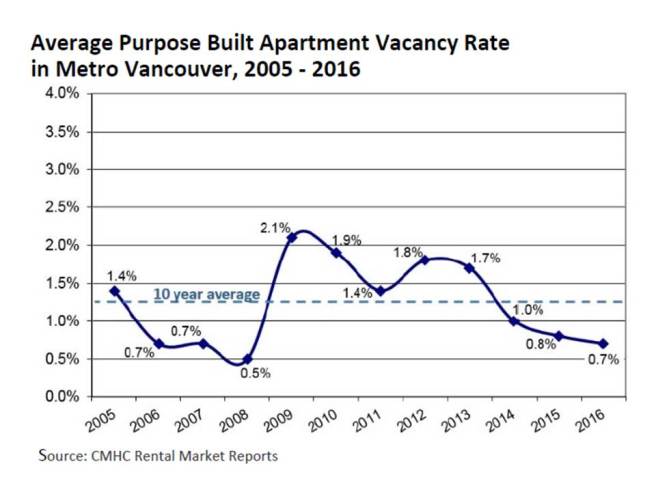
But what about that supply issue? Have we been overbuilding as much as the author suggests, adding an eye-popping 1.19 dwellings for every new household created since 2001? I replicated this result based on census data I gathered right after the first media report came out, and it deserves its own blog-post (up next! spoiler: I’m pretty sure we’re not overbuilding). Before I get there let me leave you with recent vacancy rates for rentals in Metro Vancouver. If we’ve got too much supply, it sure hasn’t hit the purpose-built rental market. Latest update just came out. Good news! We’re almost back up to 1%.

Vacancy-MetVanHouseBook


The World Comes to Canada

New immigration figures have come out from the 2016 Canadian Census! I should know: I spent three hours Wednesday talking about them on local CBC afternoon radio shows across Canada. To modify the great Johnny Cash…

I’ve been everywhere, man, I’ve been everywhere…

I’ve been to Toronto, London, St. John’s, Halifax, New Brunswick, Cape Breton, Saskatchewan, Winnipeg, Yellowknife, Calgary, and Montreal.

I’ve been everywhere, man, I’ve been everywhere…

I gave a couple of interviews in Vancouver too, but here people just want to talk to me about housing!

Back to immigration, mostly I was working off the handy Statistics Canada press release from that morning. My main takeaways were that:

  1. Immigrants to Canada look increasingly like a little miniature version of the world. For instance, our three biggest senders include the two biggest countries in the world (+ the Philippines)
  2. Immigrants to Canada are increasingly by-passing the big gateway cities (Toronto, Vancouver, and Montreal) and distributing themselves more broadly – especially into the Prairie provinces. Calgary, for instance, now well surpasses Montreal in terms of the proportion of its population foreign-born (29%)!
  3. Big Canadian cities continue to get more diverse. Most big Canadian metros now approach one quarter of their population made up of immigrants, with Toronto and Vancouver closing in on half (46% & 41%). Toronto continues to serve as the main gateway to the world, with Vancouver as a secondary gateway to the Pacific Rim and Montreal as a special gateway with a decidedly French password.

Unfortunately, I really didn’t get a lot of time to play around with immigration data on my own before talking to everyone about the Statistics Canada reports. This is always a little bit worrying: what if I missed something in my coverage? Finally, two days later, I’m checking my work a bit. Mostly it seems to hold up!

Here’s a simplified distribution of Canada’s new immigrants (arriving 2011-2016) according to birthplace from our last census compared to the distribution of the population of the world (2017 data from the Population Reference Bureau).

Can-Arrivals-2016-World-Pop

Recent Arrivals to Canada really do look a lot like a miniature version of the World as a whole! That’s pretty cool. Most of the variation I can make out concerns Canada attracting slightly MORE immigrants than might be expected from:

  • The Caribbean   (hello Haiti & Jamaica)
  • West Central Asia and the Middle East   (a warm welcome to Syrian refugees!)
  • Southeast Asia   (the Philippines is an emigration powerhouse)

On the other hand, Canada attracts slightly FEWER immigrants than might be expected from:

  • Eastern Asia
  • Southern Asia

Why are so few Eastern and Southern Asians coming to Canada relative to their proportions in the world as a whole? From the perspective of Vancouver, of course, that seems like a decidedly weird question. Different cities get different mixes of immigrants in Canada, and Vancouver remains the Gateway to the Pacific Rim. Let’s look at the city breakdown.

Can-Arrivals-2016-World-Pop-by-City

No surprise: the distribution of immigrants into Vancouver is decidedly Asian – and especially East Asian. Toronto’s newcomers also look quite Asian in origin, but more South Asian than East Asian, and Toronto remains more diverse overall. Still, it seems the African, European and American immigration streams remain a little squished in Toronto relative to the world’s population as a whole. Not so in Montreal! There streams are dominated by arrivals from the Americas, Africa, and Europe in proportions exceeding the world population. Thanks for balancing us out, Montreal! I added Calgary to the mix too, and Calgary really demonstrates how Southeast Asians (again, especially Filipinos) are really filling out Canada’s labor needs as fast the opportunities arise to do so. Otherwise Calgary, like Toronto, looks pretty darn diverse!

Just to demonstrate where immigrants are arriving from in conjunction with where they’re going to, I’ve re-plotted immigrant origins by destinations below, separating out the big gateway cities (I’m adding you, Calgary, because you really shine in this census release. I’m expecting a special thanks from mayor Naheed Nenshi!)

Canada-gateways-Origin

Most recent immigrants are still arriving through the big Gateway cities of Toronto, Vancouver, and Montreal. But these metros are no longer dominating migration quite as much as they used to, and where groups go really varies by their region of origin. Some groups, like immigrants arriving from Southeast Asia, are mostly avoiding the big Gateway cities, heading instead to Calgary and other places actively attempting to recruit them via new and improved provincial migration programs.

And with that, I bid our new immigrants welcome! And I offer up the full version of that Johnny Cash song.

Getting Educated about Working Class Whites

[Short Version: A university education is one part vaccine against lies and one part credential for entry into the middle class. Which part explains the split in the white Trump vote? Mostly the vaccination against lying part. So stop using education as a proxy for who’s in the working class!]

There have been a boatload of stories about how “working class whites” swung the US election in favor of Trump. Most of these stories, when you look at them closely, use educational divides to define class. So that:

White working class = non-Hispanic whites without university degrees

And indeed, evidence would seem to indicate that this group swung heavily toward Trump. The response, in many quarters, has been to imagine that white working class voters have been left behind in the de-industrializing economy of the USA. The vote for Trump was a vote to shake up the system, speaking of the pain and marginalization of disenfranchised factory workers and unemployed coal miners – especially in the American heartland. In more nuanced reporting, Trump voters are thought to share a “deep story” of resentment, directed at others “cutting in line” in pursuit of the American dream. (See Isaac Martin‘s thoughtful and critical review of this reporting). But let’s get back to some fundamental measurement issues. Since when was university education just about class, or class just about university education?

To be fair, universities have been selling themselves as the route to upward mobility (and/or maintenance of privilege) for a long time now. And we hear a lot about declining opportunities for those without university degrees, including in research on recent mortality trends. There is also great sociology that conflates these issues, if usually in nuanced form, as in Annette Lareau‘s very teachable Unequal Childhoods, where the big divide documented is labeled as class-based, but mostly concerns the interaction of primary schooling with different parenting styles for those with and without university educations.

Lareau’s work is nuanced and complicated in part because of how she studies education systems. These provide status and privilege directly, through credentialism, offering perhaps the clearest basis for thinking of universities as producing social classes. But Lareau shows how education systems also work in conjunction with distinct sets of parent-child interactions to inculcate particular habits. Some of these are about how to get authorities (like teachers) on your side. But others are more directly about how to use systems to gather and sort through information, as in doctor’s visits. Schools can help kids learn things, especially in conjunction with particular “classed” parental interventions. While Lareau studies elementary schools, the lesson should carry over into universities. In an ideal world (indeed, my ideal world!), university educations aren’t just about getting good jobs and reinforcing class divides. University educations are also about learning; about helping people sort through information. For instance, university educations may assist in discerning truth from lie.

To return to the 2016 presidential election: there’s been a lot of lying going on recently.

So what role did completing a university education play in the 2016 election? Was education primarily about white middle class winners from white working class losers, who correspondingly turned to Trump for their salvation? Or was the role of education primarily about sorting truth from lies?

Armed with the recently released ANES (American National Election Study) 2016 results, I think I can make a pretty strong case for the latter interpretation.

First, to establish some basic points:

Point 1) Education can not be reduced to class (nor vice-versa).

If only we could just ask people what class they belonged to! Then we wouldn’t need to use education as a proxy. ANES 2016 to the rescue! People get to (or are forced to) claim their own class identification. I’ve simplified education and self-assigned class categories (the latter drawing from combining pre- and post-election questions), to see how they fit together. Here’s what I get:

class-by-edu

There’s a definite relationship between education and self-assigned class, but it’s not at all a perfect fit. Most people make some choice between defining themselves as working class and middle class, although a few are willing to identify as lower or upper class. What’s striking is that within any given education category, you’ll find all four of these class self-identifications. There’s definitely a relationship, insofar as middle-class and upper-class identification rise with educational level, but there’s plenty of messiness, with a ton of people identifying themselves as middle class without a university degree.

But maybe this is all some kind of false consciousness? How about we run this again by pre-tax annual family income quartile and use that to assign class?

incquart-by-edu

Once again, we see a clear relationship between education and income-assigned class, but it’s far from determinative. In many ways, this is a better comparison, insofar as people aren’t forced to identify with a (culturally poorly defined) class divide between “working” and “middle” and there are a lot more people who fit into the top and bottom quartiles (the quartile cut-offs, for those who care, are $27.5k, $60k, and $100k). But in other ways it’s a worse comparison, insofar as it ignores self-identification as well as important distinctions in both partnership status (adding a dual income can easily move someone up a quartile) and geography (relative income varies a lot by place).

Still, I’ll mostly stick with income quartile assigned class to make a few further observations. After all, family income can tell us a lot about marginalization. If we’re concerned about a white working class that’s been left behind, it might be more important to measure the resources income brings directly rather than thinking of class as a cultural identification. But both could potentially tell us more about marginalization than education.

Home ownership is another marker of middle-class status for many people (hey! Read my book! Or one of many others out there making roughly the same point). So who’s left out of the middle-class in terms of home ownership? Let’s check via our education v. income splits:

renting-by-iq-edu

By and large, home ownership follows income rather than education. The lower your income quartile, the greater your likelihood of remaining a renter. This shouldn’t be too surprising. Mortgage lenders want to know your income and credit rating, but they really don’t care about your education. Indeed, there’s evidence from the recent past that lenders don’t necessarily want you to read the terms of your loan too closely. Education doesn’t track onto homeownership as a measure of class nearly as well as income. Let’s try a better measure of marginalization, tracking popular discourse about a white working class that’s been left behind. Who is most likely to be unemployed or disabled?

Unemp-by-iq-edu

People who are unemployed or disabled mostly show up in the bottom income quartile. There is a shallow relationship to education (more highly educated people look less likely to show up as unemployed or disabled), but it seems to me marginalization is overwhelmingly about being stuck in that bottom income quartile. Those are the people who have truly been left behind. But we might also measure people’s feelings of dissatisfaction with their lot in life more directly – at least in the ANES data, where they’re asked “how satisfied are you with your life as a whole?” Most people are actually pretty satisfied, so here I group together those who are unsatisfied and those just “slightly satisfied.”

disat-by-iq-edu

Lo and behold: here too I’m seeing mostly a relationship to income. Those in the bottom two quartiles are far more likely to be dissatisfied than those in the top two. To the extent there are relationships with education they look curvilinear, moving in different directions by  income quartile. A case could be made that people experience dissatisfaction both from marginalization in terms of their everyday resources, as well as in terms of the respect they feel their entitled to. I’ll set this aside for the moment to return to a central theme, education is a bad proxy for marginalization.

So if education is a bad proxy for social class insofar as we’re mostly talking about who’s getting (and feeling) marginalized in the USA, then what good IS education? And why does it so powerfully predict who voted for Trump? If we think of university educations not just in terms of the class credentials they provide, but also in terms of the skills at sorting through information we hope they provide, then we might imagine people who complete their university degrees are better at sorting lies from truth. Let’s test this. How does believing Barack Obama is Muslim breakdown by education and income quartile?

obama-by-iq-edu

Hey! Now THAT looks like an education effect! As a faculty member at a big university, this is somewhat heartening. Maybe with every class I teach, my students are actually getting better at telling truth from lie. It’s working, it’s working! On the other hand, I’m not seeing big or consistent income effects here. This isn’t a class story so much as it’s a truthiness in education story. Completing a university education, working through all of those core classes in addition to electives, can provide an inoculation, of sorts, against lying. We’ve developed an effective vaccine against con-men! It’s called the university! (Not 100% effective, I know, but not half-bad).

So how does education versus income quartile play out in predicting a vote for Trump among those who actually bothered to vote?

trump-by-iq-edu

Wow! There’s that education effect again!

Trump lies all the time. It’s pretty well documented. Those most likely to fall for the con are those least inoculated against it. This is not a straightforward story about the marginalization of the “white working class” (a story that always occludes the marginalization of everyone who isn’t white). Once you control for education in who voted for Trump, class effects either disappear, or actually turn back toward their “normal” alignment (more marginalized folks voting for more supportive candidates). Controlling for education, the unemployed and disabled tended to vote against Trump, as did renters. These election results were never about an uprising of the downtrodden (the dissatisfied on the other hand, tended to vote for Trump, which speaks perhaps to the more complicated relationship we might imagine between satisfaction in life and feelings of entitlement). Education was the big effect we saw in an election rife with misinformation – much of it weaponized against American democracy. Controlling for something as simple as people believing that “Obama is Muslim,” reduces the education effect considerably. The viral lies were effective once they got past our defenses.

So here’s a positive lesson from this election: if I sometimes doubted the value of my job prior to 2016, I can now rest a little easier. Universities aren’t just about reifying privilege, so it’s time to stop using degrees as a shortcut for talking about social class! And it’s time to take seriously what we’re doing in terms of helping people sort the truth from the lies. [In case you’re wondering, yes, it’s possible this whole post can be read as a pep talk to get myself to finish my grading…]


****************************************************************************

Here’s a full logistic regression model predicting a Trump vote, for those intrigued by such things:

stata-readout

I’ll readily admit that I’m a novice with ANES data – this is the first time I’ve played around it. I ran it through my old version of Stata 10. Happy to share my Stata code (as .pdf) Do-file-text


Guess Who’s Coming to Vancouver?

Where are most immigrants to Metro Vancouver coming from?

If you answered: “China, of course” – then I’m willing to bet you’d be in the majority. But you’d also be wrong.

At no time in the last ten years has China ever accounted for most of Metro Vancouver’s immigration. But for nine of the last ten years, China has been the top sender. As of 2015, even that’s no longer true. China’s no longer #1. It’s not even #2.

According to data from Immigration, Refugees, and Citizenship Canada compiled for Metro Vancouver, both the Philippines and India sent us more new immigrants in 2015. Here’s the data, part of the planning data library from Metro Vancouver :

metroimmigration-2015

Here I just highlighted all sending countries contributing an average of at least 1,000 new permanent residents a year across the past ten years where we have data (2006-2015). There are, of course, many other countries sending smaller numbers that collectively take us all the way up to the jagged gray line at the top of the chart in terms of total numbers of permanent residents landing every year. Graphically, it’s quite clear that China’s never accounted for the majority of immigrants to the area, and has now even lost its position as number one sender (even setting aside the thorny of question of whether to count Taiwan and Hong Kong as part of China).  In 2015, nearly 6,000 permanent residents landed as citizens of the Philippines, compared to just over 5,000 from India, and just over 4,000 from the Chinese Mainland, Hong Kong, and Taiwan combined.

I found an nice article from last year covering the relative decline in Chinese immigration as of 2014 figures in the Vancouver Sun. But that was before China dropped out of the #1 sending position. I have to admit, I’m surprised this hasn’t been a bigger story! But maybe that’s because I’ve been especially attuned to (and concerned by) the rhetoric concerning Chinese immigration and investment and its relationship to Vancouver housing.

Of course, regardless of what’s happening to immigration now, the influx of past immigrants has left a lasting impact on Vancouver. Chinese immigrants still constitute the largest grouping, by national origin, in the region. Of course, we don’t have our 2016 Census results broken down by immigration yet. But here’s a linguistic measure from 2011.

metro-linguisticdiversity-2011

Considered collectively, Chinese languages (Cantonese, Mandarin, and Chinese not otherwise specified) constituted the sole mother tongue of just over 14% of the population as of 2011. That’s a nice slice of the pie! But it’s just a slice. We actually have broader diversity in immigration across Metro Vancouver than is often recognized. (and not all of it is apparent from language, especially since the 6th and 7th largest sending countries – the US and the UK – tend to send English speakers).

Zoned for the Holidays

(here’s a little piece I originally wrote for the UBC Sociology Newsletter as a seasonally themed op-ed style essay)

What if we treated every day like a holiday? Imagine prioritizing time with family, over and over again; repeatedly enjoying travel at its most crowded; eating so much rich food that we practically burst; and buying so many expensive gifts that we drive ourselves into debt, every single day!

I suspect it would be awful, and I actually like my family! It would also be bad for democracy, bad for our health, and bad for the planet, not to mention absolutely unaffordable. Yet all across North America, this is pretty much the ideal behind how we’ve fashioned our cities, at least since the first half of the twentieth century. Insofar as it matters, we’re zoned for the holidays.

Zoning is the primary legal force behind the sprawl of single-family detached houses we see choking off the older, denser workaday urban cores of every major metropolis on the continent. Most people live in single-family residential zoned neighborhoods, which we might also think of as Great House Reserves. Nothing but houses, houses, and more houses is allowed across the majority of our metropolitan landscapes.

All those detached single-family houses prioritize privacy and focusing time on our families, or at least one particular version of our families, to the exclusion of sharing more public spaces with those around us. The more we live in houses, the less we tend to encounter people different from ourselves, diminishing our sense of obligation to others. What’s more, to get anywhere interesting, or even just to get to work, people who live in houses tend to first have to get past many other houses that look much like their own. So they drive on roads clogged with other drivers. And travel to work isn’t optional, because living in a house is really, really expensive. In many cases, zoning for houses has been used to keep out the poor on purpose. Yet we all pay for houses, even people who don’t live in them.  That’s because houses take up a lot of land and eat up a lot of energy, leading to all sorts of broadly shared environmental costs. And living in a house isn’t even very good for us! People tend to be healthier when they integrate walking or cycling into their daily lives, and to do that, it helps to have places to go.

Could we build our cities differently? Are we ready to stop treating every day like a holiday? One answer might be found in Vancouver, Canada’s third largest metropolis. Over the last fifty years, Vancouver has moved farther and faster away from reliance upon the single-family house than any other metro area in North America. Indeed, as residents will quickly confirm, no one except millionaires can afford a house in Vancouver any longer. How has this dramatic transformation affected the people who live here? Well, let’s start with how the city is regularly ranked the most livable on the continent.

If you’re skeptical of the rankings, try talking to some of the residents. As one middle class apartment dweller recently explained to me: “I can walk to the end of my street and there are probably, at a minimum, thirty ethnic restaurants within three minutes of my front door. I overlook the ocean. Access to transportation, to work, it’s so central. It doesn’t matter where I go, I’m in the middle of everything! And yet, I feel like I’m in a tiny little community. I know all the shopkeepers. I know all my neighbors. It’s like being in a small town, but living in the center of a huge city. I really feel like I have the best of all worlds.” Vancouver is proof that alternatives to the house can be made imminently livable for all types of families as well as for those living alone.

Despite the travel, the cost, and the occasional family fractiousness, the holidays can be nice. But treating every day like a holiday is a recipe for disaster. In much the same way, living in a house can also be pleasant.  But it’s only one way to live the good life. Vancouver demonstrates there are many more versions of the good life worth considering. By prioritizing only one kind of dwelling in how we zone, most metropolitan areas are severely constraining our options.  What’s more, they’re driving us toward the least socially just, least sustainable, least healthy, and least affordable lifestyle possible.  Maybe it’s time to reconsider and open up our options. Maybe we should start building our cities for everyday life instead of zoning for the holidays.


Muckraking and Making Better

We have some fabulous muckrakers working in Vancouver journalism. For instance, this story about luxury resort living and tax loopholes on Agricultural Reserve Land is really important stuff. Kathy Tomlinson, Ian Young, and a host of other local journalists in the muckraker tradition are doing really great work exposing some of the corrupting practices we see – especially those concerning local real estate. The role of good muckraking journalism is especially important for holding politicians accountable and insuring we get regulations that work and are properly enforced.

At the same time, there’s a danger that only doing and paying attention to muckraking moves us toward cynicism. That we think everything is getting worse. Even more maddening: that we can’t do much to make it better. That everyone is corrupt. That all processes are poisoned. That the world is going to hell in a handbasket.

Lest we forget: this is basically the narrative that propelled Donald Trump’s campaign and rise to power in the USA.  And here’s the thing: it’s false.

By and large, the world has gotten better for people. It’s still getting better for most people, a little bit every day. That doesn’t make the news, but it’s what we see in the data. Here’s Hans Rosling, a big data guy, making the case. As a bonus, it’s in Swedish (my dissertation was on Sweden – I miss the sound of Swedish being spoken – but don’t worry, there are English subtitles!):

Other Hans Rosling videos, with more of the data visualizations he’s rightly famous for, can be found here, here and here.

To be sure, there are still problems (e.g., Global Warming, Social Inequality, etc.). But we should take heart in how much humanity has accomplished, and move forward in the spirit of doing even better. In many respects, I suppose that makes me a progressive.But it’s more than just a belief. It’s what’s in the data.

Progress is definitely the big story we see in terms of things like life expectancy. For most people, life has been getting longer and better. We shouldn’t lose sight of this. Watch Hans Rosling, or play around with publicly accessible population reference bureau data if you want big picture stuff.

How does this matter in Vancouver? I see the same general pattern whereby for most residents things are getting better. (For example, BC has the longest life expectancy in Canada. Rents aren’t terrible.[**] Though stubborn, Core Housing Need is down from the 1990s. And millennials are not fleeing the city or metro area in droves). To be sure, we still have problems, and muckraking helps expose these problems. But there’s a danger that if we only get muckraking, we start to think Vancouver is a terrible place to live and it will never get better. We see some evidence of this kind of negative storyline inflecting discussions with young people in Vancouver. This is why it’s important that even as we acknowledge the important role of muckraking, we also need to celebrate Vancouver’s many victories and everyday pleasantries and push back against the idea that it’s a hellhole.

Because it’s not. It’s a pretty nice place to live.

And we can keep making it better. For everyone.*

*This was more or less the theme of my talk on “What we see in the media and what we see in the data” at the BC Non-profit Housing Association meetings in Richmond today.

[** – UPDATE – though wouldn’t you know it, the latest CMHC report on rents hit the media four days after I posted, demonstrating a big, 6.4% jump in rents in the past year. Rats! On the bright side, there are lots of new rental starts, so more units should be on the way. Definitely worth a look at the report.]

“Ride This Out” and Housing Summit Slides

In my last post, I combined a Leonard Cohen theme (“You Want it Darker“) with somewhat cathartic musings about the US election, in which the nation seems to have declared 2016 the Year of the Scary Clown. The next day, I found out Leonard Cohen had died.  Technically, he appears to have died before I wrote the post, which is important because I don’t want to risk causing the deaths of any other beloved musicians. On that note, here’s a bit more of a rousing theme about riding out the election results and getting back to work (please don’t die, Imaginary Cities!):

Also, the slides from my talk for the Vancouver Re:Address Summit on Housing and the Future of City Building have now been posted.* The background image is from a photo I took of a lovely mural over on Vancouver’s East Side, where the row of houses just doesn’t quite fit into the urban scene. Funny that.

*For some reason, I think whoever posted the slides thought my first name was “Michael”

Q&A on The Death and Life of the Single-Family House

Sandwiched between my teaching duties, my attempts to roll out the book, and my unhealthy obsession with the US election, I haven’t had much time to contribute commentary here on the blog about the many recent and ongoing developments concerning housing here in Vancouver, and across Canada more broadly.  Lots of new moves from taxing vacant homes in the City of Vancouver to tightening CMHC mortgage lending rules all across the country.

But back to my book…

DeathLifeHouseCover

…the roll out continues!  And today the book was featured in a UBC Media Release.  This was an edited Q&A, along with edited video of me talking in front of some houses in the University Endowment Lands (UEL).  For those interested, I’m providing the full Q&A below, with questions posed by UBC Media Relations (mostly the very helpful Thandi Fletcher):

In your book, you make the case that single-family houses are bad for the environment, urban vitality and people’s health. Why is this?

Let’s take these one at a time: With respect to the environment, the development of single-family houses directly consumes an enormous amount of land for suburban or ex-urban style sprawl, disrupting and displacing prior ecologies. By virtue of sprawl, houses also encourage people to drive everywhere, boosting greenhouse gas emissions. Moreover, houses generally require more energy to heat and cool than other types of dwelling, further leading to greater greenhouse gas emissions. Just about any way you look at it, single-family houses tend to be bad for the environment.

Strikingly, detached houses also tend to deaden city life. Houses are generally surrounded by more houses, with lots of private space and very little public space. Mostly you don’t run in to anyone you don’t already know. Urban vitality thrives when the private and public are more balanced: when people have places to go and things to do near where they live and they can walk or bike or take transit to get there. All of these ways of getting around put people in contact with one another and make for an engaging environment where people can go simply to watch other people.

Of course walking and biking are good ways to get around not just because they provide for more urban vitality. These kinds of activities are good for us because they keep us healthier. Denser, more vital, and more walkable environments encourage healthier habits. Single-family houses don’t tend to get us out and about as often.

A lot of people are still emotionally invested in the idea of owning a single-family house. They grew up in one and can’t imagine not also raising their families the same way. What do you say to them?

The first thing I say to them is that they are not alone. Culturally, many people have come to think of the house as an important symbol of success. Many others see acquiring a house as an important aspect of taking proper care of their children. No one wants to be viewed as a failure or a bad parent.

But the second thing I say to people who can’t imagine doing without a house is that they might try letting their imaginations run a little more wild. Vancouver actually provides a wonderful environment for re-thinking what’s important, both in terms of broader cultural understandings of success, and in terms of everyday aspects of livability. Most of the people who live here, including parents with children, have made a home without a house.

What’s more there is real strength in diversity. In that sense I won’t suggest a single optimal alternative to the single-family house. We have people who really enjoy high-rise living and others who thrive better in low-rise neighbourhoods. We have people who love the yard access and porch feel of some of our newer townhouses, and others who prefer the character of life in our older, subdivided mansions. There are lots of lovely ways to make a home, which is one reason we shouldn’t reserve nearly all of our urban land for only one way, like we do now.

Density is often perceived as a bad word in Vancouver. What is your response to anyone who is opposed to densification?

My first response is to bring history back into the picture. Densification used to be a normal part of urban growth, particular when land markets were left to their own devices. The prospect of having little control over one’s neighbours frightened residents of the city – especially the elites and those in the rising middle class. A factory or saloon could move in next door. The owner of a wealthy mansion nearby could subdivide their property and turn it into a hotel. These things happened a lot in old Vancouver. Single-family residential zoning was, in large part, an effort to preserve some space for residential life outside of the workings of the urban land market. So what I like to call a Great House Reserve was put in place all around the city.

So how did that turn out? Through subsequent regulation, city life became cleaner, quieter, and much more livable. Vancouver figured out how to do urban livability especially well, and more people here live outside of the single-family areas than in them. But taming the land market within the city led to its revenge in the suburbs. Single-family houses have moved well beyond the means of ordinary Vancouverites.

For those opposed to densification, I’d agree that we don’t need high-rises everywhere. We want to keep Vancouver both livable and diverse in urban form. But we still have way too many houses to encourage that diversity. Even though Vancouver is a leader in this regard, we’ve still set aside some 80 per cent of our residential land base to support single-family houses. That’s huge! At this point, we’ve got the power of the city, through these old zoning by-laws, keeping anyone but multi-millionaires from settling down in these places. I don’t think the city should be doing that.

Some people view condos as lonely places, and social isolation has come up often as a complaint among people living in Vancouver. What is your response to this? Could more condos make for a lonelier city?

There are lots of things we can encourage besides condos. Indeed, the City of Vancouver is encouraging more purpose-built rental buildings. In the past, we’ve also had a variety of programs that helped people form housing cooperatives. Cooperatives require people to work together to manage their buildings, directly countering social isolation. At the same time, they help preserve affordable living options in the city. We should be doing more of this to insure the choice isn’t simply between high-priced houses and luxury condos.

That said, there’s also no reason for us to believe that condos necessarily lead to a lonelier city. In fact, one of my livelier interviews involved a Vancouverite describing how close she’d become to her neighbours in her Yaletown condo building. She noted that everyone in her hallway left their doors open, and the kids ran back and forth between units, enjoying the communal nature of the space. Running counter to perceptions, many people described these kinds of communities developing in their buildings. More broadly, people also noted how they enjoyed running into the same people over and over at parks and playgrounds and local coffee shops. Generally speaking, mixed use urban density is a far better cure for social isolation than the largely privatized spaces of neighbourhoods dominated by single-family houses.

Do you think urban planners have made any mistakes in Vancouver’s development that have made the city less livable?

That’s an interesting question. There were some mistakes planners made everywhere across North America, and I would argue one of the biggest was creating the Great House Reserve and setting so much land aside for single-family houses. Beyond that, there were other mistakes planners really wanted to make in Vancouver, like bringing a freeway into the heart of downtown in the 1960s, that they were largely prevented from making. Since then the record of Vancouver’s planners has generally been far better, and I think they deserve a large share of the credit for the livability of the city. Vancouver has transitioned the furthest and fastest away from single-family houses of any major metropolis in North America while becoming a model for livability around the world. That’s a real achievement! But there are still issues that remain. The biggest of these is insuring livability for all residents, rather than just the most wealthy. Further enabling densification of single-family residential areas will go a long way toward opening up new market options for middle class Vancouverites. But we need a lot more non-market housing too.

What lessons can other cities learn from Vancouver on building a livable city?

I think Vancouver potentially has a lot of lessons to offer other cities. I like to think of these as building lessons. How do we move forward from the legacy of the Great House Reserves set up around cities all across North America? Vancouver figured out ways to build around this reserve, both in the old urban core of the city, and out in the hinterland. Buildings in the urban core provided the attractive living alternatives that characterize so much of Vancouver today. The big construction projects in the hinterland were the Agricultural Land Reserve and our many parks, which together protected much of the region’s land from further encroachment by suburban sprawl. Slowly but surely, Vancouver is also building over the old Great House Reserve, reincorporating this land back into the urban mix. Finally, Vancouver has renovated the very meaning of single-family residential neighbourhoods insofar as they’ve legalized secondary suites and laneway houses, transforming lots that initially could only support a single household into lots that can now support three. All of these building projects are things other metropolitan areas can also work toward.