Metrics, Mechanisms, and Mismatch: Immigration and other Components of Housing Demand in Canada

Components of Housing Demand

Co-authored by Jens von Bergmann and cross-posted at MountainMath.

Housing demand from external migration receives outsized attention in the public discussion. We take a recent Statistics Canada report on housing consumption by immigrants and non-permanent residents as an opportunity to clarify underlying concepts. We also broaden the scope to decompose housing demand in Canada into several components and estimate their sizes to better understand where demand for housing comes from and what is needed to meet that demand.

Continue reading

No spike in “foreign buying”

Co-authored with Jens von Bergmann and cross-posted on MountainMath.

Today the Globe and Mail published an opinion piece about continued flows of “foreign money” in B.C. real estate. Broadly this is a topic that has been discussed in BC for over a decade now and regularly pops up in the news. We’ve written extensively about the slipperiness of the “foreign money” discourse in our paper on Canada’s turn toward Housing Nationalism (Lauster and von Bergmann 2023) (ungated version here). There are a number of conceptualizations of “foreign” in the public discussion, as well as in data sources, policy and law as it applies to real estate holdings and purchases. Our paper describes how the flexible use and application of the “foreign” label plays an integral role in keeping anti-foreign narratives and sentiments alive.

The G&M article continues this pattern, not just mixing and matching concepts but outright misrepresenting the groups targeted by the federal Foreign Buyer Ban and the BC Foreign Buyer Tax. Moreover, it leads with the claim of a “spike” in the value of foreign buying, continuing to push the narrative that our housing problems are driven by foreign origins. We will leave it to our article on Housing Nationalism to criticize this broader framing. For now we will demonstrate that the claim about a spike is wrong, and seems to be based on an error in summing across months in BC data.

Continue reading

Migration and Housing Costs

Co-authored with Jens von Bergmann and cross-posted at MountainMath

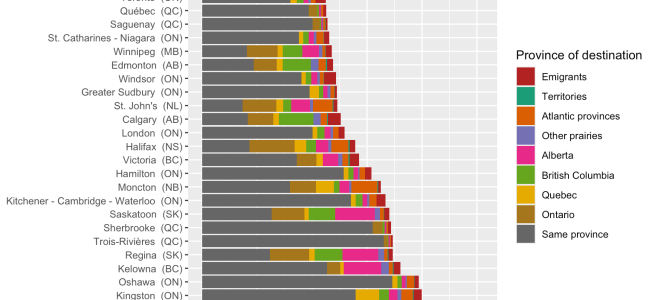
New data supports a common theme: Housing costs seem to be increasingly important as a determinant of long-distance migration, adding to their traditional importance within short-distance moves. But there are still some interesting caveats. We have a look at the data, compare it to what we know of flows, and think through some of its perhaps unexpected implications.

Continue reading

Recent Works

A lot of my efforts in this blog go toward figuring out solutions to major housing problems. What works? But I also devote time to figuring out what not to do. What doesn’t work and/or just adds new problems? Last year I spent some time working with teammates to direct these efforts into two major reports. I’m linking these reports below.

Continue reading

Two Years of BC’s Speculation and Vacancy Tax Data!

Last week, the BC Government dropped a press release linking to 2019’s data from the NDP’s Speculation & Vacancy Tax (SVT), leaving us with two years of data (!) and including a brief analysis of what happened to properties taxed in 2018! Maybe you didn’t notice? It was a busy week. I’ve been looking through the data and comparing across releases, and here are my big takeaways so far:

  • Overall, tax liability remains very rare (< 1%), and seems to be getting more so
  • The 2019 Technical Report revises some of the 2018 taxpaying figures, generally downward
  • The SVT may have added some rental in 2019, but probably not as much as claimed
  • Best guess: probably because we never had much “toxic demand” to begin with…
  • There’s some hint the SVT might have promoted divorce a bit & probably also migration
  • Some errors and lapses in SVT reporting make interpreting the data harder than it should be!

Continue reading

Homeless Counts and Migration Patterns in Metro Vancouver, Calgary, and Winnipeg

People move. That includes people who end up getting counted as homeless. How should we interpret what homeless counts tell us about these people?

To an important extent, this question brings us back to fundamental interpretations of who gets counted. Is being counted as “homeless” interpreted as a social problem: the lack of enough accessible housing? Or is it being interpreted as a person problem: identifying the “homeless” as fundamentally different from housed people?

Continue reading