The Trouble with Municipal-level Population Projections

Co-authored by Jens von Bergmann and cross-posted at MountainMath

Are people liquids or solids?

Trick question: they’re kind of both. This matters in terms of how we track people and project their location forward in time. There are basic demographic methods that effectively take people as solids. We can see where they are now. We can see how they’ve been moving recently. We can age them forward in time, including adding new little people and imagining older people dying off. And we can project forward how many people we’ll have in the future.

But people are also liquid. They slosh around a bit, but they eventually tend to settle downhill into the places where there are containers for them. Here our best bet in terms of projecting people’s location forward in time is to figure out the lay of the land and where the most likely containers are going to be located.

Sometimes our liquid and solid projections match up ok. But other times they don’t. Let’s make this discussion a little more solid by zooming in to take a look at a potential divergence in projections right here in Metro Vancouver.

When – if ever – will suburban Surrey surpass the population of the City of Vancouver?

Continue reading

Age Disparity in Shelter Cost per Room

Co-authored by Jens von Bergmann and cross-posted at MountainMath

Residential floor space offers a common denominator for trying to standardize across a range of housing metrics (e.g. price per square foot). Unfortunately we don’t have it in the Census in Canada, but we can play around with rooms to get some pretty similar results. Here we investigate how shelter costs per room have changed over time, across various regions, and by age group to construct some comparable figures to those recently coming out of the UK.

Long story short: shelter cost per room has been getting more expensive, especially for young folks, and in those metro areas where we see the greatest housing shortages, and the age discrepancy mostly comes from older folks locking in past prices, especially as they transition into ownership.

Continue reading

Metrics, Mechanisms, and Mismatch: Immigration and other Components of Housing Demand in Canada

Components of Housing Demand

Co-authored by Jens von Bergmann and cross-posted at MountainMath.

Housing demand from external migration receives outsized attention in the public discussion. We take a recent Statistics Canada report on housing consumption by immigrants and non-permanent residents as an opportunity to clarify underlying concepts. We also broaden the scope to decompose housing demand in Canada into several components and estimate their sizes to better understand where demand for housing comes from and what is needed to meet that demand.

Continue reading

Housing shortage as an explanation for family and household change

Co-authored by Jens von Bergmann and cross-posted at MountainMath.

In our new paper “The new rules: housing shortage as an explanation for family and household change across large metro areas in Canada, 1981-2021” (Lauster & von Bergmann 2025) (preprint and replication code) we estimate the impacts of housing shortage on the substantial variation we see in family and household structures, both across large metro areas in Canada and across time, focusing on 1981 through 2021.

Continue reading

Homelessness and Rents in Canada

Co-authored with Jens von Bergmann and cross-posted on MountainMath.

Evidence suggests a clear correlation between rents and rates of homelessness in the USA. The simplest interpretation is that housing shortages drive rents higher and leave more people falling through the cracks of our systems for distributing housing. That is, homelessness is a housing problem.

Do we also see this relationship in Canada? And if so, just how does it work?

Here we’ll attempt to pull together some Canadian data to address the first question and also look into the second.

Continue reading

No spike in “foreign buying”

Co-authored with Jens von Bergmann and cross-posted on MountainMath.

Today the Globe and Mail published an opinion piece about continued flows of “foreign money” in B.C. real estate. Broadly this is a topic that has been discussed in BC for over a decade now and regularly pops up in the news. We’ve written extensively about the slipperiness of the “foreign money” discourse in our paper on Canada’s turn toward Housing Nationalism (Lauster and von Bergmann 2023) (ungated version here). There are a number of conceptualizations of “foreign” in the public discussion, as well as in data sources, policy and law as it applies to real estate holdings and purchases. Our paper describes how the flexible use and application of the “foreign” label plays an integral role in keeping anti-foreign narratives and sentiments alive.

The G&M article continues this pattern, not just mixing and matching concepts but outright misrepresenting the groups targeted by the federal Foreign Buyer Ban and the BC Foreign Buyer Tax. Moreover, it leads with the claim of a “spike” in the value of foreign buying, continuing to push the narrative that our housing problems are driven by foreign origins. We will leave it to our article on Housing Nationalism to criticize this broader framing. For now we will demonstrate that the claim about a spike is wrong, and seems to be based on an error in summing across months in BC data.

Continue reading

Tenure and Household Independence across the Life Course, 1981-2021

Co-authored with Jens von Bergmann and cross-posted at MountainMath

How does owning or renting relate to household independence across the life course? How have these relationships changed over recent history? We use Census data from 1981-2021 to check in on historical relationships between age, tenure, and household composition. From these we develop a couple of preliminary demographic metrics of housing frustration. Patterns suggest that frustration abounds.

Continue reading

Migration and Housing Costs

Co-authored with Jens von Bergmann and cross-posted at MountainMath

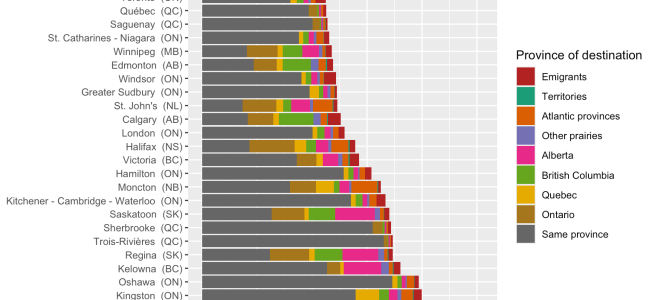
New data supports a common theme: Housing costs seem to be increasingly important as a determinant of long-distance migration, adding to their traditional importance within short-distance moves. But there are still some interesting caveats. We have a look at the data, compare it to what we know of flows, and think through some of its perhaps unexpected implications.

Continue reading