
Co-authored by Jens von Bergmann and cross-posted at MountainMath
How much should urban land cost? Generally we can think of the price being determined by the agglomeration effects of the city itself. That is, how easy is it to access all of the places one needs to go in the city? There’s your price.
We can break this down further for different users, but the basic principle holds. For industry, how easy is it to bring together what you need to make stuff and then move your products around afterward? For residents, in particular, we’re most interested in how easy is it to access all the jobs, though access to amenities also matter. For corporate interests, how easy is it to access your clients? For commercial enterprises, we can flip this a bit. How easy is it for all of your customers to see you’re there and access you? For a more academic review, see (Koster and Thisse 2024).
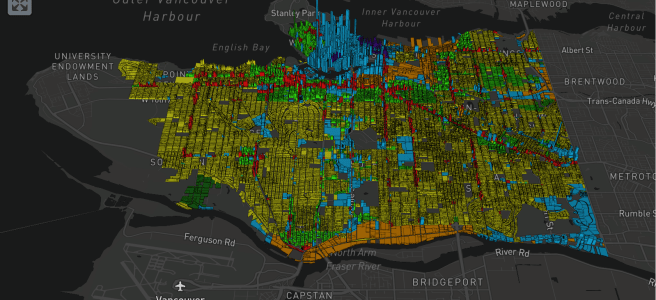
Because we’re mostly interested in agglomeration effects, we expect the city to end up with a pretty smooth price surface, where land downtown, in the centre of agglomeration effects, is most expensive, and price diminishes as one moves out from the centre. Of course, accessibility is also about transportation mode and speed. We can think about different modes of getting around (driving, transit, walk, bike, etc.) and the options they provide. So we’re effectively left with one chief determinant of land pricing: agglomeration, followed by two add-on considerations: amenity and transportation infrastructure.
That effectively sets up how we should expect land price to vary across the urban landscape. But does it? Well, kind of.


