Age Disparity in Shelter Cost per Room

Co-authored by Jens von Bergmann and cross-posted at MountainMath

Residential floor space offers a common denominator for trying to standardize across a range of housing metrics (e.g. price per square foot). Unfortunately we don’t have it in the Census in Canada, but we can play around with rooms to get some pretty similar results. Here we investigate how shelter costs per room have changed over time, across various regions, and by age group to construct some comparable figures to those recently coming out of the UK.

Long story short: shelter cost per room has been getting more expensive, especially for young folks, and in those metro areas where we see the greatest housing shortages, and the age discrepancy mostly comes from older folks locking in past prices, especially as they transition into ownership.

Continue reading

Multiplex Reforms: The Details Matter

Co-authored by Jens von Bergmann and cross-posted at MountainMath

Many Canadian municipalities are implementing reforms to allow multiplexes in formerly single family areas. These initiatives are driven by provincial reforms and federal incentives to increase housing supply. We review the findings from our recent paper studying the outcomes of multiplex reforms in Kelowna and Coquitlam that emphasize that implementation details matter, and take a look at early indicators of how multiplexes are faring in Vancouver since the City passed its own multiplex bylaw in late 2023.

Continue reading

Demand based zoning

Co-authored by Jens von Bergmann and cross-posted at MountainMath.

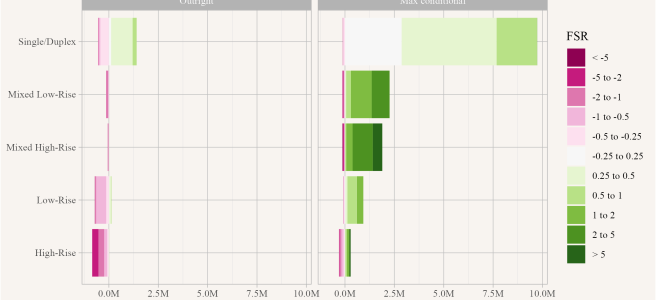
What if zoning was responsive to underlying demand to live in an area? That is, rather than reserving parts of the landscape for the exclusive use of those who can afford an entire underlying lot, what if we instead allow people to build enough residential floor space on the lot to share? This exercise sets up a kind of counterfactual, enabling us to get a look at both: a) what underlying demand for floor space on a lot actually looks like, and b) how our current zoning regime sets itself up to protect the most privileged from having to fully compete with this demand.

Continue reading

Housing is a Housing Problem

Co-authored by Jens von Bergmann and cross-posted at MountainMath.

The main housing problem in Canada is that there is not enough of it. We can see this by looking at prices and rents, but also by looking at people’s living arrangements and rates of doubling up. Doubling up is a direct measure of housing hardship that should get tracked on a regular basis. It also serves as an important compliment to traditional affordability metrics used in Canada that suffer from collider bias that makes it difficult to use them to track progress in solving housing problems. We also develop long timelines to track household formation and doubling up in Canada over the past 80 years to demonstrate the rapid undoubling during the first half of that time period, followed by a reversal to increased doubling up in most of Canada over the latter half.

Continue reading

Housing shortage as an explanation for family and household change

Co-authored by Jens von Bergmann and cross-posted at MountainMath.

In our new paper “The new rules: housing shortage as an explanation for family and household change across large metro areas in Canada, 1981-2021” (Lauster & von Bergmann 2025) (preprint and replication code) we estimate the impacts of housing shortage on the substantial variation we see in family and household structures, both across large metro areas in Canada and across time, focusing on 1981 through 2021.

Continue reading

Homelessness and Rents in Canada

Co-authored with Jens von Bergmann and cross-posted on MountainMath.

Evidence suggests a clear correlation between rents and rates of homelessness in the USA. The simplest interpretation is that housing shortages drive rents higher and leave more people falling through the cracks of our systems for distributing housing. That is, homelessness is a housing problem.

Do we also see this relationship in Canada? And if so, just how does it work?

Here we’ll attempt to pull together some Canadian data to address the first question and also look into the second.

Continue reading

Tenure and Household Independence across the Life Course, 1981-2021

Co-authored with Jens von Bergmann and cross-posted at MountainMath

How does owning or renting relate to household independence across the life course? How have these relationships changed over recent history? We use Census data from 1981-2021 to check in on historical relationships between age, tenure, and household composition. From these we develop a couple of preliminary demographic metrics of housing frustration. Patterns suggest that frustration abounds.

Continue reading

Zoned Capacity – promise and pitfalls

(Joint with Jens von Bergmann and cross-posted at MountainMath)

Is there room for new housing? There are lots of ways to try and get at this question, driven by a variety of different value calculations (e.g. if you need housing you might look around and see room for more of it everywhere, but if you’re well-housed and like your neighbourhood just the way it is, then you might think there’s no room at all). But this can also be transformed into a technical question, where we can pin a definition down to potential methods for making more room. Here’s where we start to talk about planning concepts, including zoned capacity. Is there room for new housing in municipal planning practices and regulations?

Continue reading