The Trouble with Municipal-level Population Projections

Co-authored by Jens von Bergmann and cross-posted at MountainMath

Are people liquids or solids?

Trick question: they’re kind of both. This matters in terms of how we track people and project their location forward in time. There are basic demographic methods that effectively take people as solids. We can see where they are now. We can see how they’ve been moving recently. We can age them forward in time, including adding new little people and imagining older people dying off. And we can project forward how many people we’ll have in the future.

But people are also liquid. They slosh around a bit, but they eventually tend to settle downhill into the places where there are containers for them. Here our best bet in terms of projecting people’s location forward in time is to figure out the lay of the land and where the most likely containers are going to be located.

Sometimes our liquid and solid projections match up ok. But other times they don’t. Let’s make this discussion a little more solid by zooming in to take a look at a potential divergence in projections right here in Metro Vancouver.

When – if ever – will suburban Surrey surpass the population of the City of Vancouver?

Continue reading

Age Disparity in Shelter Cost per Room

Co-authored by Jens von Bergmann and cross-posted at MountainMath

Residential floor space offers a common denominator for trying to standardize across a range of housing metrics (e.g. price per square foot). Unfortunately we don’t have it in the Census in Canada, but we can play around with rooms to get some pretty similar results. Here we investigate how shelter costs per room have changed over time, across various regions, and by age group to construct some comparable figures to those recently coming out of the UK.

Long story short: shelter cost per room has been getting more expensive, especially for young folks, and in those metro areas where we see the greatest housing shortages, and the age discrepancy mostly comes from older folks locking in past prices, especially as they transition into ownership.

Continue reading

Demand based zoning

Co-authored by Jens von Bergmann and cross-posted at MountainMath.

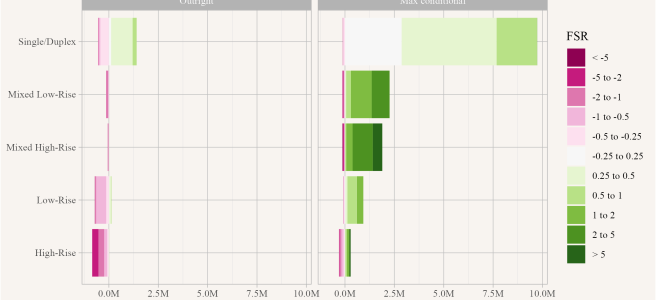
What if zoning was responsive to underlying demand to live in an area? That is, rather than reserving parts of the landscape for the exclusive use of those who can afford an entire underlying lot, what if we instead allow people to build enough residential floor space on the lot to share? This exercise sets up a kind of counterfactual, enabling us to get a look at both: a) what underlying demand for floor space on a lot actually looks like, and b) how our current zoning regime sets itself up to protect the most privileged from having to fully compete with this demand.

Continue reading

Metrics, Mechanisms, and Mismatch: Immigration and other Components of Housing Demand in Canada

Components of Housing Demand

Co-authored by Jens von Bergmann and cross-posted at MountainMath.

Housing demand from external migration receives outsized attention in the public discussion. We take a recent Statistics Canada report on housing consumption by immigrants and non-permanent residents as an opportunity to clarify underlying concepts. We also broaden the scope to decompose housing demand in Canada into several components and estimate their sizes to better understand where demand for housing comes from and what is needed to meet that demand.

Continue reading

Homelessness and Rents in Canada

Co-authored with Jens von Bergmann and cross-posted on MountainMath.

Evidence suggests a clear correlation between rents and rates of homelessness in the USA. The simplest interpretation is that housing shortages drive rents higher and leave more people falling through the cracks of our systems for distributing housing. That is, homelessness is a housing problem.

Do we also see this relationship in Canada? And if so, just how does it work?

Here we’ll attempt to pull together some Canadian data to address the first question and also look into the second.

Continue reading

Distributional effects of adding housing

Co-authored with Jens von Bergmann and cross-posted at MountainMath

Who would benefit from dramatically expanding the supply of housing in the market? How would such an expansion address housing need? What non-market interventions would still be required to meet remaining need? How would it influence household formation and migration? This post is picking up where we left off on our housing targets post (von Bergmann and Lauster 2023a), grappling with the distributional effects of adding new housing to the market. To recap: one way of setting housing targets is to figure out how much housing municipalities would have if they weren’t actively restricting its construction. We can do that by estimating how much additional housing would be profitable to build. Setting that amount of housing as a target works to enable market mechanisms to bring housing supply in line with demand.

Our version of housing targets sets a (high) overall target number for net new housing, and that’s it. There are other versions of targets that attempt to more finely tailor numbers, keyed for instance to specific income bands. Here we explain why we think starting with an overall number is the right approach, insofar as adding housing has distributional effects across the entire system. It is generally understood that increasing the housing supply lowers prices of existing housing, all else being equal. What’s less clear are the systemic effects of adding housing and how even expensive new housing helps address underlying housing need. These broad distributional effects of reaching housing targets are what we want to address here.

TL;DR

Housing is good, and adding a lot more of it in the places people want to live would have broadly beneficial effects. Even if new housing tends to house (slightly) higher income households, the vacancy chain moves these households set in motion have systemic effects, freeing up housing all across the income spectrum. To illustrate, our housing targets are set to reduce the price of new housing by roughly 30% in Metro Vancouver. We estimate this would reduce rents by an equivalent amount, and holding households constant we can further estimate this would reduce the population experiencing Core Housing Need by around 35%. The annual monetary subsidy necessary to make housing affordable for all Metro Vancouver households would drop from $1.48bn to $0.68bn. We further refine this estimate by relaxing the assumption that households would remain constant, considering the effects of meeting housing targets on new household formation and net migration. Our estimates of Core Housing Need still decline, but not by as much. We also consider the effects of rent control on who benefits from a boost to housing supply. Finally we consider the implications of these distributional effects. Finely tailored housing targets can be misleading and counterproductive when they fail to account for distributional effects of adding supply overall.

Continue reading

Doubling Up – Distinguishing Families and Households

(Joint with Jens von Bergmann and cross-posted at MountainMath)

The concepts of family and household frequently get mixed up in the broader housing discourse. We have attempted to explain how these concepts differ, their various statistical constructions, and why it matters in the past. But these explanations can quickly turn quite abstract, so we wanted to complement them by talking about doubling up. This is a very simple way of demonstrating why families and households should not be viewed as interchangeable. We’re also hoping to provide an important reminder that households are malleable and should not be used as the basic unit to analyze housing needs.

Continue reading

Zoned Capacity – promise and pitfalls

(Joint with Jens von Bergmann and cross-posted at MountainMath)

Is there room for new housing? There are lots of ways to try and get at this question, driven by a variety of different value calculations (e.g. if you need housing you might look around and see room for more of it everywhere, but if you’re well-housed and like your neighbourhood just the way it is, then you might think there’s no room at all). But this can also be transformed into a technical question, where we can pin a definition down to potential methods for making more room. Here’s where we start to talk about planning concepts, including zoned capacity. Is there room for new housing in municipal planning practices and regulations?

Continue reading

Parental Help in Property Ownership

Co-authored with Jens von Bergmann and cross-posted at MountainMath

Young adults are increasingly relying upon parental help to navigate Canada’s difficult housing market. Here we have a look at how this manifests within co-ownership trends, as described by a recent CHSP release, with a special focus on variation across more and less expensive housing markets. We round this out with contextual data on other ways parents are helping and a brief consideration of how they all fit together.

Continue reading

Recent Works

A lot of my efforts in this blog go toward figuring out solutions to major housing problems. What works? But I also devote time to figuring out what not to do. What doesn’t work and/or just adds new problems? Last year I spent some time working with teammates to direct these efforts into two major reports. I’m linking these reports below.

Continue reading