The Pyramids of Vancouver (updated)

Frances Bula has a nice piece following up on transnational investments in Vancouver’s real estate market, in particular including the big commercial and industrial properties, like the Molson Brewery.  Are purchases being crowdfunded?  If so, what does that mean? Are all of the investor/buyers being told about the planning restrictions in place?

There are lots of interesting points to draw from all of this.  One point, a point that sometimes gets lost in simplified political economic analyses of urban affairs, is that developers don’t always get their way.  There is little reason to suspect that either the City or Metro Vancouver are bluffing in their commitment to keeping the Molson Brewery zoned for light industrial land use.   Municipal regulations and their regulators still have power, even in the face of the “sharing economy.”  The Province has even more power, which is why we don’t yet have Uber in Vancouver.  It’s also why the BC Securities Commission is apparently looking into some of these crowdfunding advertisements.

Another and perhaps more disturbing point concerns the potential for crowdfunding (and other forms of investment) to operate as scams.  We know they’re out there (we’re definitely not getting straight stories from all the parties involved in the “Sun Commercial real estate brewery project”).  This is, of course, a problem for investors – mostly, it would appear, operating out of China – some of whom are undoubtedly more deserving of sympathy than others.  But scams are also a problem for Vancouver.  In a local sense, they potentially tie up properties (big & small) in litigation, leaving them unattended for years.  In a larger sense, the more of them there are out there and the more of them buying and selling to one another, either by design or by accident, then the more the market as a whole looks and feels like a giant pyramid scheme.  It’s a long, long way down to the bottom, and getting longer by the day.

*** Ummm… And here is more on pyramid-building practices via Kathy Tomlinson at the Globe & Mail.  Read the whole piece!  It’s worth it!
New Social Housing for Vancouver?

Vancouver’s mayor announced yesterday a plan to set aside 20 city-owned properties (worth an estimated $250 million) for social housing if the federal government would cough up $500 million to fund construction (joined by some commitment from the province).  Up to 3,500 new units might be added.

This seems like a smart move, insofar as the Liberal government is looking for shovel-ready projects to invest in, and has already raised social housing projects as a possibility.

To put the 3,500 possible new units in context, their addition could add nearly 14% to the current non-market housing stock for the City of Vancouver.  That’s not trivial.  Looked at a different way, 3,500 new social housing units could help house the 1,746 people counted in the City of Vancouver’s 2015 homeless count.

Still lots to be figured out here, including who will run these units if they get built.  But this seems like a positive step for the City.

Zika in Perspective (not so scary)

Having a baby is scary enough, for oh-so-many reasons.  But the recent Zika virus explosion has made it even scarier.  How scary should it be?  The Washington Post has an article on the difficulties of confirming Zika-related microcephaly cases in Brazil.  As of last week, 4,180 cases had been reported since October, but few had been confirmed by experts.  So a sample was explored in depth, and…

After experts scrutinized 732 of the cases they found that more than half either weren’t microcephaly, or weren’t related to Zika.

To be precise, just 270 cases of the 732 examined seem to be confirmed as related to Zika or something similarly infectious.  If that ratio holds, of the 4,180 cases reported since October, only about 1,542 will prove substantiated.  A bit less scary… but still a big number.

Except, in the context of Brazil, that’s actually not a big number at all.  I can’t readily find births data covering the period from October, 2015 to the present.  But I can easily find data on how many infants there were in Brazil in 2010.  Not a perfect proxy, but close enough for a rough estimate.  There were 2,713,244 infants, implying at least that many births.  Now THAT is a big number, and a good reminder that Brazil is the 5th largest country in the world, just two spots behind the USA.

The estimate from 2010 is a year’s worth of births, of course.  To make that comparable with reports from October, let’s make a heroic assumption that we’ve got about four months worth of reporting in (October through January).  So how many Brazilian babies would likely be born in four months time?  904,415.  Still a very large number.  What percentage of those babies look like might have Zika related microcephaly?

I get somewhere between 0.17% (using the ratio of confirmed cases) to 0.46% (using reported cases).  That’s between 1.7 cases per 1,000 births to 4.6 per 1,000 births.  Less scary.

But again, everything is scary to prospective parents.  What helps, perhaps, is perspective.  The pre-existing infant mortality rate in Brazil is estimated to be 19 deaths per 1,000 births (according to Population Reference Bureau data).  By contrast, the infant mortality rate in the USA is an estimated 6 deaths per 1,000 births, and for Canada, 4.8 deaths per 1,000 births.

These kinds of statistics lead me to ask: why don’t Canadians have a travel warning issued for pregnant women (or for mothers of infants) visiting the USA?  After all crossing the border to spend a year in the USA would appear to add an additional risk of dying of an extra 1.2 deaths per 1,000 births.  This is pretty close to the low end 1.7 cases of Zika-related microcephaly per 1,000 births we might be seeing in Brazil.

Not really so scary after all.

Of course there are two caveats here.  1) It would appear this is just the start of the Zika outbreak, and knowledge about its size and ultimate effects remains in flux, as witnessed by the shifting case count, and 2) We shouldn’t really equate the risks of microcephaly (Zika-related or otherwise) with the risks of infant mortality, as suggested by this CBC report.

Gateway Vancouver

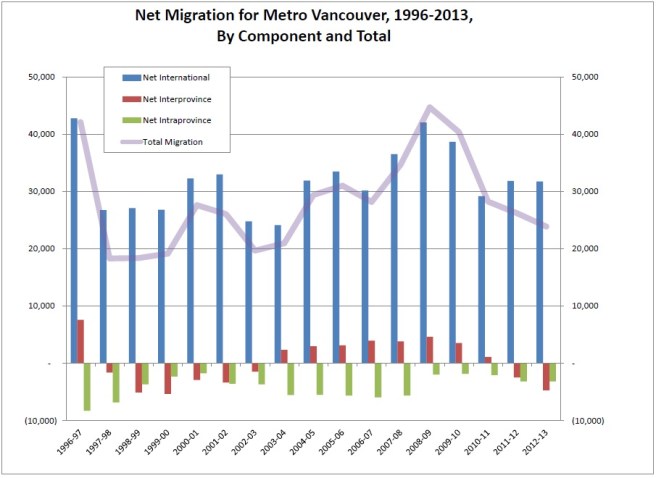
Metro Vancouver is a great source of data.  I’ve put together this little figure drawing upon their net migration dataset from 1996-2013* to get a sense of how different components of net migration influence the region.  Obviously, the overwhelming driver of growth for Metro Vancouver comes from international migration, and it has for some time.  Vancouver is a gateway metropolis into Canada.  By contrast, net provincial migration rises above and falls below zero like the tides (perhaps in response to the fortunes of oil next door).  Net intraprovincial migration is consistently negative.  More people leave for other parts of BC than arrive from the rest of the province.

NetMigMetroVan

On the face of it, this seems consistent with the gateway story.  Immigrants flood into Metro Vancouver, from whence people gradually trickle outward to the rest of the province.  But this kind of data has also been used (especially when it works in conjunction with the outward tide of interprovincial migration) to suggest that unaffordability in Vancouver, particularly of single family houses, is driving everyone away.  More often, the stories are anecdotal: a doctor leaves in a huff ; a public relations professional moves to Squamish; a Calgary management consultant refuses an offer to move to Vancouver.  But sometimes arguments are made, and vague statistics leveraged, suggesting that housing prices are pushing everyone out of Vancouver.

Taking all forms of migration together, that story simply doesn’t work.  Quite obviously, too many people are still coming in to Vancouver to claim that everyone is being pushed out.  But there is another kind of story that can be told: housing prices (or other forces), linked perhaps to particular lifestyles or standards of living, are pushing some types of people away.  Professional people.  Entrepreneurial people.  Young people.  People with kids.  People from the area.  People who aren’t immigrants.

Housing prices and rents really are very, very high.  And some of these stories may even be true (though I suspect most aren’t).  One way or another, I hope to look into many of them in the future (consider this part I).  But for now it’s worth noting that any story focusing on the loss of some types of movers and migrants runs the risk of implicitly or explicitly devaluing the many others who keep arriving.


*- yearly data compiled from BC Stats and Statistics Canada data, including immigration records and use of tax records to estimate intra and interprovincial migration, which is kind of neat!

Renewing the Compact City

There will be a talk by Dr. Hazel Easthope on “Renewing the Compact City: Lessons for the renewal of multi-unit housing” at the Allard Law School (room 122), Feb 9th, 12.30-13.30.

Much of it will be about what to do with strata (condo) properties at the end of their “natural” lives.

In this seminar, Dr Hazel Easthope will present findings from a two-year research study of strata scheme termination and renewal in Greater Metropolitan Sydney (in the state of New South Wales, Australia). This study outlined the tensions arising from the conflicting interests of the multiple stakeholders involved including tenants, owners, developers, bankers and property managers. The research used innovative methods to examine how best to deliver outcomes that are both economically viable and socially sustainable in the context of private-sector driven housing development.

Of special note, given my earlier posting, here too we see research being transformed into new legislation.

The outcomes of this research informed details of the legislation that was passed in New South Wales at the end of 2015 and that will come into effect in July 2016. This legislation, which includes provision to terminate a strata scheme with the approval of 75% of all owners, has some striking similarities with that proposed for British Columbia.

Great stuff.  Click here, or above, for more information.

What are PhDs for?

PhDs are for getting jobs as tenure-track professors, of course!  Or at least it might seem that way from recent coverage of a study that appears to be ALMOST out from the Higher Education Quality Council of Ontario (HEQCO).

The Globe & Mail reports on the study results, demonstrating that PhDs really ARE finding tenure track jobs!  One third of the PhDs produced in Ontario appear to have gone on to tenure-track jobs, with half of those jobs at Canadian institutions.  This is presented as a substantially improved outcome relative to past reporting (from the Conference Board of Canada) that less than 20% of Canadian PhD holders have full-time faculty jobs in Canada (see also here).

It’s notable that these reports, despite different methods, seem to be telling us roughly the same thing (half of one third is a little less than 20%).  You can still get a tenure-track job with a Canadian PhD, but there’s no guarantee, and your best offer (or your only offer) might not be in Canada.  Of note, we just began keeping track of our recent Sociology PhD placements at UBC.  The results from these cohorts aren’t fully in yet (we have a lot of postdoctoral placements!), nevertheless I suspect we’re doing better than average.  Still the lessons are broadly similar.  You can get a tenure-track job with a Canadian PhD, only it might not be in Canada.

But are tenure-track jobs the only thing worth getting a PhD for?  When I smugly note “we’re doing better than average,” that’s what I’m implying.  And evidence compiled within a different HEQCO report suggests that 65% of all PhDs (and 86% of Humanities PhDs) “pursued their degree with the intention of becoming a university professor.” (p. 16).  It seems clear, both from these kind of survey results and from anecdotal evidence, that we tend to socialize PhDs to value tenure-track faculty jobs.

If most of those getting their PhDs want a faculty job but aren’t getting one, are we – the keepers of PhD programs – failing them?  If so, how so?  Are we failing them 1. by admitting them?  2. by how we socialize them toward a singular professional goal?  Or 3. by our inability to effectively advocate for an expanded higher education system able to accommodate that goal?  I suppose I’m leaning toward the overlooked middle child of these possible answers.  I’d like to see more PhDs out in the world beyond academia.  So I guess I should set all professional smugness aside and start working harder to publicly celebrate all of those clever PhDs who manage to break free.

Fortunately we have some great examples from UBC, and several of our recent PhDs have gone on to exciting work as Research Scientists, Public Educators, and Directors at Non-Profits.  To you, I say, well done!

Having and Needing

I’m slow to the game on this.  Probably because I don’t yet quite get the twitter.  But I noticed, via a big billboard near Commercial and Broadway, that the #DontHave1Million phenomenon (?) campaign (?) movement (?) hashtag thing in Vancouver has now been joined by the #DontNeed1Million hashtag thing, which is more clearly an advertising campaign.

Evelyn Xia, who began the #DontHave1Million hashtag thing, credits another story, about doctors leaving over the unaffordability of Vancouver housing, for her politicization.

I hope to return to the topic of housing affordability and its effects on mobility and migration in the near future.  But for now, I’m reminded of nothing so much as the tune we sing for the two kids around our household on a regular basis:

(edited after I learned how to embed!)

If we build it, will they come?

There’s a wonderful little experiment now under way that puts to the test our ability, as academics, to build policies.  A small collection of UBC and SFU economists is now promoting the BC Housing Affordability Fund, connected to a modest property tax levied against vacant housing.

The basic idea behind the policy itself is two-fold: 1) reduce the role of rampant speculation and tax avoidance on local real estate markets – especially across the Lower Mainland, and 2) start gathering data linking properties to vacancies and taxes paid into local economies.  The full proposal, in all its two glorious pages, can be found here, (the third page is just the signatories).  There’s also a supporting website.   It’s pretty!

Those business school people really know how to sell a policy!

Which is mostly what I want to note here.  Hopefully I’ll have more to say about the plan itself soon, and I’ll be tracking its progress as carefully as I can (it appears its authors will be doing the same!).  But in the meantime, I want to draw attention to what sociologists can learn from this crew.  We, too, can work toward building things.

Too often we offer criticism rather than construction.  We tear apart rather than construct.  What would it look like if sociologists (and all our kin) more regularly engaged in building things?  I have in mind new regulations, policies, tools, and standards.  (But no need to stop there: I’ve got one of my classes working on constructing buildings for me too).  Early sociologists, like Jane Addams (yes, I’m claiming her), clearly had this sort of work in mind.

Could it work?  If we built it, would they come?  Good question.  It’s one of the reasons I’ll be watching what happens with the BC Housing Affordability Fund proposal with great interest.