Distributional effects of adding housing

Co-authored with Jens von Bergmann and cross-posted at MountainMath

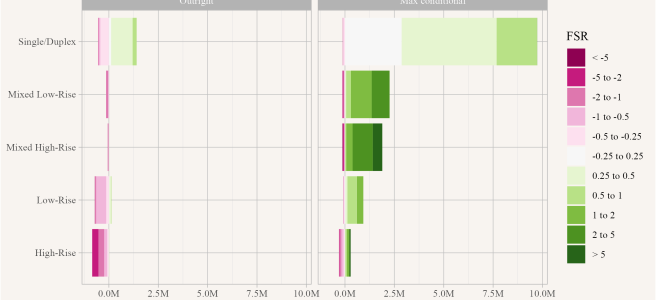
Who would benefit from dramatically expanding the supply of housing in the market? How would such an expansion address housing need? What non-market interventions would still be required to meet remaining need? How would it influence household formation and migration? This post is picking up where we left off on our housing targets post (von Bergmann and Lauster 2023a), grappling with the distributional effects of adding new housing to the market. To recap: one way of setting housing targets is to figure out how much housing municipalities would have if they weren’t actively restricting its construction. We can do that by estimating how much additional housing would be profitable to build. Setting that amount of housing as a target works to enable market mechanisms to bring housing supply in line with demand.

Our version of housing targets sets a (high) overall target number for net new housing, and that’s it. There are other versions of targets that attempt to more finely tailor numbers, keyed for instance to specific income bands. Here we explain why we think starting with an overall number is the right approach, insofar as adding housing has distributional effects across the entire system. It is generally understood that increasing the housing supply lowers prices of existing housing, all else being equal. What’s less clear are the systemic effects of adding housing and how even expensive new housing helps address underlying housing need. These broad distributional effects of reaching housing targets are what we want to address here.

TL;DR

Housing is good, and adding a lot more of it in the places people want to live would have broadly beneficial effects. Even if new housing tends to house (slightly) higher income households, the vacancy chain moves these households set in motion have systemic effects, freeing up housing all across the income spectrum. To illustrate, our housing targets are set to reduce the price of new housing by roughly 30% in Metro Vancouver. We estimate this would reduce rents by an equivalent amount, and holding households constant we can further estimate this would reduce the population experiencing Core Housing Need by around 35%. The annual monetary subsidy necessary to make housing affordable for all Metro Vancouver households would drop from $1.48bn to $0.68bn. We further refine this estimate by relaxing the assumption that households would remain constant, considering the effects of meeting housing targets on new household formation and net migration. Our estimates of Core Housing Need still decline, but not by as much. We also consider the effects of rent control on who benefits from a boost to housing supply. Finally we consider the implications of these distributional effects. Finely tailored housing targets can be misleading and counterproductive when they fail to account for distributional effects of adding supply overall.

Continue reading →

Tenure and Household Independence across the Life Course, 1981-2021

Co-authored with Jens von Bergmann and cross-posted at MountainMath

How does owning or renting relate to household independence across the life course? How have these relationships changed over recent history? We use Census data from 1981-2021 to check in on historical relationships between age, tenure, and household composition. From these we develop a couple of preliminary demographic metrics of housing frustration. Patterns suggest that frustration abounds.

Continue reading →

Migration and Housing Costs

Co-authored with Jens von Bergmann and cross-posted at MountainMath

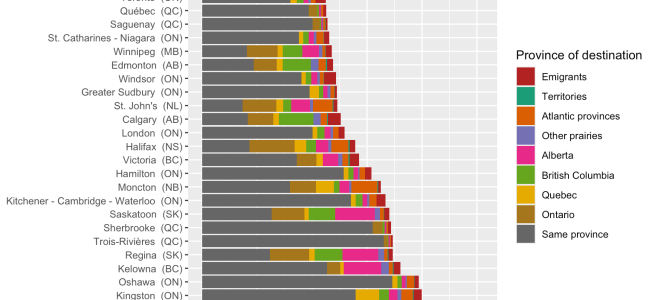
New data supports a common theme: Housing costs seem to be increasingly important as a determinant of long-distance migration, adding to their traditional importance within short-distance moves. But there are still some interesting caveats. We have a look at the data, compare it to what we know of flows, and think through some of its perhaps unexpected implications.

Continue reading →

Doubling Up – Distinguishing Families and Households

(Joint with Jens von Bergmann and cross-posted at MountainMath)

The concepts of family and household frequently get mixed up in the broader housing discourse. We have attempted to explain how these concepts differ, their various statistical constructions, and why it matters in the past. But these explanations can quickly turn quite abstract, so we wanted to complement them by talking about doubling up. This is a very simple way of demonstrating why families and households should not be viewed as interchangeable. We’re also hoping to provide an important reminder that households are malleable and should not be used as the basic unit to analyze housing needs.

Continue reading →

Zoned Capacity – promise and pitfalls

(Joint with Jens von Bergmann and cross-posted at MountainMath)

Is there room for new housing? There are lots of ways to try and get at this question, driven by a variety of different value calculations (e.g. if you need housing you might look around and see room for more of it everywhere, but if you’re well-housed and like your neighbourhood just the way it is, then you might think there’s no room at all). But this can also be transformed into a technical question, where we can pin a definition down to potential methods for making more room. Here’s where we start to talk about planning concepts, including zoned capacity. Is there room for new housing in municipal planning practices and regulations?

Continue reading →

Parental Help in Property Ownership

Co-authored with Jens von Bergmann and cross-posted at MountainMath

Young adults are increasingly relying upon parental help to navigate Canada’s difficult housing market. Here we have a look at how this manifests within co-ownership trends, as described by a recent CHSP release, with a special focus on variation across more and less expensive housing markets. We round this out with contextual data on other ways parents are helping and a brief consideration of how they all fit together.

Continue reading →

What if recent apartment buildings in Vancouver were 20% taller?

(co-authored with Jens von Bergmann and cross-posted at MountainMath)

Earlier this year a report from the NSW Productivity Commission in New South Wales, Australia, included a useful estimate to illustrate the harm that’s being done by height restrictions in Sydney. We thought it might be helpful to replicate the analysis for the Vancouver context.

Taking ideas from the report we set up a simple counter-factual question:

What would rents be if every apartment building built in Metro Vancouver over the past five years had been on average 20% taller?

TL;DR

We estimate that planning decisions preventing apartment buildings built in the past 5 years in Metro Vancouver from being on average 20% taller are resulting in an annual redistribution of income from renters to existing landlords on the order of half a billion dollars across the region via higher rents.

Continue reading →

Recent Works

A lot of my efforts in this blog go toward figuring out solutions to major housing problems. What works? But I also devote time to figuring out what not to do. What doesn’t work and/or just adds new problems? Last year I spent some time working with teammates to direct these efforts into two major reports. I’m linking these reports below.

Continue reading →

Housing Outcomes

(co-authored with Jens von Bergmann and cross-posted at MountainMath)

Almost everyone agrees that we have a housing crisis in Canada, and that it has gotten progressively worse over recent history. But there is a problem. The metrics most commonly used don’t reflect that.

TL;DR

Most commonly used metrics use existing households as the base of analysis, but households are a consequence of housing pressures. This kind of misspecification is a form of collider or selection bias that, especially in tight housing markets, misleads researchers toward faulty conclusions and policy recommendations. It blinds researchers to the struggles of people who are unhappy about their current household living arrangement, like young adults struggling to move out of their parent’s place or out of a bad roommate setup, as well as people who have left their desired region and moved away, or failed to move in, because of the lack of housing options.

This post explains the problem with analysis based solely on households in more detail, and explains why this will lead to incorrect diagnoses of our housing problems and misguided policy recommendations.

Continue reading →

Housing Targets

(co-authored with Jens von Bergmann and cross-posted at MountainMath)

Municipalities in BC are required to submit Housing Needs reports, and integrate these into Official Community Plans and Regional Growth Strategies in something resembling housing targets. The BC Housing Supply Act now sharpens this process and adds some teeth, effectively enabling the province to define housing targets, accompanied by new provincial enforcement mechanisms, where the province selects municipalities not meeting housing need. Left unstated are the details of precisely how we should go about calculating housing needs or housing targets.

Continue reading →